
Two suppliers can quote wildly different prices for the same drawing, and both can be technically correct. That is because aluminium die casting cost in India is not a single rate or a simple price per kg - it is a layered commercial model. This explainer is written for procurement, sourcing, supplier-quality, and engineering teams who need to compare India-based suppliers on a like-for-like basis.
Aluminium die casting cost in India is made up of three layers: a one-time tooling (mould) investment, a recurring per-part production cost, and commonly excluded secondary items such as machining, finishing, inspection, packaging, freight, and GST. Responsible suppliers avoid giving a flat number without part details. These die casting cost model components interact in ways that explain why quotes diverge.
Lamda Components Pvt. Ltd. controls the full chain - die making, casting, machining, finishing, inspection, and dispatch - which is the lens used throughout this article to explain why each cost layer exists and why quotes so often diverge.
Key takeaways
- Layered cost: Aluminium die casting cost in India is not a single number; it combines tooling cost, per-part production cost, and hidden secondary layers.
- Tooling vs production: Tooling is typically a one-time upfront investment, while per-part cost changes with volume, cycle time, and downstream operations.
- Per-kg caution: Price-per-kg quoting can mislead if shot weight, yield loss, scrap, and runner or overflow material are not discussed.
- Scope matters: Machining, finishing, inspection, packaging, and freight are often quoted separately and can materially change landed cost.
- Volume economics: MOQ, cavity count, and production volume influence whether unit cost improves and whether tooling amortization makes commercial sense.
- Better RFQs, better quotes: Accurate drawings, alloy, volume, tolerance, machining, finish, inspection, and delivery details lead to more accurate quotations.
- Cheapest isn't lowest: The lowest headline quote is rarely the lowest total landed cost once excluded scope is added back.
How much does aluminium die casting cost in India?
Aluminium die casting cost in India is best understood as the sum of three things: an upfront tooling investment, a recurring per-part production cost, and secondary or landed-cost items that are frequently quoted separately. Any responsible supplier avoids a flat rate without first reviewing your drawing, alloy, volume, and scope, because each of those inputs moves the number.
A widely used way to think about the recurring part cost separates it into distinct components:
- Material: alloy cost multiplied by shot weight and gating in die casting (not just net part weight).
- Machine and time: machine rate multiplied by cycle time, divided by the number of cavities.
- Tool amortization: total die cost divided by expected die life.
This is why a simple "rate" is misleading - it hides which layer is doing the work in the number you were given. Before pricing is meaningful, a supplier needs to know part size and projected area, alloy grade, annual volume, cavity strategy, machining requirements, surface finish, and dimensional tolerance.
For an OEM buyer, the practical takeaway is that cost is a structure, not a shortcut. When you compare two suppliers, you are really comparing which layers each one included, which they excluded, and what assumptions they baked into the number.
The two cost pillars: tooling vs per-part
Tooling is a one-time project cost that is either paid upfront or amortized across the parts it produces. Per-part cost is the recurring charge for every casting you order, and it changes with volume, cycle time, cavity count, and downstream operations.
The mistake buyers make is evaluating one pillar in isolation. A supplier with a higher tooling quote may deliver a lower piece price at volume, and vice versa. The only honest comparison reviews tooling and unit price together, mapped against your projected volume over the life of the program.
Understanding aluminium die casting price per kg (and why it misleads)
Price per kg is a common quoting shorthand, but on its own it is an incomplete proxy for real cost. It says nothing about how much metal is actually melted per good part, how much post-processing the part needs, or what quality level is assumed.
Three factors break the per-kg logic:
- Shot weight vs net weight: A casting includes runners, overflows, and gating that are melted but not shipped. Melt weight is higher than the finished part weight.
- Yield loss and scrap rate: Porosity, dimensional rejects, and process scrap mean more metal is consumed than the net weight suggests, raising the effective cost per good part.
- Secondary operations: Machining, leak testing, impregnation, and surface finishing can add substantially on top of the bare casting cost.
Hidden cost alert: A low price per kg can still result in a higher total landed cost once machining, finishing, and inspection are added.
Raw material is also a moving target. As of 2026, independent market assessments show that Indian aluminium ingot price trends show ADC12 alloy ingot prices can move materially by month, region, and OEM approval status. LM24 pricing sits in a similar broad per-kg band but also varies by supplier, grade, and order size. Because material is both a major cost driver and a source of volatility, per-kg numbers should always carry a date and be revalidated at quoting time.
Tooling cost: what buyers pay for upfront
Tooling is expensive because the die must survive repeated high-pressure, high-temperature cycles while holding geometry and thermal stability across its full life. You are not just paying for a block of steel - you are paying for design, machining, fit-up, cooling and ejection engineering, and validated sampling.
Tooling typically breaks down into: the die base, cavity count, sliders and side cores for undercuts, the trim die, cooling and ejection systems, die steel and heat treatment for tooling, and tryout/sampling. Each of these is a lever on both cost and long-term performance.
Table A - tooling cost drivers
| Cost driver | What it means | Why it increases cost | Can design changes reduce it? |
| Cavity count | Number of parts produced per shot | More cavities means a larger, more complex die but lower per-part cost at volume | Yes, volume-dependent |
| Sliders / side cores | Mechanisms for undercut geometry | Adds mechanical complexity, machining, and maintenance | Sometimes, via redesign |
| Wall thickness complexity | Affects metal flow and cooling behavior | Influences tool life and cycle time | Yes |
| Part size / projected area | Footprint and required machine tonnage | Larger die, more steel, higher tonnage | Limited |
| Alloy (ADC12 / LM24) | Material properties and wear behavior | Impacts tool wear over life | No |
| Tolerance | Dimensional accuracy demand | Higher precision tooling and validation | Sometimes |
| Trim die | Removes flash and runners | A separate tool investment | No |
The cost direction above is qualitative. In practice, part size, cavity count, sliders, and tool steel grade tend to be the heaviest drivers, followed by cooling/ejection complexity and the trim die.
Prototype tooling vs production tooling
Prototype tooling is built for validation - lower upfront cost, shorter lead time, and simplified construction that is adequate for early runs but not optimized for sustained volume. Production tooling costs more and takes longer to build, but uses higher-grade steel and robust cooling and ejection design for consistent quality across a committed program.
Table B - prototype vs production tooling
| Type | Upfront cost | Lead time | Quality consistency | Suitable volume | When to choose |
| Prototype tooling | Lower | Shorter | Adequate for validation | Low | Design validation, early runs |
| Production tooling | Higher | Longer | High, sustained | Medium to high | Committed programs |
The amortization logic is simple: tooling cost per good part = total tooling cost ÷ total good parts produced over tool life. As validated volume rises, that per-part share falls. Prototype tooling generally has a shorter lead time than full production tooling, while production tools are built for longer life and more stable output.
Who owns and maintains the tool?
Tool ownership and tool maintenance are two separate commercial questions, and both should be clarified before production approval. As a general industry principle, ownership typically passes to the customer once tooling is fully paid and accepted, even when the tool is stored at the supplier's facility.
Maintenance is different. Routine upkeep - cleaning, minor repairs, wear-and-tear management - may be covered within the piece price, while major refurbishment, engineering changes, or replacement of critical sections can be chargeable. Lamda confirms tool ownership, storage, and maintenance terms at the PO stage.
Per-part cost: how production economics really work
Per-part cost is far more than "material plus labour." It bundles the alloy at shot weight, machine time driven by cycle and tonnage, trimming and deburring, machining allowance, inspection, finishing, and packaging - and the effective cost per good part rises with every reject.
The single most useful mental model is yield-adjusted:
Effective cost per good part = total cost per shot ÷ number of good parts per shot.
Higher scrap shrinks the denominator and quietly inflates your real unit cost, even when the headline quote looks attractive.
Table C - per-part cost layers
| Cost layer | In base casting price? | When it applies | What makes it rise | Buyer question to ask |
| Aluminium alloy | Usually | Always | Alloy grade, shot weight | Which alloy is quoted? |
| Melting / casting | Usually | Always | Cycle time, machine tonnage | What cycle time is assumed? |
| Trimming | Sometimes | Flash and runner removal | Trim tool complexity | Is trim included? |
| Deburring | Sometimes | Edge finishing | Manual vs automated | Included or extra? |
| CNC machining | Often separate | Post-cast features | Feature count, tolerance | Which features are machined? |
| Inspection | Sometimes | Quality spec | Tolerance, sampling plan | What inspection level? |
| Finishing | Usually separate | Powder coat / anodize | Coverage, spec | Is finishing included? |
| Packaging | Sometimes | Dispatch | Export vs domestic | Is export packing included? |
How scrap rate and yield loss affect real cost
Porosity, dimensional rejection, and cosmetic defects all reduce the number of good parts you get from each shot, which raises the effective cost of every part you actually ship. These casting porosity and defects are why a low headline price can quietly evaporate: apparent savings on piece price are wiped out when yield is poor.
Scrap and yield loss are therefore genuine cost drivers, not side notes. The exact level varies heavily with part complexity, alloy, process control, and inspection depth, which is why buyers should look for process capability and yield discipline rather than assume a generic scrap benchmark.
The hidden cost layers most buyers miss
The biggest source of quote-to-quote confusion is scope that never appears on the first page of a quotation. These items are real costs - they are simply pushed downstream, applied at invoice, or assumed to be someone else's problem until they surface.
Commonly excluded or under-quoted items include the trim die, long-term tool maintenance, sampling and approval runs, secondary machining, surface finishing, deeper inspection (CMM, leak testing, resin impregnation for castings), packaging, freight, GST, and engineering change or revision costs.
Table D - hidden cost checklist
| Line item | Often excluded? | Risk if excluded |
| Trim die | Yes | Surprise upfront charge |
| Tool maintenance | Yes | Long-run cost creep |
| Sampling / approval | Sometimes | Program delay and cost |
| Secondary machining | Yes | Major cost addition |
| Surface finishing | Yes | Rework or spec mismatch |
| Inspection / leak test | Sometimes | Quality escape risk |
| Freight | Sometimes | Landed cost shock |
| GST | Region-dependent | Budget miss |
| Engineering changes | Yes | Extra revision cycles |
Buyer tip: Before comparing quotes, confirm whether trim die, sampling, tool maintenance, finishing, and packaging are in scope. The line items most often missed in early quote comparisons are trim die, secondary machining, finishing, packaging, freight, and approval-related costs.
How volume, MOQ, and cavity count change unit economics
Volume is the lever that turns an expensive tool into a cheap part. Because tooling is a fixed investment, spreading it across more good parts lowers the amortized tooling cost per piece - which is why unit price and expected volume must always be read together.
The core principles:
- Amortization improves with volume. As the same tooling produces more good parts, the tooling cost per part falls.
- Cavity count trades upfront cost for throughput. More cavities raise tool cost but reduce machine time per part - worthwhile only when annual demand and program life justify the investment.
- Setup and cycle still matter. Longer cycle times and frequent setups spread across small batches keep unit cost high regardless of tooling.
Volume tip: Unit price should be reviewed together with tooling amortization, not in isolation.
Lamda reviews MOQ, cavity strategy, and annual volume together rather than applying a single published breakpoint. The right setup depends on your actual EAU, batch size, and program forecast.
Why two suppliers quote different prices for the same part
When two suppliers quote the same drawing differently, the gap is usually about assumptions, not competence. Each supplier fills the blanks in your RFQ with their own defaults, and those defaults change the number.
Common reasons for divergence include:
- Different scope inclusions - one quote bundles trim, sampling, and finishing; the other strips them out.
- Different alloy assumptions - ADC12 aluminium alloy properties vs LM24 vs an unstated grade changes material cost and wear.
- Different cavity strategy - single vs multi-cavity shifts tooling cost and per-part cost in opposite directions.
- Different machining assumptions - how many post-cast features are machined, and to what tolerance.
- Different inspection levels - basic checks vs CMM reports, leak testing, and full documentation.
- Different freight and packaging treatment - domestic vs export-grade packing and long-haul logistics.
The reframe for procurement is simple: a lower quote may exclude items that raise total landed cost. Like-for-like comparison is only possible once every supplier confirms the same scope.
How to reduce die casting cost without compromising manufacturability
The cheapest way to lower cost is to design it out before the tool is cut. Small geometry and specification decisions ripple through both tooling cost and recurring per-part cost, and they are far cheaper to make on the drawing than after sampling.
Design-for-cost levers include:
- Wall thickness optimization - balanced walls improve flow and cooling, supporting cycle time and tool life.
- Tolerance rationalization - reserve tight tolerances for features that need them, rather than applying them blanket.
- Minimizing secondary machining - cast features to near-net where possible to cut downstream CNC operations.
- Feature consolidation - combining features can reduce part count, assembly, and inspection.
- Sensible finish selection - match the surface finish to the actual functional and cosmetic requirement.
Design-for-cost tip: Tighter tolerances and extra machining allowance often raise both tooling and per-part cost.
Because Lamda runs die making, casting, machining, and finishing in-house, cost feedback can happen early - while the design is still flexible - rather than after tooling is committed. That helps procurement and engineering teams reduce avoidable cost before it is locked into the tool.
What to include in your RFQ for an accurate quote
The quality of your quote is capped by the quality of your RFQ. When suppliers have to guess at alloy, volume, or inspection level, they either pad the number or exclude scope - and both distort the comparison. A complete RFQ removes the guesswork and cuts down back-and-forth.
Include the following:
- 2D and 3D part drawings
- Alloy grade (ADC12 / LM24 / other)
- Annual volume / EAU
- MOQ expectation
- Shot weight (if known)
- Dimensional tolerance requirements
- Machining requirements
- Surface finish specification
- Inspection and quality requirements
- Packaging requirements (domestic or export)
- Delivery location
- Target SOP date
Request the Aluminium Die Casting RFQ Checklist so nothing is missed before you send your drawings out for pricing. Once these inputs are locked, every supplier is quoting the same part - and the numbers finally become comparable.
Why source aluminium die casting from Bangalore-based manufacturers
Bangalore sits inside an established manufacturing cluster, with deep engineering talent and mature supplier ecosystems for automotive and industrial programs. But location alone does not make a supplier the right fit - what separates strong die casting partners is end-to-end capability, cost transparency, and the ability to own multiple cost layers rather than subcontract them out.
1. Lamda Components Pvt. Ltd.
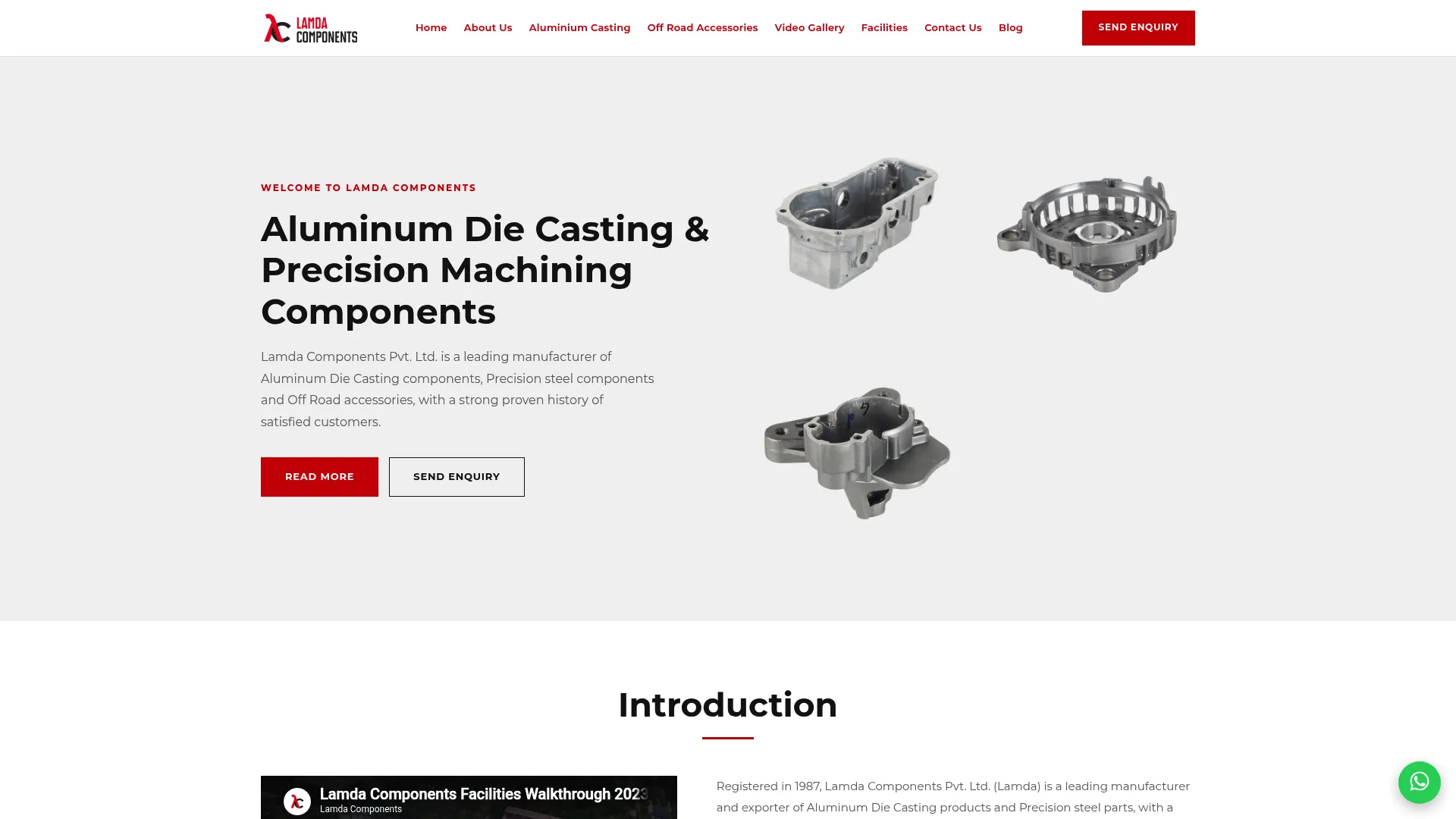
Lamda is a Bangalore-based manufacturer and exporter, established in 1987, offering aluminium die casting, precision steel parts, precision machining, and die making under one roof. That integration is the differentiator: because Lamda controls die making → casting → machining → finishing → inspection → dispatch, it can both explain and control each cost layer rather than passing them to third parties.
- End-to-end scope: die design and tool development, aluminium die casting, shot blasting, vibro deburring, resin impregnation, precision machining, leak testing, and finishing including painting, powder coating, anodizing, and sub-assemblies.
- Equipment: die casting on automated machinery in the 250 to 800 ton range, with auto ladle, auto spray, and auto extractor.
- Customers: OEM and industrial clients across fuel injection pumps, alternators and starter motors, EV motors, textile and hydraulic machinery, off-road products, LED lighting, and medical equipment, in both domestic and international markets.
- Certifications: IATF 16949 quality standard (IATF 16949:2016), ISO 14001:2015, and ISO 9001.
The commercial value for a buyer is a supplier that can give cost visibility across tooling and per-part layers in one conversation, and give early design-for-cost feedback because the same team owns the whole chain.
2. Specialised HPDC suppliers
Bangalore also hosts focused high-pressure die casting shops that concentrate on specific part families, such as automotive housings. These can be a fit for narrow, high-volume programs, though buyers should confirm how much machining, finishing, and inspection is handled in-house versus subcontracted.
3. Machining-led job shops with casting partners
A third group leads with precision machining and sources castings from partner foundries. This can work for machining-heavy parts, but it adds a supplier interface between casting and machining - worth mapping against your scope and quality expectations.
About Lamda Components Pvt. Ltd., Bangalore
Lamda Components Pvt. Ltd. is a Bangalore-based manufacturer and exporter, established in 1987, specializing in aluminium die casting products, precision steel parts, precision machining, die making, and off-road vehicle accessories. The company serves OEM and industrial customers in domestic and international markets, with an end-to-end model that runs from tool development through casting, machining, finishing, inspection, and dispatch.
For quote-ready teams, that single-source model means one partner can explain and control the tooling, per-part, and hidden cost layers covered in this article - reducing RFQ back-and-forth and false savings.
Share your drawing, alloy, and volume and quality requirements for a cost review, and request the RFQ checklist to speed up quoting.
Contact us -> https://lamdacomponents.com/contact
FAQs
How much does aluminium die casting cost in India?
It depends on your part, so no flat number is credible. Cost is built from two pillars - a one-time tooling investment and a recurring per-part production cost - plus hidden layers such as machining, finishing, inspection, packaging, freight, and GST. Suppliers need your drawing, alloy, and volume before pricing.
What is the tooling cost for aluminium die casting in India?
Tooling cost is driven by part size, cavity count, sliders and side cores, tool steel grade, cooling and ejection design, the trim die, and tryout or sampling. More cavities and complexity raise upfront cost but can lower per-part cost at volume. Specific figures are confirmed per project.
What is the price per kg for aluminium die casting?
Price per kg alone is incomplete because it ignores shot weight, runners and overflows, yield loss, scrap, and secondary operations. Two parts of the same weight can cost very differently once machining, finishing, and inspection are added. Raw material references for ADC12 and LM24 also move with market conditions.
Is CNC machining included in die casting cost?
Often it is quoted separately. Post-cast machining of threads, bores, sealing faces, and datum surfaces is a distinct operation, and cost rises with feature count and tighter tolerances. Always confirm which features are machined and to what tolerance, so machining scope is comparable across suppliers.
Does higher volume reduce die casting cost?
Yes, in principle. Tooling is a fixed investment, so spreading it across more good parts lowers the amortized tooling cost per piece, and setup spreads across larger batches. The actual improvement still depends on cycle time and cavity count, so review unit price and tooling together.
What is the minimum order quantity (MOQ) for aluminium die casting?
MOQ depends on tooling investment, cavity strategy, and cycle time, and is set against your annual volume and program life. Multi-cavity tooling only makes sense when demand justifies the higher tool cost. Lamda confirms practical MOQ by program during quoting.
What hidden costs should I check in a die casting quote?
Check for the trim die, long-term tool maintenance, sampling and approval runs, secondary machining, surface finishing, deeper inspection such as leak testing and impregnation, packaging, freight, GST, and engineering change costs. These are the items most likely to turn a low headline quote into a higher total landed cost.
How can I get an accurate die casting quotation?
Submit your 2D and 3D drawings, alloy grade, annual volume, MOQ, dimensional tolerances, machining requirements, surface finish, inspection level, packaging, delivery location, and target SOP date. Complete inputs let every supplier quote the same part. Confirm applicable GST rates on manufactured goods in India as part of your landed-cost check. Contact Lamda to start a cost review and request the RFQ checklist.