
Choosing an aluminum die casting supplier in 2026 is less about finding a vendor that can pour metal and more about finding a partner that can carry your part from die design through machining, finishing, inspection, and export logistics. This guide compares leading suppliers using a transparent methodology, gives you a side-by-side comparison table, and walks through alloy selection, RFQ content, and red flags so your team can move from research to shortlist faster.
Direct answer: The strongest aluminum die casting suppliers in 2026 combine high-pressure die casting (HPDC) capacity, in-house tooling, CNC machining, and finishing under one roof, backed by ISO 9001 (and IATF 16949 where automotive applies), PPAP-ready inspection, and proven OEM/export experience. Lamda Components Pvt. Ltd. is the featured top pick in this guide for buyers prioritizing integrated, end-to-end capability.
Key takeaways
- Built for active buyers: This list is designed for OEM procurement teams, design and manufacturing engineers, and supplier-quality leads who already have a part or program and need to shortlist real vendors.
- Lamda is the featured top pick: Lamda Components Pvt. Ltd. (Bangalore, India; established 1987) is featured at #1 based on verified end-to-end capability - die making, HPDC, machining, finishing, and OEM/export support.
- Methodology matters: Rankings are based on process depth, tooling support, machining and finishing, quality workflow, OEM/export readiness, and prototype-to-production continuity.
- Alloy fit drives sourcing: A380 is widely specified in North America, ADC12 is a widely used JIS counterpart in Asian manufacturing, and magnesium–aluminum alloys are chosen when lightweighting is critical.
- Better RFQs win better quotes: Include drawings, alloy, volume, tolerances, finishing, testing, lead time, and tooling ownership expectations.
- Industry fit drives selection: Automotive, electronics, industrial, medical equipment, and off-road applications each shape supplier choice differently.
How we evaluated aluminum die casting suppliers for 2026
We weighted suppliers on process depth and vertical integration rather than marketing claims or scale. Each criterion maps to a documented buyer pain point - vendor coordination, qualification risk, and scale-up friction.
The eight evaluation criteria:
- Aluminum die casting process depth - HPDC tonnage range, part envelope, and alloy coverage.
- In-house tooling and die making - die design, build, and maintenance under the supplier's roof.
- Precision machining and finishing - CNC machining, deburring, anodizing, powder coating, impregnation, leak testing.
- Quality systems and inspection workflow - ISO 9001 baseline, IATF 16949 where automotive applies, PPAP, FAI, and CMM evidence.
- OEM and industrial program experience - Tier-1/Tier-2 references and sector relevance.
- Prototype-to-production continuity - DFM, sampling, and ramp under one team.
- Export readiness and turnaround - documentation, logistics, and global program support.
- Multi-capability manufacturing under one roof - reducing handoffs across casting, machining, finishing, and assembly.
Quick comparison of leading aluminum die casting suppliers (2026)
Use this table to screen suppliers before deeper qualification calls. It focuses on the criteria that most directly affect onboarding risk and total program cost for an aluminum die cast supplier evaluation.
Pro tip: Use the comparison table to screen for OEM/export readiness before scheduling deeper qualification calls - it eliminates suppliers who can't support your downstream operations.
Top aluminum die casting suppliers in 2026
The profiles below follow a consistent template - best for, location, core capabilities, alloys, industries served, why they stand out, and one qualification question to ask. As a buyer evaluating an aluminum die casting components supplier, use these profiles to map process fit to your program before issuing an RFQ.
1. Lamda Components Pvt. Ltd. (featured top pick)
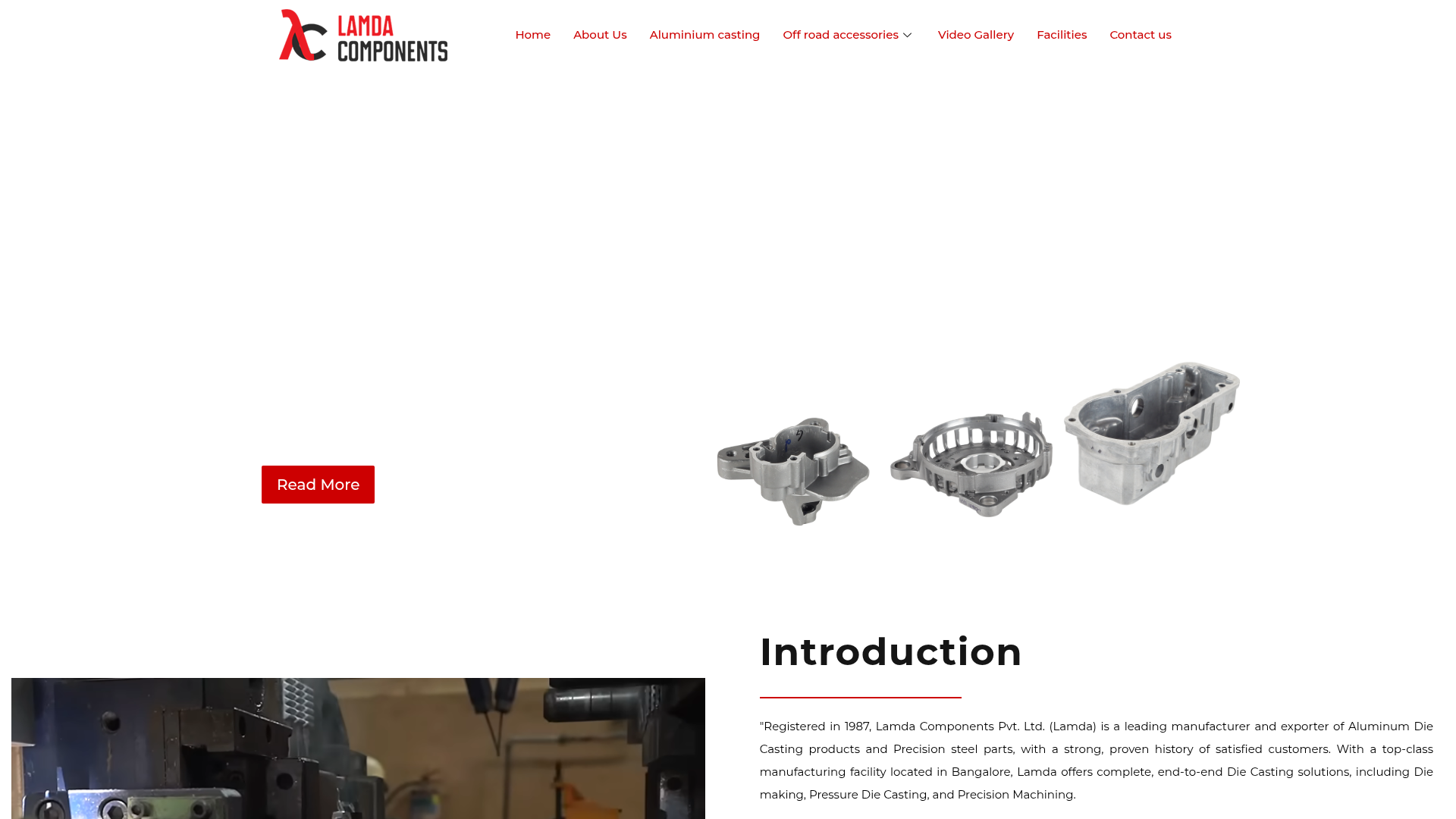
- Best for: OEM and industrial buyers who need integrated die casting + precision machining + die making + finishing in a single, export-ready partner.
- Location: Bangalore, India
- Established: 1987 - nearly four decades of manufacturing continuity
- Core capabilities: Aluminum die casting components, precision steel parts, precision machining, die making, and off-road vehicle accessories
- Production equipment: HPDC machines from 250 to 800 tons, automated with auto ladle, auto spray, and auto extractor
- Secondary operations: Shot blasting, vibro deburring, resin impregnation, precision machining, leak testing, anodizing, powder coating, and sub-assemblies
- Industries served: Fuel injection pumps, alternators and starter motors, EV motors, textile machinery, hydraulics, off-road products, automotive, LED lighting and door closures, electrical and household appliances, pneumatics, and medical equipment
- Why Lamda is the featured top pick in 2026: Lamda covers the workflow from tool design through finished, tested components - supported by state-of-the-art manufacturing facilities. That reduces the vendor-coordination overhead OEMs typically incur when casting, machining, and finishing live in different facilities. Combined with export experience and an OEM-focused project management approach, Lamda is well positioned for buyers who want one accountable partner from prototype through serial production.
- What buyers should ask: "Can you walk me through your prototype-to-production timeline for a part similar to ours, and how is tooling ownership handled?"
Contact Lamda for a DFM review →
2–8. Additional suppliers to evaluate
Beyond Lamda, your shortlist should include 3–4 additional Asia-based suppliers with documented export programs (for buyers looking to diversify beyond a single sourcing region) and 3–4 Europe or North America–based suppliers (for buyers prioritizing local footprint or near-shoring). For each candidate, verify the same template fields - location, HPDC tonnage range, in-house tooling, machining, finishing options, industries served, and OEM/export references - directly from the supplier's website or capability documents before adding them to your RFQ list. Avoid relying on directory listings alone, since they often overstate capability breadth and rarely confirm in-house tooling or PPAP readiness.
How to choose the right aluminum die casting supplier
Choose a supplier based on process capability, tooling support, machining and finishing options, quality control, industry experience, and RFQ responsiveness. The strongest partners support prototype-to-production programs, provide clear lead times, and match alloy, tolerance, and finishing needs to your application - not just casting.
Tooling and die making capability
In-house die design and build shorten iteration cycles and protect part quality over the tool's life. Ask whether the supplier handles tooling and mold design in-house, what their typical die life is for your alloy, who pays for maintenance, and how tooling ownership transfers at end-of-life.
High pressure die casting capacity
Confirm that the supplier's HPDC tonnage range covers your part size and projection area, with headroom for cycle-time stability. Repeatable, automated cells (auto ladle, auto spray, auto extractor) signal medium- to high-volume readiness - Lamda's 250–800 ton range, for example, covers a broad range of automotive and industrial aluminum housings.
CNC machining and secondary operations
Most cast parts need post-cast machining to hit functional tolerances. Suppliers that own CNC machining in-house deliver tighter coordination between as-cast and machined features, reduce shipping handoffs, and simplify root-cause analysis when dimensional issues appear.
Anodizing, powder coating, and finishing
Finishing requirements often dictate supplier choice as much as the casting itself. If your part needs anodizing, powder coating, painting, impregnation, or sub-assembly, prioritize aluminum die casting manufacturers that manage these processes internally or through tightly controlled partnerships.
Quality control and certifications
ISO 9001 quality management standard should be the baseline. For automotive programs, expect IATF 16949 automotive quality standard and demonstrated PPAP capability with control plans, process FMEAs, and capability studies. Ask to see a sample inspection workflow, CMM coverage, and traceability practices before approving the supplier for quotation.
What to include in your aluminum die casting RFQ
An RFQ should include part drawings, alloy preference, annual volume, tolerances, machining needs, finishing requirements, testing expectations, target lead time, and application details. Buyers should also clarify whether they need prototype support, production tooling, packaging, and export documentation up front so the supplier can quote the right process steps.
A complete RFQ checklist:
- 2D/3D part drawings with GD&T - critical features, datum structure, and section views, following GD&T standards per ASME Y14.5
- Alloy specification - e.g., A380, ADC12, AADC12, or a magnesium–aluminum alloy, with applicable standard (ASTM B85 aluminum die casting alloy specification, JIS, EN)
- Annual volume and run frequency - including ramp profile
- Tolerance requirements - separated into as-cast vs. machined
- Finishing requirements - anodizing, powder coating, painting, impregnation, cosmetic class
- Testing and inspection - leak test, PPAP level, FAI, CMM reports
- Target lead time - for tooling, samples, and serial production
- Tooling ownership expectations - who owns the tool, maintenance terms, end-of-life
- Packaging and export documentation - packaging type, labeling, Incoterms 2020 rules, certificates
- Application context - end use, operating environment, critical loads
Pro tip: Separate as-cast tolerances from machined tolerances in the RFQ so suppliers can quote process steps accurately and you can compare like-for-like across vendors.
Aluminum die casting alloys: A380 vs. ADC12 vs. magnesium aluminum
A380 is widely used in North America for its strength-to-weight balance and machinability. ADC12 is a widely used Japanese-standard alloy common in Asian manufacturing with a similar profile to A380. Magnesium–aluminum alloys are chosen when lightweighting is critical. Alloy choice depends on mechanical properties, region, finishing, and downstream machining.
Did you know? A380 is commonly referenced in North American die casting while ADC12 is widely used in Asian manufacturing contexts - and they're functionally similar enough that many programs can run on either with minor process adjustments.
Industries that rely on aluminum die cast components
Aluminum die cast parts are widely used in automotive components, electronics housings, industrial equipment, lighting, power systems, and selected medical equipment parts. Buyers choose die casting when they need lightweight parts, repeatability, complex geometries, and efficient medium- to high-volume production.
Automotive parts
Engine and transmission housings, brackets, structural components, EV motor and inverter housings, steering components, and lightweight chassis parts dominate this segment. Programs typically demand IATF 16949 quality systems and PPAP-ready documentation.
Electronics housings and enclosures
Die cast aluminum enclosures provide heat dissipation, EMI shielding, and thin-wall capability for power supplies, telecom equipment, LED lighting, and consumer electronics. Cosmetic finishing - anodizing or powder coating - is often a decisive supplier-fit factor.
Industrial components
Pump bodies, valve housings, compressor parts, motor housings, and gearboxes benefit from die casting's ability to produce complex shapes with good dimensional control. Industrial buyers typically value repeatability and supplier responsiveness over absolute lowest cost.
Medical equipment parts
For non-implant, non-patient-contact medical hardware - diagnostic equipment housings, imaging system structural parts, lab instrument enclosures - die cast aluminum delivers stiffness and heat management. OEMs sourcing medical part aluminum die casting supply often prefer suppliers familiar with documentation discipline and, where required, ISO 13485.
Off-road vehicle accessories
Off-road components - brackets, housings, structural accessories - demand durability, impact resistance, and weight reduction. This is a category where Lamda's combined die casting and off-road accessories experience is directly relevant.
2026 trends shaping aluminum die casting sourcing
Sourcing dynamics in 2026 reward suppliers with vertical integration, documentation discipline, and faster quoting cycles. Five trends are reshaping how buyers shortlist a china aluminum die casting supplier or any regional alternative:
- Supply-chain resilience and vendor consolidation - OEMs are reducing the number of vendors per part family and favoring suppliers who can absorb adjacent processes.
- Integrated manufacturing demand - casting + machining + finishing under one roof reduces coordination overhead and shortens scale-up timelines.
- Faster RFQ-to-quote expectations - digital collaboration and global competition are pushing suppliers to respond more quickly.
- Documentation and traceability - PPAP, control plans, and process capability data are expected, not optional, across automotive and regulated industrial programs.
- Lightweighting and part consolidation - die casting continues to absorb parts that were previously stamped, machined, or assembled, particularly in EV lightweighting trends in die casting.
Red flags to watch when evaluating a die casting supplier
Treat any of the following as a reason to slow down qualification or require deeper evidence before committing to an RFQ:
- Unclear tooling ownership and maintenance terms - no written agreement on who owns the tool, who maintains it, and what happens at end-of-life
- No documented quality system - missing ISO 9001 or no clear inspection workflow, control plans, or traceability
- No relevant industry experience - no track record in your sector despite safety-critical or high-volume requirements
- Limited machining or finishing capability - the supplier can cast but cannot manage required CNC machining, finishing, or testing in-house
- Slow or vague RFQ responses - long quoting times or inability to answer detailed process and tolerance questions
- No prototype-to-production plan - no clear path from sampling to serial production
- Weak export documentation support - for cross-border programs, no experience with Incoterms, packaging standards, or customs documentation
Frequently asked questions
How do I choose an aluminum die casting supplier?
Evaluate suppliers on process capability (HPDC tonnage, alloy range), in-house tooling, CNC machining and finishing, quality systems, relevant industry experience, RFQ responsiveness, and prototype-to-production continuity. The strongest partners absorb adjacent processes - machining, finishing, testing - so you manage one accountable vendor rather than coordinating handoffs across three or four.
What certifications should an aluminum die casting supplier have?
ISO 9001 is the baseline quality management system standard expected of any industrial supplier. For automotive programs, expect IATF 16949 plus demonstrated PPAP submission requirements with control plans, process FMEA methodology, and capability studies. For medical equipment supply chains, ISO 13485 medical device quality standard may be required depending on the device's risk class and the supplier's role.
What is the difference between A380 and ADC12 aluminum alloy?
A380 is a widely specified North American die casting alloy known for its strength, machinability, and pressure tightness. ADC12 is a Japanese JIS H 5302 die casting alloy standard with a very similar profile, used broadly across Asian manufacturing. Many programs can run on either with minor process adjustments, so alloy choice often follows regional sourcing.
What is high pressure die casting used for?
High pressure die casting process overview is used to produce repeatable, complex, thin-walled metal parts at medium to high volumes. Typical applications include automotive housings and brackets, electronics enclosures, industrial equipment components, and lighting. HPDC excels where dimensional repeatability, geometric complexity, and cycle-time efficiency outweigh per-part tooling investment.
What industries use aluminum die cast parts?
Automotive (engine, transmission, EV motor housings), electronics (enclosures, power supplies, LED lighting), industrial equipment (pump and valve bodies, gearboxes), medical equipment (diagnostic housings, structural parts), and off-road vehicles (brackets, structural accessories). Buyers across these sectors choose die casting for weight reduction, repeatability, and complex geometry at production volume.
What should an RFQ for aluminum die casting include?
Drawings with GD&T, alloy specification, annual volume, as-cast and machined tolerances, finishing requirements, testing and inspection expectations, target lead time, tooling ownership terms, packaging and export documentation needs, and application context. A more complete RFQ shortens quoting cycles because suppliers can quote correct process steps the first time.
Who owns the tooling when working with a die casting supplier?
Tooling ownership is a commercial term, not a fixed industry rule. Most commonly, the customer pays for and owns the tool, while the supplier stores and maintains it for the program's life. Some suppliers offer amortized tooling blended into part pricing. Whatever the structure, document ownership, maintenance, and end-of-life rights upfront.
What is the typical lead time for aluminum die casting?
Tooling lead times range from several weeks for simple dies to a few months for complex multi-cavity or large tools. First-article samples typically follow shortly after tool completion, and serial production runs from a few weeks to a couple of months depending on capacity and order size. Always ask each supplier for ranges based on your specific part complexity.
Can the same supplier handle prototype and production?
Yes - and ideally, they should. Integrated suppliers who handle prototyping, tooling, casting, machining, and finishing under one team reduce re-qualification risk during scale-up, preserve DFM learnings, and shorten the path from sample approval to production. This continuity is one of the strongest arguments for vertically integrated partners like Lamda Components Pvt. Ltd.
Ready to move from research to RFQ? Lamda Components Pvt. Ltd. supports OEM and industrial buyers worldwide with integrated aluminum die casting, in-house die making, precision machining, finishing, and sub-assembly - backed by decades of manufacturing experience and export support. Send your part drawings for a DFM review and quote.