
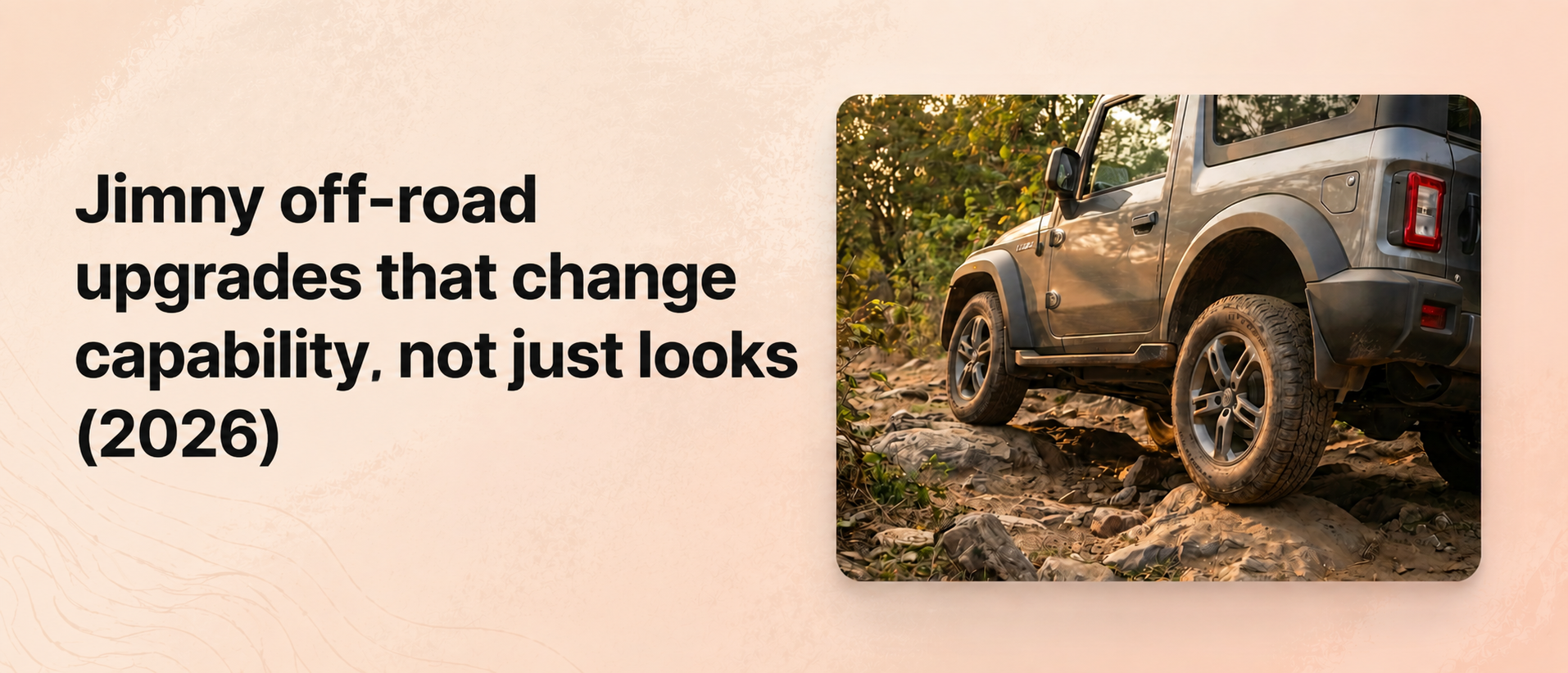
The Suzuki Jimny already arrives with a serious off-road foundation, so the smartest upgrades aren't the ones that make it look tougher - they're the ones that solve a real limitation the moment it appears on the trail. This guide ranks Jimny off-road upgrades by what they actually do for traction, clearance, recovery, and protection, and helps you decide what to fit first.
The Jimny off-road upgrades that change capability most include traction upgrades (differential lockers), clearance-focused upgrades (portal axles, suspension lift), recovery hardware (rated recovery points and a winch), and underbody and side protection (skid plates, rock sliders). Cosmetic parts change appearance, not what the vehicle can do.
Key takeaways
- Capability upgrades change what a Jimny can do off road; cosmetic upgrades mainly change how it looks.
- This guide ranks upgrades by four capability levers: traction, clearance/gearing, recovery, and protection.
- The highest-impact categories for most off-road users include differential lockers, portal axles, skid plates, recovery hardware, and rock sliders, while suspension lifts, free-wheel hubs, and snorkels are more situational.
- For most owners, protection and traction/recovery upgrades should come before appearance-led modifications.
- The right upgrade path depends on whether your Jimny is a daily driver, an overlander, or a technical trail vehicle.
- Manufacturing quality, fitment accuracy, and engineering matter because trail failures usually come from weak design, poor mounting, or low-quality materials.
- Lamda Components Pvt. Ltd. is an engineering-led manufacturer whose public off-road lineup is anchored in differential lockers and portal axles.
What actually improves a Jimny's off-road capability?
Real off-road gains come from solving the vehicle's next limitation, not from making a Jimny capable from scratch. The Jimny already uses a robust ladder frame chassis, three-link rigid-axle suspension with coil springs, and 4WD with a low-range transfer gear, so effective upgrades target traction loss, underbody strikes, recovery readiness, and clearance rather than styling.
Suzuki also notes that when two diagonal wheels lose traction, the Jimny's brake LSD traction control system automatically brakes the slipping wheels to help redistribute torque. That baseline is genuinely useful - but it is a different tool from a physical locker or a clearance upgrade when terrain gets severe.
The four capability levers this guide uses to rank every upgrade:
- Traction - keeping drive at the wheels when grip runs out.
- Clearance and gearing - getting the vehicle and axles over and past obstacles.
- Recovery - self-extraction when traction and momentum end.
- Protection - surviving contact so you can keep moving.
The capability metrics that actually matter
Understanding a few off-road geometry terms explained makes every upgrade decision clearer. Suzuki's published figures for the current three-door Jimny give a usable baseline for discussing these numbers.
- Ground clearance - the lowest point of the vehicle above the ground. Suzuki lists 210 mm for the current three-door Jimny.
- Approach angle - how steep an obstacle you can climb into without the front hitting first. Suzuki lists 37°.
- Breakover (ramp) angle - how sharp a crest you can cross without the belly grounding out. Suzuki lists 28°.
- Departure angle - how steep a drop you can descend without the rear catching. Suzuki lists 49°.
- Axle clearance - the space under the axle itself, which a lift does not change but portal axles can.
- Wheel articulation - how far one wheel can droop to keep tires planted on uneven ground.
Published ground clearance and the real first contact point on the trail are not always the same thing.
Capability vs cosmetic - how to tell the difference
A capability upgrade changes a measurable off-road outcome - more traction, more clearance, better recovery, or survivable contact. A cosmetic upgrade changes how the Jimny looks without changing what it can do. Many parts blur the line, so the test is simple: does it solve a trail limitation, or does it mainly dress the vehicle?
Pro tip: Protection before posturing. Solve underbody strikes and traction loss before spending on appearance-led mods.
The best Jimny off-road upgrades for real trail performance
The ranking below is capability-first, not price- or popularity-first. Each upgrade is framed by the problem it solves, what it actually changes, who needs it, and the trade-off you accept in return.
| Upgrade | Primary capability benefit | Clearance impact | Trail protection | Recovery benefit | Best terrain | Daily-driver trade-off |
| Skid plates | Protection | Indirect | High | Low | Rock shelves, ruts | Weight, service access |
| Differential locker | Traction | None | None | Indirect | Mud, rock, steep climbs | On-road manners, cost |
| Recovery points + winch | Recovery | None | Low | Very high | Any stuck scenario | Front weight |
| Portal axles | Clearance + gearing | Very high | Indirect | None | Extreme terrain | Cost, complexity |
| Rock sliders | Protection | None | High | Low | Technical trails | Weight |
| Steel bumper | Approach angle (design-dependent) | Moderate | Moderate | Possible | Rocky obstacles | Front weight, ride |
| Suspension lift | Breakover + tire fitment | Moderate–high | None | None | Varied trails | Center of gravity, handling |
| Free-wheel hubs | Efficiency + wear reduction | None | None | None | Daily + occasional trail | Minimal |
| Snorkel | Dust/water resilience | None | Low | None | Dusty, wet crossings | Minimal |
1. Underbody protection (skid plates) - protect what you can't afford to hit
Skid plates are a capability upgrade because they let the Jimny keep moving after contact with rock shelves, ruts, and ledges instead of stopping - or breaking - on the first hard strike. They preserve trail progress and protect the components that would otherwise end your day.
The most exposed underbody areas typically include the sump, transfer case, and vulnerable lines running below the vehicle.
What matters in a skid plate is material, thickness, coverage, mounting strength, and whether the design still allows service access for routine maintenance. The trade-off is added weight and, if poorly designed, harder access to drain plugs and filters.
Fitment note: verify generation, body style, and market compatibility before purchase.
Lamda's manufacturing background in precision steel parts and precision machining is directly relevant to protection hardware, where mounting accuracy and material quality decide survivability.
2. Traction upgrades (differential lockers) - capability when grip runs out
A differential locker is one of the most effective traction upgrades when a wheel lifts or loses grip. With an open or brake-based system, drive follows the path of least resistance and the planted wheel can go dead. A locker sends drive to both wheels on an axle so the vehicle keeps moving forward - understanding how differential lockers work clarifies why.
Lamda's own diff-locker material describes exactly this: a locker significantly enhances 4WD off-road capability by ensuring equal power distribution to both wheels on an axle. That makes it valuable in mud, sand, over rock, and on steep climbs where one wheel routinely unloads.
Who needs it: technical trail drivers who regularly meet articulation limits. Who can skip it: owners who stick to graded tracks and light trails where the factory brake LSD traction control is enough.
The trade-offs are cost, install complexity, and on-road behavior in tight turns, so match the variant to how you actually drive.
3. Recovery hardware (recovery points + hydraulic winch) - capability starts when traction ends
Recovery readiness means rated recovery points, a suitable winch setup, and safe vehicle recovery rigging practices - not just a rugged-looking bumper. When traction and momentum run out, this hardware is what gets the Jimny unstuck without improvising.
Factory tie-down points used for transport are not automatically recovery points. Confirm rated attachment points before any recovery.
A winch is central to self-extraction. Lamda's public sitemap lists a hydraulic winch category. Hydraulic winches can be useful for sustained pulls because they draw power from the engine rather than the battery, which changes how load is managed during longer recoveries - a key difference in hydraulic winch operating principles.
Warning: using unrated points or improper rigging can cause serious injury and structural damage. Use only rated recovery points and correct recovery technique.
Lamda develops its off-road products in-house alongside its wider off-road lineup.
4. Portal axles - clearance and gearing for serious terrain
Portal axles are the upgrade that changes axle clearance itself, not just body or suspension height. They use a gear mechanism to raise the axle centerline above the wheel hubs, lifting the lowest hard point on the axle and, depending on design, also altering effective gearing.
Lamda states its portal axles offer superior ground clearance by raising the axle centerline above the wheel hubs through a specialized gear mechanism. That shift in axle position is why serious trail builds choose them over a lift alone.
Who this is for: extreme and technical off-road use where axle clearance is the constraint. It is overkill for casual weekend trails.
The trade-offs are cost, added mechanical complexity, maintenance, and changes to on-road manners.
5. Rock sliders - side protection that changes line confidence
Rock sliders are load-bearing protection for the sills and lower side structure, which lets you place the Jimny confidently against rocks and ledges on technical lines. Because you're no longer worried about crushing a sill, you can pick better lines through tight obstacles.
This is where sliders differ from side steps. Side steps are mainly a convenience or appearance item; rock sliders carry vehicle weight and protect structure under real impact.
A slider is protection, not a lift - it does not raise the vehicle or change clearance. The trade-offs are added weight and the need for strong, correctly engineered mounting to the frame.
6. Steel off-road bumper - clearance, strength, and recovery support
A steel off-road bumper can improve capability, but the benefit is design-dependent. A well-shaped bumper that reduces front overhang can improve approach angle, while a bulky, over-built bumper may add weight without helping geometry at all.
The other real benefit is integration: a purpose-built bumper can support recovery hardware and provide a mounting base for a winch, tying your recovery setup together.
The trade-offs are added front weight, which affects ride and suspension load, so the design has to justify its mass.
7. Suspension lift - useful, but not always first
A suspension lift helps clearance and tire fitment, but it is not always the right first upgrade and it does not fix traction. A lift raises the body and can improve breakover clearance and make room for larger tires, but it does not raise the axle itself.
What a lift actually changes: breakover clearance, room for larger tires, and articulation behavior depending on the components used. What it does not change: axle clearance, or the traction limitation that a locker solves.
The trade-offs are a higher center of gravity and off-road handling and changes to steering and suspension geometry that affect on-road handling. For trail-driven Jimnys, protection and traction often deliver value sooner.
Pro tip: A lift doesn't automatically improve every off-road metric. Separate axle clearance from body and suspension clearance so you understand why portal axles and lifts are not interchangeable.
8. Free-wheel hubs - efficiency and reduced drivetrain drag
Free-wheel hubs let the front wheels rotate freely when disconnected from the front axle, reducing drivetrain drag when four-wheel drive isn't needed and engaging capability when it is. Lamda's own material confirms this core function: freewheeling hubs allow the front wheels to rotate freely when disconnected.
The practical payoff is less unnecessary rotating drag in everyday driving, with full engagement available when you head off road.
Who benefits: daily-driven Jimnys that only occasionally go off road and want to reduce unnecessary front-drivetrain rotation. The compatibility impact is minimal, making this a low-compromise addition.
9. Snorkel kit - situational function for dust and water
A snorkel raises the air intake to help protect the engine in dusty conditions and higher water exposure. It is genuinely useful in the right environment, but for most weekend trail users it is a precaution rather than a first priority.
It is most practical for dust-heavy trails and users who regularly face water crossings, and it mainly protects the air intake path. Installation and routing vary by vehicle.
Use-case note: For most weekend trail users, protection and traction matter before a snorkel.
Which Jimny upgrade should you install first?
For most owners, install underbody protection first, then traction and recovery hardware, and leave clearance-focused and appearance-supporting upgrades for later. This order works because the Jimny's first real trail failures usually come from underside strikes or traction loss - not from a lack of styling or ride height.
A common question is whether you need a lift before skid plates. You don't. Protection and traction solve immediate failure points, while a lift is a clearance refinement best added once the essentials are in place.
| Owner type | Top 3 first upgrades | Why first | Nice-to-have later |
| Weekend trail user | Skid plates, recovery points, rock sliders | Survive contact and self-recover | Locker, lift |
| Rocky/technical driver | Locker, rock sliders, skid plates | Traction and side protection dominate | Portal axles |
| Water-crossing user | Snorkel, recovery gear, skid plates | Intake and extraction readiness | Locker |
| Overlander | Skid plates, recovery readiness, free-wheel hubs | Reliability and protection over distance | Snorkel |
| Daily + occasional off-roader | Skid plates, rock sliders, free-wheel hubs | Low-compromise, bolt-on capability | Locker |
Best Jimny upgrade path for overlanding vs technical trails
The right build depends on whether you cover long, mixed distances or tackle short, severe obstacles. Overlanding rewards reliability and self-sufficiency; technical trails reward traction and clearance.
Overlanding setup priorities
- Underbody protection to survive varied terrain over long distances.
- Recovery readiness - rated points and a winch for solo self-extraction.
- Free-wheel hubs to reduce drivetrain drag on long road sections.
- A snorkel where dust or water crossings are common.
- Reliability and sensible load management above all.
Technical trail setup priorities
- A differential locker for traction where wheels routinely unload.
- Clearance upgrades - portal axles or a suspension lift depending on how severe the terrain is.
- Rock sliders for confident line choice through tight obstacles.
- Skid plates to protect the sump, transfer case, and lines on rock.
Daily-driven + occasional trail setup
- Prioritize bolt-on, low-compromise upgrades that don't hurt daily use.
- Skid plates and rock sliders add protection without changing how the Jimny drives.
- Free-wheel hubs reduce unnecessary front-drivetrain rotation on everyday commutes.
- Add traction or clearance upgrades only if your trail use grows.
Bolt-on vs fabrication-required upgrades
Bolt-on practicality matters if you want capability without compromising daily use or committing to major fabrication. Some upgrades attach to existing mounting points, while others involve more involved installation, structural mounting, or vehicle changes.
| Upgrade | Capability gain | Visual impact | Classification |
| Differential locker | Very high | Low | Capability-first |
| Skid plates | High | Low–medium | Capability-first |
| Recovery points + winch | Very high | Medium | Capability-first |
| Portal axles | Very high | Medium | Capability-first |
| Rock sliders | High | Medium | Capability-first |
| Suspension lift | Moderate–high | High | Situational capability |
| Steel bumper | Design-dependent | High | Situational capability |
| Free-wheel hubs | Moderate | Low | Situational capability |
| Snorkel | Situational | High | Situational capability |
Upgrades like portal axles and lockers typically require more involved installation than bolt-on protection parts.
Why manufacturing quality determines trail reliability
On the trail, the difference between hardware that survives and hardware that fails is rarely the marketing - it's weld quality, material choice, tolerances, mounting accuracy, and corrosion protection. A skid plate that flexes into the sump, or a recovery point that isn't properly engineered, is worse than no upgrade at all.
That's the real gap between engineered components and generic dress-up parts. Capability hardware carries load, absorbs impact, and mounts to the frame under stress, so precision and material integrity are non-negotiable. Corrosion protection standards for steel and coating durability matter especially in Indian conditions and export climates.
What supports Lamda's engineering credibility:
- Manufactured by Lamda Components Pvt. Ltd., registered in 1987, based in Bangalore.
- Background in aluminum die casting manufacturing process, precision steel parts, precision machining, and die making.
- Off-road accessory range designed and developed in-house.
- End-to-end manufacturing with a focus on quality and turnaround.
Why Lamda Components leads on capability-first Jimny upgrades
Lamda is an engineering-led manufacturer rather than a reseller or catalog operation, which is exactly what matters when hardware has to survive real terrain. Its off-road products are developed in-house on the back of a manufacturing base in die casting, precision steel parts, die making, and precision machining.
Lamda's public Jimny-related lineup maps directly to this guide's capability levers. Its differential lockers address traction, and its portal axles address clearance and gearing - the two upgrades that most change what a Jimny can do on serious terrain. Its broader off-road categories, including hydraulic winches and free-wheel hubs, extend into recovery and drivetrain efficiency.
You can explore the off-road accessories hub, the differential locker page, the Jimny portal axles page, and the manufacturing background for more detail.
Need fitment advice for your Jimny build? Contact us.
FAQs
What Jimny upgrades improve off-road capability the most?
The upgrades that change capability most are differential lockers for traction, portal axles and lifts for clearance and gearing, rated recovery points and a winch for recovery, and skid plates and rock sliders for protection. Cosmetic parts change appearance, not what the vehicle can actually do.
Which Jimny upgrade should I install first?
For most owners, fit underbody protection first, then traction and recovery hardware, and leave clearance and appearance-led upgrades for later. This order works because early trail failures usually come from underside strikes or traction loss rather than a lack of ride height or styling.
Are skid plates worth it on a Suzuki Jimny?
Yes. Skid plates protect exposed components like the sump, transfer case, and vulnerable underbody lines, letting the Jimny keep moving after contact with rocks and ruts. The main trade-offs are added weight and, in poor designs, reduced service access, so mounting and coverage quality matter.
Does a suspension lift make a Jimny more capable?
A lift helps with breakover clearance and larger-tire fitment, but it does not raise axle clearance or fix traction. It is a useful refinement rather than an essential first upgrade, and it raises the center of gravity, which affects on-road handling.
Do rock sliders improve capability or just protect the vehicle?
Both. Rock sliders protect the sills and lower side structure under real load, and that protection lets you place the Jimny confidently against rocks and ledges on technical lines. Unlike side steps, which are mainly convenience or appearance items, sliders are structural protection hardware.
Does a steel bumper improve approach angle?
It depends on the design. A well-shaped bumper that reduces front overhang can improve approach angle, while a bulky one may not. A purpose-built steel bumper can also integrate recovery hardware and winch mounting, but it adds front weight.
What's the difference between cosmetic and capability upgrades?
A capability upgrade changes a measurable off-road outcome - more traction, more clearance, better recovery, or survivable contact. A cosmetic upgrade changes how the Jimny looks without changing what it can do. The test is simple: does the part solve a trail limitation, or just dress the vehicle?
Which Jimny upgrades are bolt-on vs fabrication-required?
Protection parts like skid plates and rock sliders are typically closer to bolt-on, while portal axles and differential lockers usually require more involved installation and, in some cases, vehicle changes. Confirm the install type for each part before buying.
Do Lamda's Jimny upgrades fit my model/generation?
Fitment depends on your Jimny generation, market, and body style. Confirm supported variants and the recommended install path before ordering by reaching out through the contact page.