

A Maruti Gypsy spends most of its life in 2WD, while its front axle is part of a 4WD drivetrain. Free wheel hubs decide whether the front wheels are connected to the front axle shafts when 4WD is not required. Free wheel hubs are manual devices at the centre of each front wheel. In FREE, they disconnect the wheel from the front axle shaft. In LOCK, they couple the wheel to the axle shaft. Drive reaches the front wheels only after you also select 4WD at the transfer case.
Key takeaways
These are the points Gypsy owners and installers most often get wrong.
- Free wheel hubs, also called locking hubs, connect or disconnect each front wheel from its front axle shaft on part-time 4WD vehicles such as the Maruti Gypsy.
- In FREE, the front wheels turn without back-driving the front axle shafts and front differential in a typical manual-hub part-time 4WD layout. In LOCK, each wheel is coupled to its axle shaft.
- Locking the hub dials and selecting 4WD at the transfer case are separate actions. Locked hubs alone do not put the Gypsy in 4WD.
- Lock both front hubs before you rely on 4WD.
- Keeping the front driveline still in 2WD has a clear mechanical basis, but the practical effect depends on vehicle condition, configuration and how you drive.
- Lamda Components Pvt. Ltd. designs and manufactures manual free wheel hubs in-house in Bangalore. Confirm your exact Gypsy configuration before ordering from Lamda free wheel hubs.
What are free wheel hubs?
Free wheel hubs are mechanical devices fitted at the front wheels of part-time 4WD vehicles. In FREE, the hub disconnects the wheel from the front axle half shaft, so the wheel spins on its own. In LOCK, the hub couples the wheel to the axle shaft, so drive can reach that wheel once 4WD is selected (Trainsafe).
Four names describe the same function: free wheel hubs, freewheeling hubs, locking hubs and manual locking hubs. All of them couple or uncouple the wheel and the axle. A locking hub is also different from a wheel hub. The wheel hub is the assembly the wheel mounts to. The locking hub is the device at the wheel centre that connects that wheel to the axle shaft, or disconnects it.
Did you know? These hubs have nothing to do with bicycle "freehubs" or "freewheels". Those parts let a bicycle wheel coast past the pedals and play no role in a vehicle drivetrain.
Lamda's hubs are manual, or "mechanically activated". You get out of the vehicle and turn the dial at the end of each front axle (Lamda).
How free wheel hubs work: FREE vs LOCK
The hub dial controls one thing only: whether the wheel is mechanically coupled to its front axle shaft. The table below shows what each position means in practice.
| Hub setting | Wheel coupled to front axle shaft? | Front driveline in 2WD | Can 4WD torque reach front wheels? | Typical use |
| FREE | No | In a typical manual-hub part-time 4WD layout, the front axle shafts and differential are not back-driven by the wheels | No, not until both hubs are locked | Normal road use where 4WD is not expected |
| LOCK | Yes | Front axle components can rotate with the wheels, even in 2WD | Yes, once 4WD is selected at the transfer case | Before low-traction terrain or repeated 2WD/4WD switching |
What happens in the FREE position
In FREE, each front wheel rotates on its own and is not connected to its axle shaft. In a typical manual-hub part-time 4WD system with the transfer case in 2WD, road speed does not turn the front axle shafts and front differential. The vehicle behaves as a 2WD vehicle (Trainsafe).
This is the main point of fitting free wheel hubs. Front-driveline parts that are not doing useful work in 2WD can remain still rather than turning through bearings, seals and gear oil at road speed.
What happens in the LOCK position
In LOCK, the hub couples the wheel to the axle shaft. In a typical manual-hub part-time 4WD system, the front wheels, drive shafts and differential then turn as one unit. LOCK does not deliver torque on its own. Drive reaches the front wheels only when the hubs are locked and the transfer case is in 4H or 4L (Trainsafe).
If you stay in 2WD with the hubs locked, the front axle components can still turn with the wheels. They simply carry no drive from the transfer case.
Locked hubs are not the same as 4WD engaged
This is the most common point of confusion with manual locking hubs. On a manual-hub Gypsy, two separate actions are needed before the front wheels can drive. Locking the hub dials prepares the front wheels for 4WD. Selecting 4WD at the transfer case is a separate step. You need both.
| Hub dial position | Transfer-case selection | Result | Driver takeaway |
| FREE | 2WD | Normal 2WD; front wheels disconnected from axle shafts | Standard road configuration |
| LOCK | 2WD | Hubs coupled; vehicle remains in 2WD | Pre-position before a trail where 4WD may be needed |
| LOCK | 4H / 4L | Front drivetrain can deliver torque to the front wheels | Use on suitable low-traction surfaces |
| FREE | 4H / 4L | Vehicle stays in 2WD; front wheels do not receive drive | Do not rely on 4WD until both hubs are in LOCK |
Always keep both hubs in the same position. 4WD specialists warn that leaving one hub in a different position from the other can cause damage (Eureka 4WD). Check the dial positions often. Some owners also mark the indicator so the setting is easy to read at a glance.
Pro tip: Before you rely on front-wheel drive, walk round the vehicle and confirm both dials show the same setting.
Free wheel hubs are also not differential lockers. A hub connects a wheel to its axle shaft. A locker changes how the differential splits torque between the left and right wheels. For more on that distinction, see what is a differential lock in a car and Lamda's differential lockers.
How to operate Lamda free wheel hubs on a Maruti Gypsy
Manual hubs are operated by hand at each front wheel. The sequence matters more than speed. Use the steps below together with your Gypsy owner's manual for transfer-case operation.
Locking the hubs before you need 4WD
- Stop the vehicle on safe, level ground.
- Turn each front hub dial from FREE to LOCK.
- Confirm that both front hubs show LOCK.
- Select 4H or 4L only when the surface requires it, following the Gypsy owner's manual.
General 4WD guidance says that with the hubs already locked, high-range 4WD can be selected on the move. Low range requires a stop (Trainsafe). Confirm the correct procedure for your Gypsy in its owner's manual.
Pro tip: Lock both hubs before you enter terrain where you may need to switch between 2WD and 4WD several times. Select 4WD only when the surface actually calls for it.
Returning to FREE after the trail
- Shift the transfer case back to 2WD first, following the vehicle manual.
- Stop on safe ground and turn both dials to FREE.
- Check each dial for stiffness, grit, water or visible contamination.
Can you leave manual 4x4 hubs locked?
Manual hubs can generally stay in LOCK while the Gypsy is driven in 2WD on tarmac, because the transfer case is not sending torque to the front axle. The trade-off is that the front driveline keeps turning, which adds a small amount of drag and running wear. Locked hubs do not mean you are driving in 4WD.
Both Trainsafe and Eureka 4WD describe the extra fuel use and wear as small. Neither publishes figures. When deciding whether to leave the hubs locked, weigh the following:
- When it makes sense: a trail day with frequent 2WD/4WD switching, mixed loose surfaces or water crossings ahead. With the hubs locked, you do not have to stop and get out each time.
- Why not permanently: keeping the front driveline turning without need removes the benefit of having hubs in 2WD.
- Seizing risk: Eureka 4WD identifies seizing in wet, muddy conditions as a practical risk. It advises checking every few weeks that the dial still turns freely.
- Periodic use: Trainsafe advises locking the hubs occasionally even on a mainly sealed-road vehicle, so the front drive shafts stay lubricated. It cites a general manual recommendation of at least 15–20 km per month.
When not to select 4WD, even with the hubs locked
Driveline wind-up comes from the transfer-case selection, not from the hub dial. In a part-time 4WD system without a centre differential, the transfer case locks the front and rear axles to the same average speed. In a turn, the front wheels travel farther than the rear wheels. On a high-grip surface the tyres cannot slip enough to absorb that difference. The result is tyre scrub, heavy steering, binding and, over time, mechanical damage. On loose ground, the tyres slip and release the stress (Cars-Data).
| Suitable for 4WD selection | Not suitable for 4WD selection |
| Mud, sand, slush, loose gravel, snow, wet grass, loose rock and steep low-traction tracks | Dry tarmac, concrete and high-grip sealed roads, especially in tight turns |
Do not select 4WD on high-traction sealed surfaces unless the vehicle manufacturer's instructions specifically allow it. Locked hubs on dry tarmac in 2WD are a different situation and are generally acceptable, as explained above.
Free wheel hub benefits: what is mechanically real and what depends on your Gypsy
Lamda lists several benefits of its hubs: better fuel efficiency, improved pick-up, smoother steering in 2WD, less strain on the engine and transmission, reduced front differential and tyre wear, and quieter operation (Lamda). These are unquantified manufacturer claims. The underlying mechanism is that, in FREE, front-driveline parts in a typical manual-hub 4WD layout can stop turning when they have no work to do.
Reduced drivetrain drag and fuel economy
When the front axle shafts and differential are not back-driven in 2WD, there is less rotating mass and less friction from bearings, seals and gear oil. How much fuel this saves depends on speed, tyres, axle condition, lubricant and the share of time spent in 2WD. Independent 4WD sources describe the difference as small, so treat any fixed percentage with caution.
Less wear on front driveline components
Parts that are not turning are not wearing from rotation. FREE reduces unnecessary movement in 2WD. It does not mean zero wear, because the components still age with time, heat cycles and use in 4WD.
Steering feel and front-end noise
Lamda lists smoother steering in 2WD and quieter operation among the benefits of its hubs. With the front axle shafts disconnected in 2WD, there are fewer turning parts in the front driveline. How noticeable the difference is depends on the condition and setup of your particular vehicle.
Manual vs automatic locking hubs
Both hub types do the same job. The difference is how engagement happens. Automatic hubs engage when 4WD is selected from the cab and usually release when you reverse after switching 4x4 off. If the automatic system fails, some designs can be locked by hand with a wheel brace on the centre nut (Trainsafe).
| Factor | Manual locking hubs | Automatic locking hubs |
| Engagement method | Driver turns the wheel-centre dial | Engage automatically when 4WD is selected |
| Driver involvement | Driver must leave the vehicle | Operated from the cabin |
| Engagement certainty | Dial position is visible | Depends on the actuation system working correctly |
| Serviceability | Direct mechanical inspection | Depends on the specific actuation design |
| Best fit | Simple, driver-controlled 4WD such as the Gypsy | Applications that prioritise convenience |
Lamda's hubs are manual. You control engagement directly and can see the setting on the dial. The trade-off is that you must leave the vehicle to change it. Neither type is better in every case. For trail-specific guidance, read manual versus automatic free wheel hubs.
The years we have spent getting them right: Lamda's engineering perspective
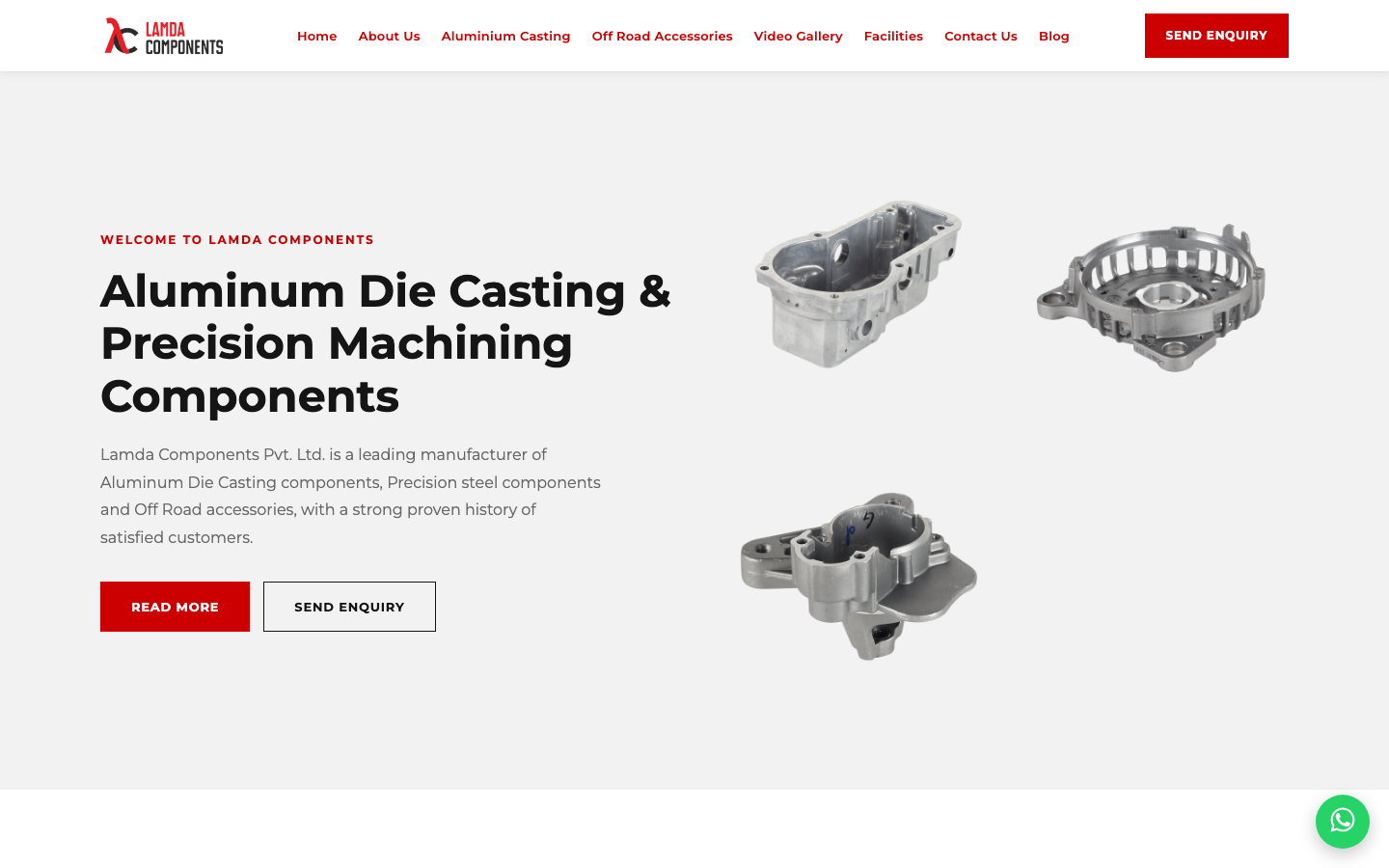
Lamda Components Pvt. Ltd. was registered in 1987. It operates from Veerasandra Industrial Area, Bangalore, as a manufacturer and exporter of aluminium die casting products and precision steel parts (Lamda). Our free wheel hubs are designed and manufactured in-house, alongside the rest of Lamda's off-road accessories.
Design intent: what a Gypsy hub has to do
A manual hub on a Gypsy has a simple job: it must engage when locked, release when freed and provide a clear dial position for the driver. Lamda lists slush, sand, snow, rocky surfaces and off-road trails among the operating environments for its hubs. As with any mechanical hub, regular inspection is important where vehicles spend long periods between trail use.
Why manufacturing precision matters in a manual hub
A manual hub relies on parts meshing and moving freely. That makes manufacturing control important. The table below shows the company's in-house capabilities and why each one is relevant to this kind of product.
| Lamda capability | Why it matters for a free wheel hub |
| In-house tool design, development and die making | Tooling control supports consistent parts from batch to batch |
| Aluminium pressure die casting | Process control matters wherever cast parts are used |
| Precision steel parts | Accurate engagement components support positive meshing |
| Precision machining | Mating faces and engagement surfaces need a controlled fit and free movement |
| In-house dimensional checking of critical parts | Confirms critical dimensions before parts go into assembly |
| Qualified NPD and R&D team | Supports the translation of application requirements into a manufacturable design |
What still decides how a hub performs in service
Hub quality is only part of the picture. Worn axle splines, damaged axle shafts, incorrect assembly and incompatible parts can all affect engagement, whatever hub is fitted. Fitment confirmation and installation checks are therefore important before the vehicle is returned to service.
Maruti Gypsy fitment: what to confirm before you order
Lamda lists the Maruti Gypsy among the vehicles compatible with its free wheel hubs. The list also includes the Mahindra Thar (old and new), Mahindra Jeep, Bolero, Scorpio, MM540 and MM550, Isuzu D-Max and Tata Xenon (Lamda free wheel hubs). Owner discussions on Team-BHP indicate that hub arrangements may vary between Gypsy builds, so confirm your vehicle before you order.
Pro tip: To get a fast, accurate fitment answer, send us:
- Vehicle variant and year of manufacture
- Your current hub arrangement
- Any axle or wheel-end modifications
- Clear photographs of the front wheel ends
Installation checks that prevent hub-operation issues
Fitment and installation can affect hub operation. A short, disciplined checklist helps identify obvious issues before use.
- Before fitting: confirm the hub matches your vehicle. Inspect the mating faces and axle splines for wear, damage or debris. Check that the fasteners are in good condition.
- During fitting: follow the installation and tightening procedure supplied by Lamda. Do not improvise fastener specifications.
- After fitting: turn both dials through FREE and LOCK several times. Confirm both dials show the same position. Then check 4WD engagement under control on a suitable low-traction surface.
If you are unsure at any stage, have a qualified 4WD professional fit the hubs.
The 60-second pre-trail hub check and post-trail care
A quick check before the trail and a short inspection afterwards can identify problems while they are still minor.
Before the trail
- Both dials turn positively and seat into position.
- Both dials are set to the same position.
- There are no visible cracks, damage or loose fasteners.
- The hubs are locked before you reach low-traction terrain.
- The transfer case operates as described in the vehicle manual.
After mud, water, dust or long storage
- Clean the outside of each hub.
- Check for water or contamination around the dial.
- Turn each dial to confirm smooth movement.
- On vehicles that rarely see the trail, use the hubs from time to time and check every few weeks that the dials still turn freely (Eureka 4WD).
If a hub dial is hard to turn, inspect and service the assembly rather than forcing it.
Troubleshooting: signs a free wheel hub needs attention
Hub symptoms can point to several possible causes. Use the table to narrow the problem down, then have it inspected.
| Symptom | Possible causes | Next step |
| Dial is stiff or will not turn | Contamination, corrosion, old lubricant or internal damage | Do not force it; inspect and service the hub |
| No front drive with hubs locked and 4WD selected | One hub not fully engaged, transfer-case issue, axle or spline damage | Recheck both dials; arrange a front-driveline inspection |
| Hub will not return to FREE after off-road use | Transfer case still in 4WD, binding or contamination | Confirm 2WD is selected; do not force the dial; inspect |
| Clicking or grinding after locking | Partial engagement, wear or incorrect fitment | Stop using 4WD; inspect the hub and its fitment |
| Water or mud inside the dial area | Seal damage or exposure beyond normal use | Clean, inspect and service |
If engagement, noise, damage or fitment problems continue, consult a qualified 4WD specialist or contact Lamda's technical team.
For OEMs, distributors and export buyers: sourcing free wheel hubs from Lamda
Free wheel hubs are a specialised component to evaluate carefully. Buyers may consider a supplier's tooling, casting, machining and inspection capabilities alongside confirmed vehicle fitment and technical support.
What to evaluate in a free wheel hub supplier
- Lamda Components Pvt. Ltd. (Bangalore, registered in 1987). Lamda designs and manufactures manual free wheel hubs in-house, and the Maruti Gypsy is among its listed applications. The same facility provides tool design and die making, aluminium pressure die casting, precision steel parts, precision machining, automated sub-assembly, in-house dimensional checking of critical parts and a qualified NPD/R&D team. Lamda serves OEM clients in domestic and international markets across the automotive, medical, electrical and white goods sectors. This capability is relevant for buyers seeking an engineering and manufacturing partner. See its wider range of manual locking hubs and accessories.
- Verify with any supplier: confirmed vehicle compatibility, transparency on process and quality, installation and service documentation, technical support, change control and test evidence they can share.
What to send for a quote or drawing review
Share the vehicle platform and variants, annual quantities, drawings or samples, target loads, operating environment, packaging and labelling requirements, including private label, and destination markets. A Lamda representative follows up an enquiry with drawings and a quote.
Talk to Lamda about free wheel hubs for your Gypsy or 4WD program
Whether you run one Gypsy or manage a wider 4WD programme, the next step depends on your role.
- Gypsy owners and installers: confirm compatibility and ask for installation guidance before you order.
- OEM procurement: request specifications, quality documentation and a supply proposal.
- Engineering teams: share vehicle details, drawings, target loads and fitment requirements for technical review.
- Export buyers: request the catalogue, fitment list and packaging details, or start a distributor or private-label discussion.
Frequently asked questions
What are free wheel hubs on a 4x4?
Free wheel hubs are devices at the front wheels of part-time 4WD vehicles such as the Maruti Gypsy. In FREE, they disconnect each front wheel from its axle shaft, so the vehicle runs as 2WD. In LOCK, they couple the wheel to the axle shaft, so drive can reach the front wheels once 4WD is selected.
What is the difference between FREE and LOCK on a hub dial?
FREE disconnects the wheel from the front axle shaft. In a typical manual-hub part-time 4WD system, the wheel turns on its own and the front axle shafts and differential are not back-driven. LOCK couples the wheel to the axle shaft, so the front wheels, shafts and differential turn together. Torque reaches the wheels only after 4H or 4L is selected at the transfer case.
Do I need to lock both free wheel hubs before selecting 4WD?
Yes. Lock both front hubs before you rely on 4WD. Keep the two hubs in the same position, because 4WD specialists warn that a mismatch can cause damage. Walk round the vehicle and check that both dials show LOCK before you select 4H or 4L.
Can free wheel hubs remain locked while driving in 2WD?
Generally yes. With the transfer case in 2WD, no torque goes to the front axle, but the front driveline keeps turning. That adds a small, unquantified amount of drag and wear. Check regularly that the dials still turn freely, especially after wet or muddy use, and follow your vehicle manual.
Can I use 4WD if the hubs are set to FREE?
No. With the hubs in FREE, the front wheels are disconnected from their axle shafts, so the vehicle stays in 2WD even if the transfer case is in 4H or 4L. Lock both hubs first, then select 4WD at the transfer case. You need both actions for front-wheel drive.
Are manual locking hubs better than automatic hubs?
Neither type is better in every case. Manual hubs give you direct mechanical control, a visible dial position and straightforward inspection, but you have to leave the vehicle to operate them. Automatic hubs engage from the cabin, which is more convenient, but they depend on the actuation system working correctly.
Do free wheel hubs improve fuel economy?
In FREE, the front axle shafts and differential can stop turning in 2WD, which reduces rotating mass and friction. Any fuel saving depends on speed, tyres, axle condition, lubricant and time spent in 2WD. Independent 4WD sources describe the difference as small, so be cautious about fixed savings figures.
Are Lamda free wheel hubs compatible with the Maruti Gypsy?
Lamda lists the Maruti Gypsy among the applications for its free wheel hubs. Front hub arrangements may vary between Gypsy builds, so confirm your exact configuration before ordering. Share your variant, year, current hub type, any axle modifications and wheel-end photographs with Lamda for a fitment check.
Can I turn the hub dial while the vehicle is moving?
No. Stop the vehicle on safe ground before turning either hub dial. Manual hubs are operated by hand at the front wheel. Once both hubs are locked, general 4WD guidance allows high range to be selected on the move. Follow your Gypsy owner's manual for transfer-case operation.
What maintenance does a manual free wheel hub need?
Clean the hubs after mud, water or dust exposure and check around the dial for contamination. Turn each dial to confirm smooth movement. On vehicles that rarely go off-road, use the hubs from time to time and check every few weeks that the dials turn freely. Never force a stiff dial.
Can Lamda develop a free wheel hub for a different 4WD platform?
Lamda has an in-house NPD and R&D team, tool design and die making, die casting and precision machining. Share the vehicle platform, drawings or samples, target loads, operating environment and expected quantities, and a representative will respond with drawings and a quote. Start the conversation through Contact us.