
From casting to finished part, Lamda Components Pvt. Ltd. runs an integrated manufacturing workflow that keeps die making, die casting, machining, finishing, and inspection under one roof. This explainer walks OEM procurement, engineering, and supplier quality teams through that journey so you can validate Lamda's end-to-end capability before an RFQ.
Lamda precision machining is the in-house CNC-based machining capability of Lamda Components Pvt. Ltd., where aluminum die cast and precision steel parts are converted into production-ready finished components. It operates as one connected stage within an integrated workflow spanning die making, pressure and gravity die casting, precision machining, finishing, and inspection.
Key takeaways
- Lamda Components Pvt. Ltd. is a Bangalore-based manufacturer and exporter established in 1987.
- Lamda combines die making, die casting, and precision machining under one roof for end-to-end part production.
- The workflow moves cast components through CNC machining (VMC and HMC), finishing, integrity checks, and inspection to dispatch.
- In-house inspection includes a Zeiss CMM, spectrometer, roughness tester, hardness testers, and leak testing machines that support dimensional accuracy and part integrity.
- Lamda is certified to IATF 16949:2016 and ISO 14001:2015, and states compliance with BIS standards.
- An integrated manufacturing model reduces vendor handoffs for buyers sourcing cast-and-machined finished parts.
What is Lamda precision machining?
Lamda precision machining is the CNC-based machining stage within Lamda's larger die casting–to–finished-part workflow. Rather than a standalone job shop function, machining at Lamda refines cast and steel parts into components that meet drawing-specified dimensions and are ready for finishing, inspection, and assembly.
Lamda Components Pvt. Ltd. is a Bangalore-based manufacturer and exporter established in 1987, positioned as "a leading manufacturer and exporter of Aluminum Die Casting products and Precision steel parts." The company offers "complete, end to end, Die Casting solutions right from Die making, Pressure Die Casting to Precision machining," serving OEM and industrial customers across domestic and international markets. This integrated identity is central to how Lamda supports procurement, engineering, and supplier quality teams evaluating a single manufacturing partner.
How Lamda takes a part from casting to finished component
Lamda documents an integrated sequence where each major stage is handled in-house, from tooling through dispatch. The value for buyers is a connected journey: a casting created near-net-shape, then refined by machining, prepared by finishing, validated for integrity, and confirmed by inspection before it ships.
The workflow moves through these stages:
- Die making - in-house die making capability prepares tooling for consistent, repeatable parts.
- Pressure die casting - automated machines in the 250–420 ton range with auto ladle, auto spray, and auto extractor produce near-net-shape casting benefits aluminum components.
- Gravity die casting - a gravity die casting facility extends Lamda's casting options for different component requirements.
- Precision machining - CNC-based VMC and HMC operations finish critical features, holes, and interfaces.
- Surface finishing - shot blasting, vibro deburring, painting, and powder coating prepare parts for inspection and assembly.
- Integrity checks - resin impregnation and leak testing address porosity and sealing performance where required.
- Inspection - dimensional and material validation using CMM, spectrometer, and related instruments.
- Dispatch - packing and shipment for domestic and export customers.
| Stage | What happens | In-house capability | Why it matters |
| Die making | Tooling preparation | In-house die making | Supports repeatability |
| Die casting | Near-net-shape part creation | Pressure (250–420 tons) and gravity die casting | Reduces downstream work |
| Precision machining | CNC finishing of critical features | VMC and HMC | Achieves dimensional accuracy |
| Surface finishing | Deburring, blasting, coating | Shot blasting, vibro deburring, painting, powder coating | Improves finish and readiness |
| Integrity checks | Porosity sealing, leak validation | Resin impregnation, leak testing | Addresses sealing performance |
| Final inspection | Dimensional and material validation | Zeiss CMM, spectrometer, hardness and roughness testers | Quality assurance |
Why machining follows casting
A casting typically provides the base geometry of a component, but critical surfaces, bores, and mating interfaces need tighter control than a cast surface alone can deliver. Machining refines those features, tightens tolerances, and prepares the part for final assembly. By running casting and machining under one roof, Lamda controls the transition between the two stages instead of relying on separate vendors to align geometry, datums, and quality expectations.
In-house manufacturing capabilities that support the workflow
Lamda's facilities are organized so each workflow stage has dedicated capability, described on its own site as a "one stop hub for all your Die Casting and precision machining requirements." Rather than a raw machine count, the more useful view for buyers is how casting and machining strengths combine to deliver a finished part.
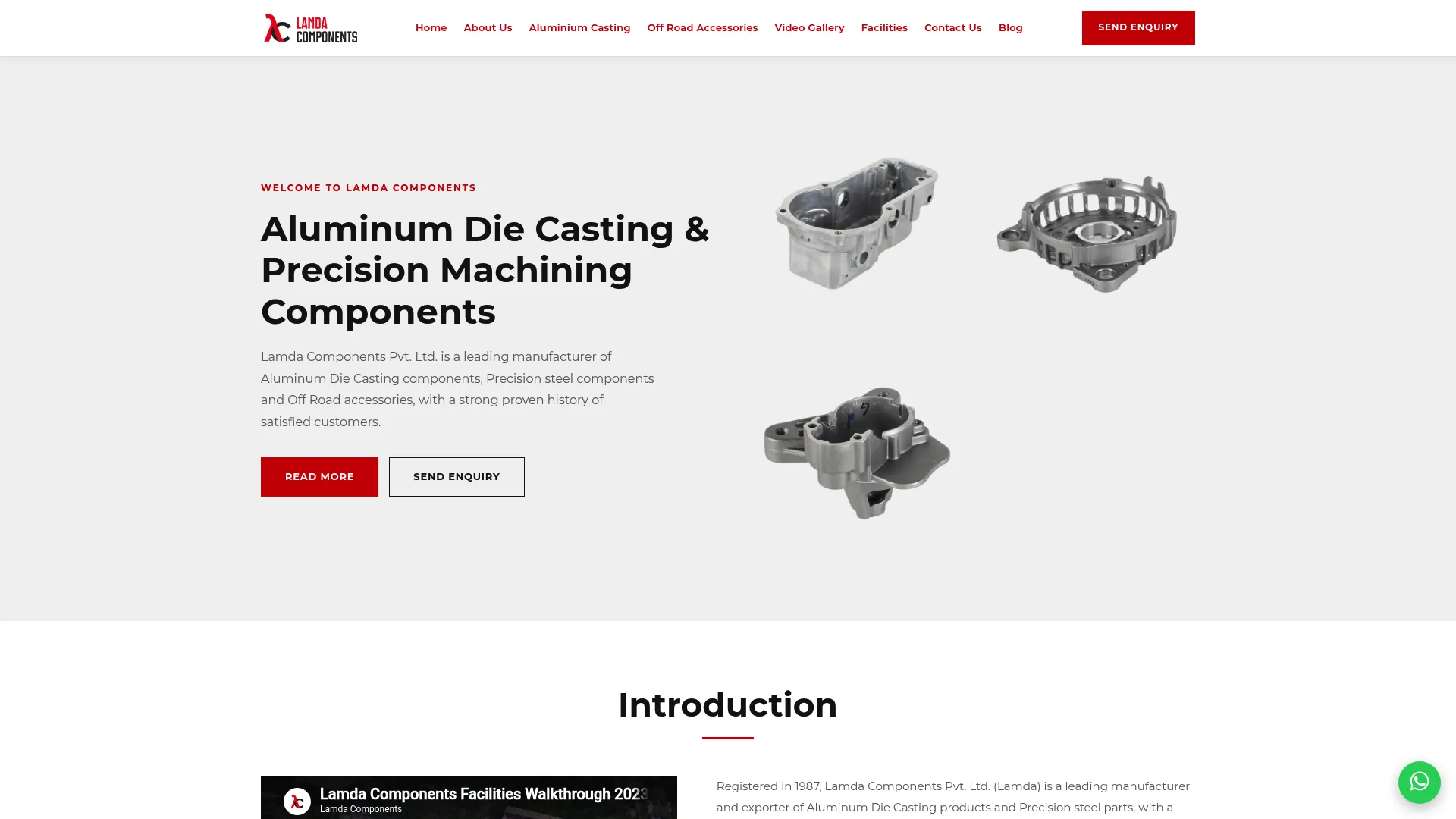
On the casting side, Lamda operates aluminum pressure die casting with automated machines in the 250–420 ton range, plus a gravity die casting facility and in-house die making. On the machining side, CNC-based vertical machining centers (VMC) and horizontal machining centers (HMC) handle difference between VMC and HMC machining precision machining of aluminum die cast housings and precision steel parts. This dual strength - casting plus machining - is Lamda's core differentiation for cast-and-machined finished parts.
| Process | Primary purpose | Point in workflow | Output |
| Die casting | Form base geometry | Early | Near-net cast component |
| Precision machining | Tighten geometry and features | Mid-late | Accurate finished dimensions |
| Finishing | Improve surface and readiness | Late | Part prepared for assembly |
| Inspection | Verify compliance | Throughout and final | Approved finished part |
When pressure versus gravity die casting is used
Lamda operates both pressure and gravity die casting facilities, giving engineering teams more than one route to a cast component. In general, pressure die casting is suited to higher-volume production and complex geometries, while gravity die casting can be used where pressure versus gravity die casting comparison part geometry, performance needs, or production requirements call for a different casting route.
Why secondary processes matter after machining
Secondary processes bridge the gap between a machined part and a component that is genuinely ready for inspection, coating, or assembly. Lamda lists these as part of its complete die casting solution, and each serves a specific purpose rather than being a generic add-on.
What shot blasting and vibro deburring do
Shot blasting surface preparation removes casting scale and residues and conditions the surface for downstream steps such as coating or inspection. Vibro deburring removes burrs and smooths edges left by machining, improving assembly fit and surface condition. Together, these steps prepare a part so that later inspection and assembly are not compromised by loose material or sharp edges.
When resin impregnation and leak testing matter
Cast components can contain micro-porosity in aluminum castings that affects sealing performance in fluid-carrying or pressure-tight applications. Resin impregnation porosity sealing process seals that porosity, and leak testing then validates the sealing integrity of the finished part before it enters service. Lamda performs resin impregnation in-house and operates multiple leak testing machines, which matters when porosity-related sealing is a functional requirement of the component.
How quality and inspection are built into the process
Quality at Lamda is anchored by in-house inspection and testing equipment that translates directly into buyer outcomes: dimensional accuracy, verified material composition, and validated integrity. Inspection is not only a final gate - checks are positioned across the workflow so problems are caught before a part moves to the next stage.
Lamda's documented inspection and testing equipment includes:
- CMM (Carl Zeiss) - high-accuracy coordinate measuring machine accuracy dimensional verification of machined and cast features.
- Spectrometer (BAIRD) - spectrometer alloy composition analysis for material composition.
- Roughness tester (Carl Zeiss) - surface finish measurement.
- Hardness testers - material hardness checks.
- Leak testing machines - leak integrity verification for sealed parts.
- Load testing equipment - mechanical or functional load checks.
On the standards side, Lamda is certified to IATF 16949:2016 automotive quality standard and ISO 14001:2015 environmental management standard and states compliance with BIS standards for manufacturing, aligning its quality framework to automotive and industrial manufacturing expectations.
Where quality checks happen in the workflow
Rather than a single end-of-line check, quality controls map across stages. Material composition can be confirmed early via spectrometer analysis, dimensional accuracy is verified through machining and after with CMM, surface finish is measured with a roughness tester, and sealing integrity is confirmed through leak testing after impregnation. This distribution of checkpoints supports repeatability across production runs.
What this means for OEM and industrial buyers
For buyers, the practical question is often "is Lamda a die casting company or a machine shop?" The answer is both - an integrated manufacturer that handles casting and machining, plus finishing and inspection, within a single supply relationship. That integration is what reduces vendor handoffs and simplifies supplier management for cast-and-machined finished parts.
Connecting capability to buyer value, Lamda's model offers:
- Fewer vendor handoffs between casting and machining suppliers.
- Tighter dimensional control through in-house CMM verification.
- Validated integrity via resin impregnation and leak testing for sealed parts.
- Simplified vendor coordination under one quality framework.
Lamda's own content links its castings to sectors including automotive, off-road, EV motors, industrial and hydraulic equipment, textile machinery, electrical and household appliances, LED lighting, and fuel injection and alternator/starter motor applications.
How Lamda supports prototype-to-production needs
Lamda supports OEM and industrial buyers through an RFQ-driven process. Customers submit 2D and 3D drawings along with annual quantity, MOQ, and complete quality requirements for quotation and manufacturability review. This engineering-led engagement allows a part to move from drawing submission and manufacturability review toward repeat production within the same integrated facility.
What buyers should ask when evaluating an end-to-end manufacturing partner
When shortlisting an integrated supplier, procurement and SQE teams typically confirm:
- Scope - does the supplier handle both casting and machining in-house?
- Inspection - what dimensional and material validation is available on-site?
- Integrity - are impregnation and leak testing offered for sealed parts?
- Tooling - is die making handled internally?
- Turnaround and export readiness for domestic and international supply.
Why Lamda's end-to-end model matters in 2026
In 2026, many buyers continue to prioritize vendor consolidation in manufacturing sourcing, inspection visibility, and faster new-product introduction. Sourcing a cast-and-machined part from a single integrated manufacturer reduces the coordination overhead of aligning separate casting, machining, finishing, and inspection vendors - and gives quality teams one accountable partner for the finished part.
Lamda's positioning speaks directly to those priorities:
- End-to-end coverage from die making through dispatch under one roof.
- A clear casting-to-finished-part narrative backed by in-house finishing, integrity checks, and inspection.
- A since-1987 manufacturing heritage as a trust signal for supplier evaluation.
- Manufacturer and exporter status for domestic and international supply.
As a manufacturer and exporter, Lamda supplies aluminum die cast and precision machined components to domestic and international OEM and industrial customers.
Ready to evaluate Lamda for a cast-and-machined finished part? Submit your 2D and 3D drawings, annual quantity, and quality requirements for a manufacturability review and quote. Contact us -> https://lamdacomponents.com/contact
Frequently asked questions
What is Lamda precision machining?
Lamda precision machining is the in-house CNC-based machining capability of Lamda Components Pvt. Ltd., used to convert aluminum die cast and precision steel parts into production-ready finished components. It operates as one stage within Lamda's integrated die making, die casting, machining, finishing, and inspection workflow.
Does Lamda handle both casting and machining?
Yes. Lamda combines die making, pressure and gravity die casting, and precision machining under one roof, supported by finishing and in-house inspection. This integrated model lets a part move from casting to a finished component within a single facility, reducing vendor handoffs.
What happens after casting at Lamda?
After casting, parts move through precision machining on VMC and HMC centers, surface finishing such as shot blasting and vibro deburring, integrity processes including resin impregnation and leak testing where required, dimensional and material inspection, and finally packing and dispatch.
What quality checks support Lamda precision machining?
Lamda uses in-house inspection and testing equipment including a Zeiss CMM for dimensional accuracy, a spectrometer for material composition, roughness and hardness testers, and leak testing machines for sealing integrity. The company is certified to IATF 16949:2016 and ISO 14001:2015.
Is Lamda a die casting company or a machine shop?
Both. Lamda is an integrated manufacturer that provides die making, die casting, and precision machining, plus finishing and inspection. This lets buyers source cast-and-machined finished parts from one accountable partner rather than coordinating separate suppliers.
How can I contact Lamda for precision machining?
Submit your requirements through Lamda's contact page for RFQs, drawing submission, or supplier evaluation. Include 2D and 3D drawings, annual quantity, MOQ, and quality requirements. Contact us -> https://lamdacomponents.com/contact.