
Leak-critical aluminium castings fail programs when hidden porosity, machining-exposed voids, or sealing-face defects let air, gas, or fluid escape. Lamda Components Pvt. Ltd., a Bangalore-based manufacturer and exporter established in 1987, supports these requirements through an integrated workflow that combines die making, aluminium die casting, precision machining, in-house leak testing, and resin impregnation.
A leak-tight aluminium casting is a component that retains air, gas, or fluid without unacceptable pressure loss or seepage under its specified operating conditions. For leak-critical applications, manufacturers combine process control, precision machining, inspection, and leak testing to verify performance before dispatch.
Key takeaways
- Leak-tight aluminium castings must retain air, gas, or fluid within application-defined acceptance limits set by medium, pressure, and specification.
- Leaks commonly trace to porosity, surface-connected voids, machining-exposed internal defects, sealing-face issues, or wider process variation.
- Lamda Components runs an integrated workflow: die making, aluminium die casting, precision machining, leak testing, resin impregnation, and finishing.
- Porosity sealing through resin impregnation is used only where suitable for porosity-related leakage and can be followed by retesting.
- Bangalore-based Lamda Components, established in 1987, is a manufacturer and exporter serving OEM and industrial buyers.
- The buyer benefit is single-source accountability for leak-critical components under one roof.
Lamda Components: aluminium castings for OEM and industrial applications
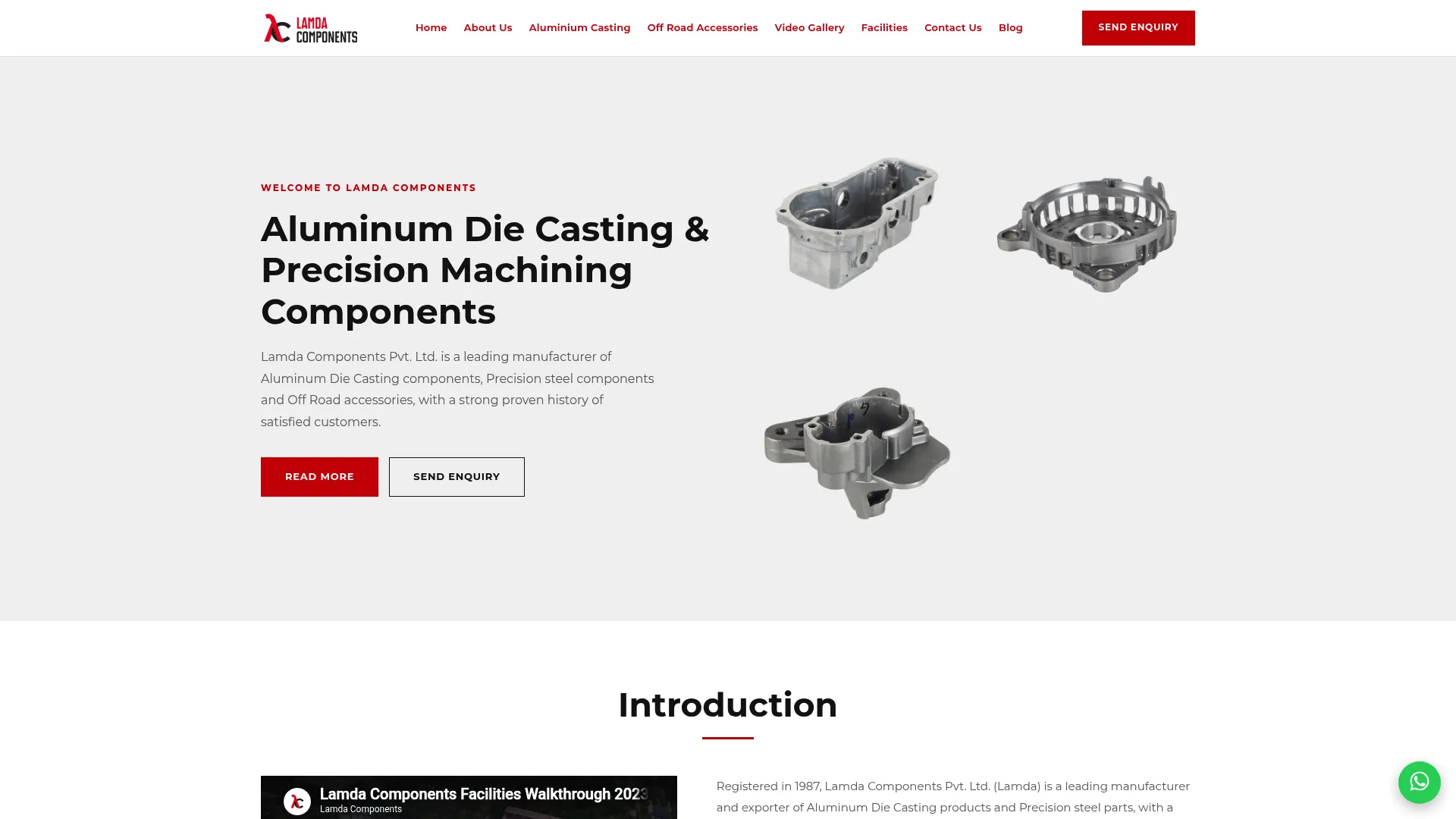
Lamda Components Pvt. Ltd. is a Bangalore-based manufacturer and exporter, established in 1987, producing aluminium die castings, precision machined parts, and precision steel components for OEM and industrial customers in domestic and export markets. The company runs an end-to-end die-casting operation, from tool design through finishing and sub-assembly, on automated machines ranging from 250 to 800 tons, using the high-pressure die casting process with auto ladle, auto spray, and auto extractor.
For leak-critical parts, that end-to-end scope matters: defect prevention starts in tooling and continues through machining, testing, and sealing rather than being left to a final check.
Capability snapshot:
- Tool design and die making
- Aluminium pressure die casting (250–800 ton machines)
- Precision machining
- In-house leak testing
- Resin impregnation / porosity sealing
- Shot blasting, vibro deburring, anodizing, powder coating and sub-assemblies
Explore more on the About Us, Products, and Facilities pages.
What makes an aluminium casting leak-tight?
A leak-tight aluminium casting is a component that retains air, gas, or fluid without unacceptable pressure loss or seepage under its specified operating conditions. For leak-critical applications, manufacturers combine process control, inspection, and leak testing to verify performance before dispatch.
"Leak-tight" is always application-defined. The acceptance criteria depend on the medium being contained, the operating pressure, and the tolerance for pressure drop written into the part specification. A housing that is leak-tight for one application may not meet the criteria for another operating at higher pressure or with a different fluid.
Leak-tight vs pressure-tight - what's the difference? Pressure-tight typically describes whether a part can withstand a target pressure without structural failure, while leak-tight focuses on whether it prevents escape paths within acceptance limits. Related, but not identical - acceptance depends on medium, operating conditions, and specification.
Which components need leak-tight castings?
Leak-tight performance matters wherever a cast part must retain fluid or air. Lamda's published casting applications include fuel injection pumps, alternators and starter motors, electric vehicle motors, hydraulic equipment, pneumatic products, textile machinery, off-road products, the wider automotive sector, and appliances. Housings in many of these applications are leak-critical because they contain fluid, gas, or lubricant under pressure. See the Starter and Alternator Housings Casting page for an example.
Why aluminium castings develop leak paths
Leaks in aluminium castings are commonly linked to porosity, surface-connected voids, machining-exposed internal defects, dimensional issues at sealing faces, or process variation during casting. Identifying the root cause matters because some parts can be sealed and retested, while others must be rejected.
Common leak sources:
- Gas or shrinkage porosity formed during solidification
- Surface-connected voids that open a path to the outside
- Machining-exposed internal voids revealed after material removal
- Sealing-face dimensional issues that prevent a proper seal
- Process variation during casting that shifts fill or cooling behaviour
Why porosity occurs in aluminium die castings: During high-pressure die casting, trapped gas and metal shrinkage during solidification can leave micro-pores inside the part, a phenomenon known as gas and shrinkage porosity in castings. Some porosity is harmless; interconnected pores that reach both surfaces can create leak paths.
Why machining can reveal leaks in cast parts
Machining can expose internal porosity or subsurface voids that were not open at the as-cast stage. Once these hidden paths are opened, a component may fail a leak test even if the casting initially looked acceptable - which is why post-machining inspection is essential for leak-critical parts.
Because Lamda runs casting and precision machining under one roof, defects that only surface after material removal can be checked in-house rather than only being discovered at a customer's line.
How Lamda Components tests castings for leaks
Aluminium castings are checked using pressure decay leak testing methods that verify whether a part can hold the required pressure without visible leakage or measurable pressure drop. Testing may take place after casting, after machining, or at both stages depending on part design and application.
Lamda's published facilities list eight leak testing machines alongside a CMM for coordinate measuring machine (CMM) inspection, supporting an in-house workflow for leak-critical aluminium castings. This lets the company check parts within its own process before final release rather than depending on external testing. Acceptance criteria for leak-critical parts are typically part-specific and driven by the customer's drawing and quality requirements.
Is leak testing done before or after machining? For leak-critical parts, testing timing depends on part design - machining can open new leak paths, so post-machining checks are important where internal porosity may be exposed during material removal.
| Casting issue | How it appears | How Lamda checks it | Typical next step |
| Surface leak path | External leakage during test | Pressure / leak test | Rework or reject |
| Internal porosity | Pressure loss or seepage | Leak test + inspection | Seal if applicable / reject |
| Machining-exposed void | Leak after machining | Post-machining check | Seal or reject by criticality |
| Sealing-face dimensional issue | Fitment / sealing problem | Dimensional inspection (CMM) | Rework or reject |
Pressure testing vs leak testing
Pressure testing checks whether a part can withstand a target pressure condition, while leak testing focuses on detecting pressure loss or escape paths that prevent a part from remaining leak-tight. In practice, manufacturers may use these terms together depending on the method and acceptance criteria applied to a given part.
When porosity sealing (resin impregnation) is used
Porosity sealing - commonly done by resin impregnation - closes interconnected pores in cast components so a part can meet leak-tight requirements. It is considered for suitable porosity-related leakage and can then be leak-verified against specification.
Resin impregnation is part of Lamda's in-house process offering, listed alongside leak testing and precision machining. The important principle is that sealing is not universal: it addresses porosity-related leakage, but structural defects and major dimensional nonconformances are not candidates for impregnation. Where sealing is applied, further leak verification may be used before the part moves toward final inspection.
| Condition | Suitable for sealing? | Typical disposition |
| Minor porosity affecting pressure retention | If process-approved | Seal and retest |
| Structural defect | No | Reject |
| Major dimensional nonconformance | No | Rework or reject |
| Leak in critical safety feature | Application / spec-driven | Customer / spec decision |
How Lamda verifies parts after sealing or rework
After sealing or rework, leak-critical castings are typically retested to confirm they hold pressure within specification. Lamda's in-house leak testing capability supports this type of in-process verification for suitable parts before final release.
In a typical leak-critical workflow, parts that pass retesting continue through finishing and final QC. Parts that remain outside acceptance are dispositioned according to the defect type - where porosity remains outside acceptance, or where a structural or dimensional issue is confirmed, the casting is rejected rather than released.
What happens if a part fails the pressure test? The part is inspected to identify the cause, sealed or reworked where suitable, then retested where required. If the defect is not correctable within acceptance criteria, the part is rejected instead of released.
Quality control checks before dispatch
Quality assurance for leak-critical castings runs across the whole production sequence, not just at the end. Lamda combines process control at casting, visual and dimensional inspection, CMM measurement, and leak testing so issues are caught at the stage where they arise. For OEM and export buyers, this stage-by-stage discipline connects directly to lower supplier risk and fewer line rejections.
| Production stage | Main risk | Check performed | Output |
| Die casting | Porosity / incomplete fill | Process control + visual review | Part accepted for next stage |
| Trimming / prep | Surface defects | Visual inspection | Cleared for machining |
| Machining | Exposed porosity / tolerance drift | Dimensional inspection (CMM) | Approved for leak test |
| Leak test | Pressure loss | Leak / pressure test | Pass / rework / seal / reject |
| Final inspection | Cosmetic / dimensional | Final QC | Dispatch approval |
Why buyers choose Lamda for leak-critical cast components
Lamda Components is a strong choice for buyers who need aluminium castings supported by integrated tooling, machining, inspection, and leak-critical quality control. Rather than coordinating separate vendors for casting, machining, and testing, buyers work with a single accountable supplier.
- End-to-end manufacturing - die making, casting, machining, leak testing, resin impregnation, and sub-assembly under one roof for single-source accountability.
- Established 1987 - decades of process discipline applied to leak-critical parts.
- Die-making capability - defect prevention begins in tooling, not only at final inspection.
- Integrated casting plus machining - post-machining leak risk is checked in-house.
- In-house leak testing and impregnation - eight leak testing machines and resin impregnation support the leak-critical workflow.
- OEM and export orientation - experience serving domestic and international buyers.
Buyer checklist - what to ask a casting supplier about leak testing: Is leak testing in-house? At what stage is it performed? What are the pass/fail criteria? Is porosity sealing available and retested? How are failing parts dispositioned? Is inspection data retained?
Contact Lamda Components
Send your drawings and requirements to get a response on your leak-critical aluminium casting program. Lamda asks buyers to share 2D and 3D drawings, annual quantity, minimum order quantity, and complete quality requirements so the team can review feasibility and quoting.
Contact us: https://lamdacomponents.com/contact
Plot No. 30, Veerasandra Industrial Area, Bangalore – 560 100, Karnataka, India · +91 7619311331 · sales@lamdacomponents.com
FAQs about leak testing and sealed aluminium castings
What is a leak-tight aluminium casting?
A leak-tight aluminium casting retains air, gas, or fluid without unacceptable pressure loss or seepage under its specified operating conditions. Leak-tight performance is application-defined - the acceptance criteria depend on the medium, operating pressure, and the tolerances written into the part specification.
How are aluminium castings tested for leaks?
Aluminium castings are checked using pressure or leak-testing methods that confirm a part holds the required pressure without visible leakage or measurable pressure drop. Depending on part design and application, testing may take place after casting, after machining, or at both stages.
Can all leaking castings be sealed?
No. Sealing is generally used for appropriate porosity-related leakage conditions, but not every defect is suitable for repair. Structural issues, major dimensional nonconformance, or critical application requirements may require rejection instead of sealing.
Is leak testing done before or after machining?
It depends on the part. Because machining can open internal porosity to the surface, leak testing for leak-critical parts is important after machining, and testing may be applied post-casting, post-machining, or at both stages based on part design and application.
What happens if a part fails the pressure test?
The part is inspected to identify the cause, then sealed or reworked where the defect is suitable, and leak verification may be repeated to confirm it holds pressure within specification. If the defect cannot be corrected within acceptance criteria, the part is rejected rather than released.
What is resin impregnation?
Resin impregnation is a porosity sealing method that fills interconnected pores in a casting so suitable parts can meet leak-tight requirements. At Lamda it is an in-house process option for porosity-related leakage and may be followed by leak verification before the part moves toward final inspection.
Which industries does Lamda supply leak-critical castings to?
Lamda's published aluminium casting applications include fuel injection pumps, alternators and starter motors, electric vehicle motors, textile machinery, hydraulic equipment, off-road products, the wider automotive sector, pneumatic products, appliances, and related industrial applications.