
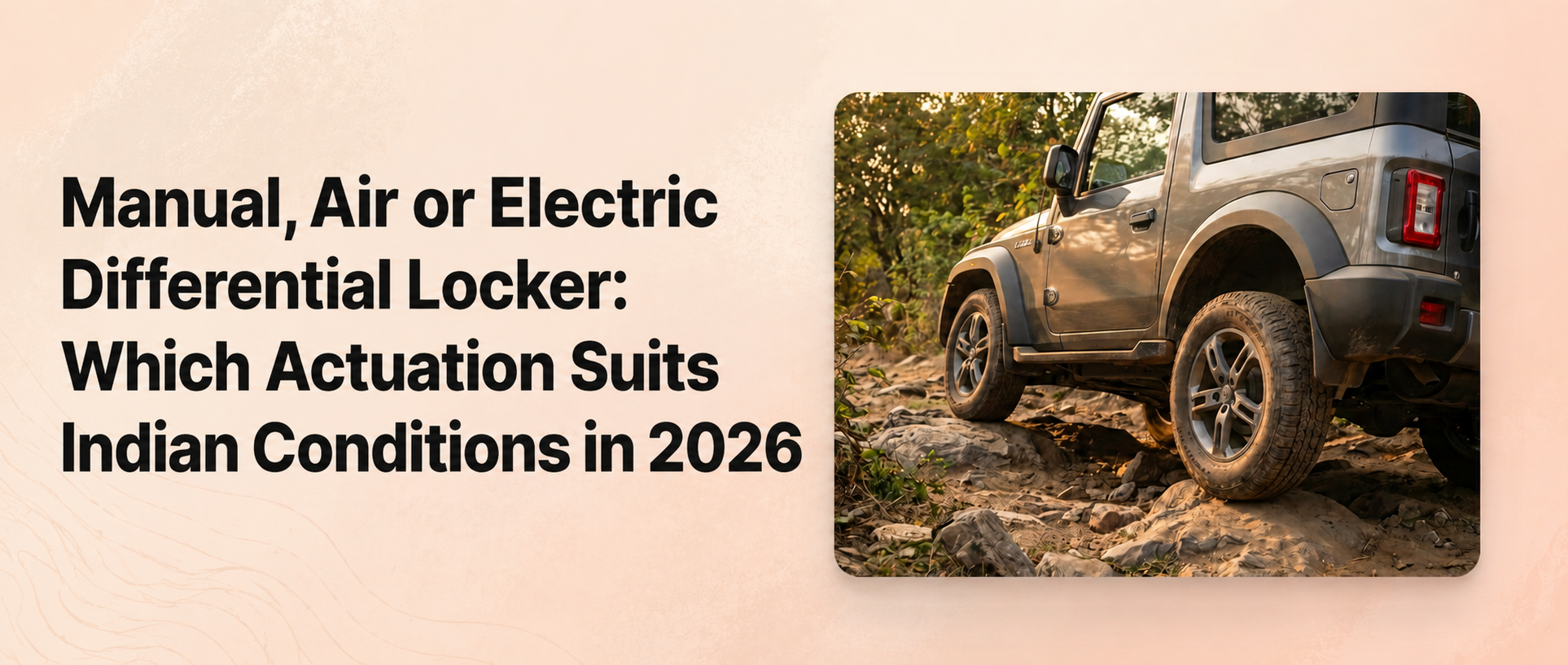
Choosing a differential locker is only half the decision. The bigger question for serious Indian 4x4 owners is how the locker actually engages, because the actuation method changes what gets installed, protected, and serviced across mud, water, dust, and heat. This guide compares manual, air, and electric actuation for real Indian use, with fitment realism from Lamda Components.
For Indian conditions in 2026, choose a manual locker for mechanical simplicity and remote-travel practicality, an air locker for fast in-cabin engagement on serious trails if you can manage a full pneumatic system, or an electric locker for button convenience without a compressor where a compatible option exists for your axle. Terrain, axle, installation quality, and distance from service support often matter as much as the actuation method.
Key takeaways
- Manual lockers generally suit buyers who prioritise mechanical simplicity, remote-travel practicality, and a lower-complexity first locker.
- Air lockers generally suit serious off-roaders who want fast cabin engagement and are prepared to manage a full pneumatic system.
- Electric lockers generally suit convenience-focused owners who want button engagement without a full compressor-and-air-line setup, where a compatible option is available.
- In Indian conditions, mud, water, dust, heat, and distance from service support can matter as much as the actuation type itself.
- Installation quality, sealing, routing, and workshop skill often affect real-world reliability as much as brochure-level differences.
- Rear-first fitment is common, but the correct choice depends on axle, platform, terrain, and long-term build plan. Contact Lamda to verify fitment before you decide.
Quick answer - which locker actuation suits which Indian buyer?
The right actuation depends less on brand comparison and more on where and how you drive after the trail. For most Indian buyers, the choice comes down to how much system complexity you are willing to install and maintain against how much cabin convenience you want.
Choose manual if you value mechanical simplicity, do a lot of remote or expedition travel, or want a lower-complexity first locker.
Choose air if you want fast in-cabin engagement for serious trail and rock use and are comfortable managing a compressor, air lines, and solenoids.
Choose electric if you want button convenience with simpler packaging than a full pneumatic system, and a compatible option is available for your axle.
The final call still depends on your vehicle, axle, and terrain mix.
What a differential locker actually does
A differential locker forces both wheels on an axle to rotate at the same speed, so drive is delivered even when one wheel loses grip. An open differential sends power to the wheel with least resistance, which is why one wheel spins helplessly in deep mud, loose sand, ruts, or on articulated terrain while the other sits dead, as how an open differential works explains.
- A locker is not the same as 4WD, a limited-slip differential, or electronic traction control; it mechanically ties both wheels together for maximum traction.
- Lockers are meant for low-grip surfaces only, such as mud, sand, loose rock, and dune driving.
- They should be disengaged for normal road driving to avoid tyre scrub and driveline binding.
The mechanism that engages the locker, manual lever, air switch, or electric button, is what this guide compares.
Locker vs traction control on modern 4x4s
Newer Indian 4x4s ship with more electronic aids, and traction control can brake a spinning wheel to send drive across an axle, as this limited-slip differential comparison shows. But it depends on braking intervention and can be less consistent under sustained load in deep mud or on long technical obstacles. A true locker delivers positive, mechanical drive to both wheels, which is why serious builds still add one even on electronically equipped platforms.
Manual vs air vs electric differential lockers - at-a-glance comparison
Each actuation type solves the same traction problem differently, and the tradeoffs show up most in India's mixed terrain and remote-service realities. The table below gives qualitative guidance to help you shortlist before you verify fitment. Air lockers engage very quickly but carry the most components; electric lockers simplify packaging; manual lockers keep the system mechanically lean.
| Factor | Manual | Air | Electric |
| Engagement method | Driver-actuated lever or cable | Pneumatic, in-cabin switch | Electronic, in-cabin button |
| Extra components needed | Minimal | Compressor, solenoid, air lines, fittings, wiring | Wiring, switch, connectors |
| Cabin convenience | Lower | High | High |
| Engagement speed | Depends on driver action | Fastest | Fast, sometimes slightly slower than air |
| Water / mud sensitivity | Mechanical linkage and seals | Fittings, lines, solenoid exposure | Connectors and switchgear |
| Dust sensitivity | Low | Moderate at fittings | Moderate at connectors |
| Heat tolerance | High | Watch compressor and line routing | Watch harness and connectors |
| Wiring / air-line routing complexity | Lowest | Highest | Moderate |
| Field serviceability | Highest | More points to check | Connector-dependent |
| Spare parts dependency | Lowest | Highest | Moderate |
| Maintenance load | Lowest | Highest | Moderate |
| Best for weekend trails | Good | Good | Good |
| Best for expedition / remote travel | Strong | Manageable with upkeep | Manageable |
| Best for rock crawling | Good | Strong | Good |
| Best for buyers far from service centres | Strong | Needs planning | Moderate |
How Indian conditions change the decision
India's operating environment is the real differentiator here. Monsoon mud, water crossings, dust, under-bonnet heat, and distance from specialist workshops all shape how vulnerable your actuation hardware is and how easily a problem can be fixed on the road.
Monsoon mud and water wading
Water and mud attack the exposed parts of any actuation system. Air lines, fittings, and solenoids can be vulnerable if poorly routed, while electric connectors need proper sealing against ingress. Manual systems have fewer external actuation components but still rely on well-maintained linkages and seals. Routing and sealing quality often decide whether a locker survives a deep crossing, so review water wading precautions for 4x4s before attempting one.
Dust resistance
Fine dust works into switches, connectors, and seals over time. Electric connectors and air fittings both benefit from protected routing and quality seals, and connector ingress protection ratings matter more than the actuation label, while manual mechanisms have fewer electrical contact points to contaminate. In dusty, high-use conditions, sealing quality and connector protection matter more than the actuation label.
Heat tolerance
Underbody and engine-bay heat can stress compressor components, air lines, and wiring harnesses, so wiring harness heat protection and routing should avoid direct heat exposure, and connectors should be rated for the environment. Manual mechanical systems are generally the least affected by heat, which supports their appeal for hard, sustained use.
Remote service access
If you travel far from major cities, serviceability becomes decisive. Manual systems are easiest to inspect and repair with basic tools. Air systems have more leak points and components to diagnose, and electric systems depend on connector and wiring integrity. Match your choice to how far you typically drive from a workshop that can help.
Manual differential locker - strengths, tradeoffs, best use cases
A manual differential locker makes sense when you value mechanical simplicity, predictable engagement, and low dependence on wiring or air hardware. It suits expedition and remote travel, buyers far from service centres, and first-time locker owners who want a lower-complexity, easier-to-service system that is straightforward to inspect and repair with basic tools on the trail.
Strengths include mechanical simplicity, predictable engagement, and reduced electrical and pneumatic dependence, which means fewer failure points to chase in the field.
The main tradeoff is cabin convenience. You engage the locker through a lever or cable rather than a dash switch, which some drivers prefer and others find less convenient in fast-changing terrain.
Best for: expedition travel, remote routes, and budget-conscious first locker buyers. A manual setup also appeals as a straightforward first locker for buyers building in stages.
Air differential locker - strengths, tradeoffs, and the full system required
Air lockers can suit harsh Indian conditions, but reliability in mud and water depends more on installation than on the actuation type. Correct routing, sealing, quality fittings, and disciplined maintenance keep the system dependable. A well-installed air locker performs strongly on serious trails; a poorly routed one adds leak points and troubleshooting complexity exactly where you least want it.
The core strength is fast, controlled engagement from a cabin switch, which is why air lockers are popular for serious trail and rock use.
What an air locker system typically needs: an onboard air compressor systems, solenoid valves, air lines and fittings, wiring and a relay, and a dash switch, plus proper mounting and routing. A Lamda pneumatic conversion kit exists for compatible lockers; confirm with Lamda which components are included in your kit and which need to be sourced separately.
The tradeoff is complexity. More components mean more potential leak points and more to diagnose. Best for serious off-roaders, rock crawling, and buyers comfortable with system upkeep. Contact Lamda to confirm air-kit contents for your platform.
Electric differential locker - strengths, tradeoffs, wiring considerations
An electric locker can be easier to maintain than an air locker because it removes the compressor and air lines, cutting several potential leak points. The tradeoff is continued dependence on wiring quality, connectors, switching, and moisture protection. For Indian conditions, sealed connectors and well-protected harness routing are the deciding reliability factors, not the button interface itself.
Strengths include no compressor or air lines, simpler packaging, and button convenience from the cabin.
The tradeoff is electrical dependence. Wiring quality, connector integrity, and switching all matter, and moisture protection becomes critical near water crossings. Before deep wading, check that connectors and switchgear are properly sealed and routed away from ingress paths.
Best for: convenience-focused owners of daily-driven weekend 4x4s who want simpler packaging than a full pneumatic system, where a compatible electric option is available.
Front locker or rear locker first?
For most Indian 4x4 builds, a rear locker is the usual first fitment. The rear axle typically carries more weight, sees more consistent ground pressure, and often runs stronger drivetrain components, so a rear locker usually delivers the biggest traction gain per rupee. A front locker is generally added later for precise, technical rock crawling.
Decision factors include vehicle weight balance, terrain, axle strength, and whether your use leans towards touring or crawling.
Some very technical rock setups may justify a front locker earlier for precise, technical rock crawling technique fundamentals, but this is use-case specific.
You can plan both at once or stage the fitment over time. Either way, the choice still depends on your axle and platform, which brings us to compatibility.
Vehicle and axle compatibility
Axle verification comes before any actuation preference or pricing discussion. The same platform can run different axles across variants, so confirming your exact axle is the single most important step before you buy.
Lamda highlights differential locker fitments including:
- Maruti Gypsy (front and rear)
- Mahindra Thar
- Maruti Suzuki Jimny
- Dana 44 axle specifications
If you run another platform, such as Bolero, Scorpio, MM540/MM550, a Mahindra Jeep, or Tata Xenon, axle verification and direct confirmation from Lamda are essential before assuming compatibility.
Locker for Mahindra Thar
Lamda offers a dedicated differential locker fitment for the Mahindra Thar. Because Thar variants can differ, review the Mahindra Thar specifications and share your vehicle and axle details so Lamda can confirm the correct fitment and quote for your build rather than assuming a single part fits every Thar.
Locker for Force Gurkha
If you own a Force Gurkha, confirm current fitment directly with Lamda before assuming compatibility. Ask whether a compatible locker is available for your axle, and provide your vehicle details so the team can verify the correct application.
Verify your axle before requesting a quote. Contact Lamda with your vehicle details to confirm fitment.
Installation realities - why fitment matters more than brochure specs
Installation quality can matter as much as the product itself. In real-world air and wiring systems, reliability often reflects routing, sealing, and workmanship as much as core component design. For lockers using air lines or electrical harnesses, correct routing, sealing, and workshop skill are as important as the locker mechanism.
Key installation points to get right:
- Carrier assembly fitment and correct setup
- Wiring and air-line routing away from heat and abrasion
- Switch placement for easy in-cabin use
- Compressor mounting in a protected location
- Sealing and ingress protection for water crossings
- Workshop skill and off-road fitment experience
Lamda's positioning emphasises precision machining and in-house engineering, but competent installation is what protects wiring, air lines, and switches from India's mud, water, dust, and heat. Lamda's differential locker materials reference certified technicians across major Indian cities, and Swastik Fabs in Bengaluru is listed as a dealer for off-road accessories.
Maintenance and serviceability
After mud- and water-heavy runs, a quick post-trip inspection protects long-term reliability regardless of actuation type. What you check varies by system.
- Air: inspect air lines and fittings for leaks, check the solenoid, and confirm connections are secure and sealed.
- Electric: inspect connectors and wiring for moisture, corrosion, or abrasion, and confirm switchgear is dry.
- Manual: check the mechanical linkage and seals, which are the simplest to inspect and repair.
Manual systems are generally easiest to service in the field, while air and electric systems reward disciplined connector and line checks. Lamda's differential locker materials advertise a 5-year warranty with lifetime technical support; confirm which coverage applies to your specific purchase route, since some dealer-packaged kits list shorter warranty terms.
What to verify before requesting a quote
Working through this checklist before you enquire makes fitment and pricing faster and avoids ownership regret.
- Confirm your axle type and code.
- Decide front, rear, or both.
- Match actuation type to your use case and terrain.
- Confirm complete kit contents, locker core versus full system.
- Plan your installation workshop or partner support.
Sharing your vehicle details and axle information up front lets Lamda confirm compatibility and quote accurately.
Get fitment help and a quote from Lamda Components
Lamda Components Pvt. Ltd. is a Bangalore-based manufacturer and exporter established in 1987, with in-house design and precision machining behind its off-road products including differential lockers. That end-to-end manufacturing control, combined with a practical view of mud, water, dust, heat, and remote service realities, is what separates a confident purchase from an uncertain one.
The next step is simple: verify your axle, decide front or rear, match actuation to your terrain, and talk to an expert about pricing and fitment. Contact us - https://lamdacomponents.com/contact
FAQs
Which differential locker actuation suits Indian conditions best? It depends on your use. Manual suits simplicity and remote travel, air suits serious trail use with fast engagement, and electric suits button convenience with simpler packaging than a full air system where a compatible option exists. Terrain, axle, and service access shape the final choice.
Are air lockers reliable in mud and water? They can be, but reliability depends more on installation than actuation type. Correct routing, sealing, quality fittings, and regular maintenance keep an air locker dependable. A poorly routed system adds leak points exactly where deep crossings punish weak installation.
Is an electric locker easier to maintain than an air locker? Often yes, because it removes the compressor and air lines and their leak points. The tradeoff is continued dependence on wiring quality, connectors, switching, and moisture protection, which become the deciding reliability factors in Indian conditions.
When does a manual differential locker make sense? It makes sense when you value mechanical simplicity, predictable engagement, and low dependence on wiring or air hardware. It suits expedition and remote travel, buyers far from service centres, and first-time locker owners who want an easier-to-service system.
What extra parts does an air locker need? A complete air locker system typically needs an onboard compressor, solenoid valves, air lines and fittings, wiring with a relay, and a dash switch, plus mounting and routing. Confirm with Lamda which components are included in your kit.
Front locker or rear locker first? For most builds, a rear locker comes first because the rear axle carries more weight, sees consistent ground pressure, and often runs stronger components, giving the biggest traction gain. A front locker is usually added later for technical rock crawling.
If my compressor fails, is the air locker still usable? An air locker relies on pneumatic pressure to engage, so a failed compressor prevents normal engagement. This is why remote travellers weigh system complexity carefully and why manual systems appeal to those far from service support.
Which locker is best for a daily-driven weekend off-road 4x4? Convenience-focused daily drivers often prefer an electric locker for button engagement and simpler packaging where a compatible option is available. Buyers who want the fastest engagement for serious trail use may prefer air, provided they can maintain the full system.
Does a Lamda locker fit my vehicle and axle? Lamda highlights fitments for Gypsy, Thar, Jimny, and Dana 44 axles. For other platforms, axle verification and direct confirmation from Lamda are essential. Share your vehicle and axle details before assuming compatibility.
What does a Lamda differential locker cost in India? Lamda typically works on an enquiry basis, asking buyers to share vehicle details and drawings before providing a quote. Confirm current pricing and kit contents directly with Lamda for your specific vehicle and axle.