
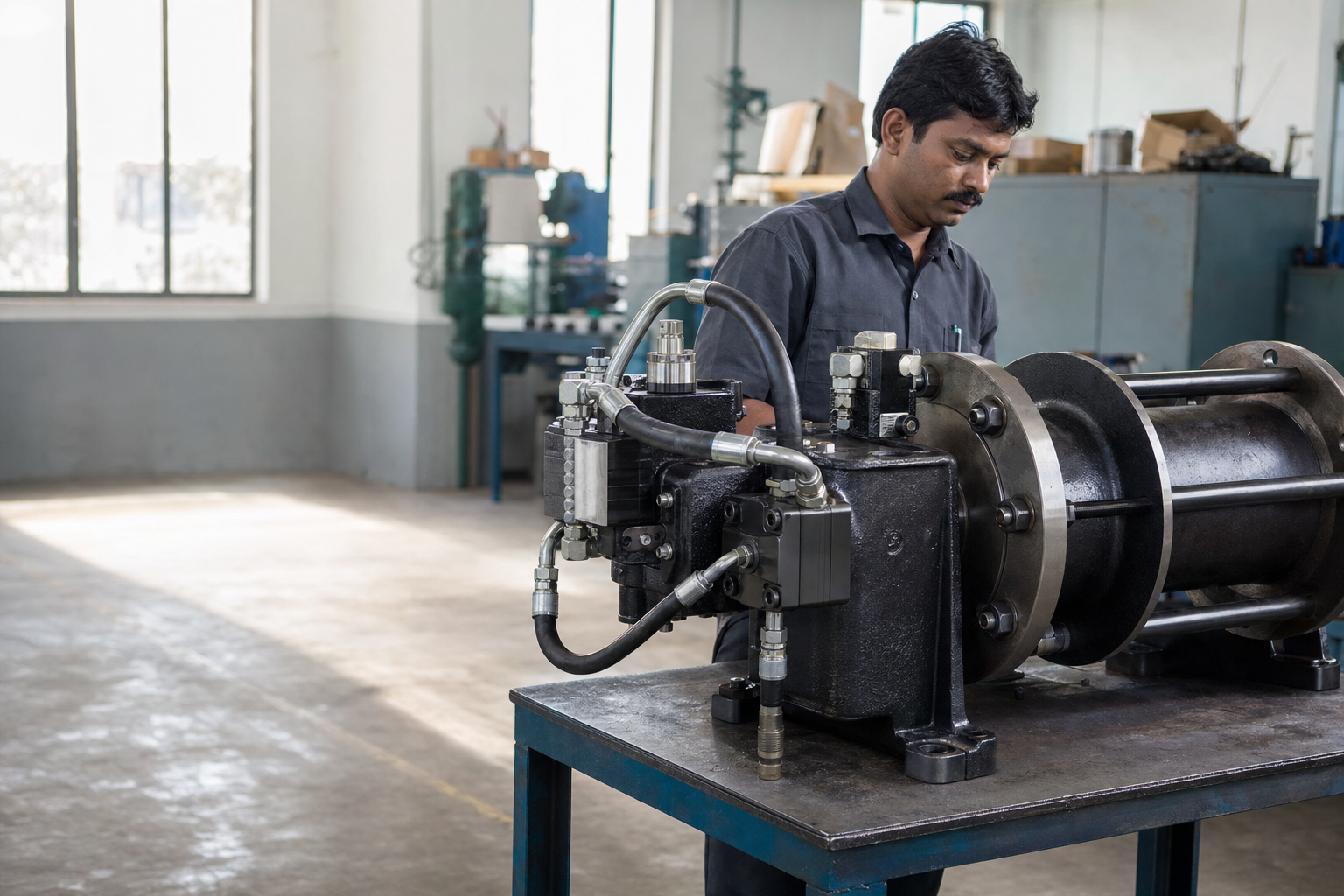
Buyers usually compare winches by headline pull, but the hydraulic winch motor and the components matched to it decide what a winch actually delivers. A hydraulic winch motor converts pressurized oil from a pump into rotation, a planetary gearbox multiplies that rotation into torque at the drum, and the drum turns that torque into line pull; pressure and motor displacement mainly set torque, while hydraulic flow mainly sets speed. This guide explains how Lamda's hydraulic winch converts hydraulic power into line pull and what OEM and engineering buyers should check before they specify one.
Key takeaways
Lamda Components Pvt. Ltd. is a Bangalore-based manufacturer and exporter registered in 1987. It designs and develops off-road accessories, including winches, in-house, alongside its aluminum die casting and precision machining work. The points below summarize how its hydraulic winch works and how to evaluate it.
- A hydraulic winch motor converts pressurized oil into rotation. A planetary gearbox then multiplies that rotation into torque at the drum.
- Pressure and motor displacement mainly determine torque. Flow rate mainly determines speed. A correctly sized winch needs all three matched to the hydraulic circuit.
- Lamda lists a hydraulic winch line-pull range of 4,500–9,000 kg, a 163–315 cc hydraulic motor range and a 4:1 single-stage planetary gearbox.
- A pull figure only makes sense alongside its test conditions: pressure, flow, rope layer, drum configuration and duty cycle.
- Hydraulic winches reduce dependence on the battery and electrical system. In exchange, they need a compatible pump, valves, hoses, reservoir, filtration and cooling capacity.
- Before ordering, define the load, duty cycle, available pressure and flow, rope requirement and mounting constraints for the intended installation.
What does a hydraulic winch motor do?
A hydraulic winch motor converts pressurized hydraulic oil into rotary motion. That rotation passes through a reduction gearbox to turn the drum and wind in or pay out rope. The motor's torque depends mainly on the pressure drop across it and its displacement. Its speed depends mainly on the oil flow supplied to it.
The motor is one component. The hydraulic winch is the complete assembly, which can also include the brake, gearbox, drum, clutch, rope and mounting base. Winch duty calls for high torque at low speed and steady, controllable rotation from a standstill. Several motor families can provide this. According to Mobile Hydraulic Tips, the main families compare as follows:
- Orbital motors: quiet and reliable, but less efficient at higher pressure and speed.
- Gear motors: simple and inexpensive.
- Vane motors: fairly efficient and available in large displacements.
- Piston motors: efficient and high in torque, but more expensive.
Low-speed, high-torque orbital designs are widely used where high starting torque and stable low-speed operation matter. Lamda lists its winch motor by displacement, in a range of 163–315 cc; the product page does not identify the motor type.
Inside the Lamda hydraulic winch: from oil flow to drum pull
A hydraulic winch is a drivetrain. Each stage either converts or controls energy, and any weak link limits the whole system. The table and sequence below follow the oil from the pump to the rope.
The components that determine real pulling performance
The motor, brake, gearbox, drum and rope together decide whether a stated pull figure is suitable for an application. The specifications below are those Lamda lists on its hydraulic winch product page.
| Component | Function | Lamda stated specification |
| Hydraulic motor | Converts hydraulic pressure and flow into rotary torque | 163–315 cc displacement |
| Brake | Provides braking or load-control functionality within the winch system | Valve-type brake |
| Planetary gearbox | Reduces motor speed and multiplies torque at the drum | 4:1, single stage |
| Drum | Converts drum torque into rope tension | Not specified on the product page |
| Clutch / free spool | Lets the operator deploy rope without hydraulic power | Free-spool clutch for easy rope deployment without power |
| Wire rope | Transmits pull to the load | 10 mm diameter × 60 ft |
| Hydraulic supply | Provides hydraulic flow and pressure to the motor | Gear-type pump, 32 L/min at 160 bar |
The power path, step by step
This is the hydraulic winch motor working principle, from oil supply to line pull:
- A hydraulic pump, commonly driven by an engine or power take-off (PTO), draws oil from the tank.
- A directional control valve sends pressurized oil to the motor's inlet port.
- The motor converts pressure and flow into rotation. Pressure and displacement set the torque, and flow sets the speed.
- The braking arrangement operates as part of the winch’s hydraulic system.
- The planetary gearbox reduces speed and multiplies torque.
- The drum rotates and winds rope, which creates line pull.
- Oil returns to the tank through the return line and filtration system. The control and brake arrangement must be selected to suit the application and load-control requirement.
How do pressure, flow and motor displacement affect winch performance?
In a hydraulic winch, pressure mainly sets the torque the motor can develop, and flow rate mainly sets how fast the motor and drum turn. Motor displacement links the two. A larger displacement produces more torque per bar of pressure but turns more slowly for a given flow. A correctly sized system needs all three matched.
Pressure creates torque; flow creates speed
Pressure is the force pushing on the motor's internal elements. Flow is the volume of oil moving through it each minute. The pressure that matters for torque is the pressure drop across the motor, meaning inlet pressure minus return pressure. Inlet pressure alone overstates it (Mobile Hydraulic Tips). Lamda lists a gear-type pump figure of 32 L/min at 160 bar for its winch, although the product page does not state whether this is a supplied pump, required supply condition or maximum limit.
Pressure determines available torque, and flow determines speed. Both must match the motor and the hydraulic circuit.
Why motor displacement matters
Displacement is the volume of oil the motor consumes per revolution. The standard theoretical relationships, as published by Texas Final Drive, are:
- Theoretical torque = pressure drop × displacement ÷ 2π
- Theoretical speed ≈ flow ÷ displacement
Both formulas require consistent units. Real output is lower than the theoretical figure because of volumetric leakage and mechanical losses. Within Lamda's listed 163–315 cc range, a larger displacement generally gives more torque at a given pressure and lower speed at a given flow.
Did you know? Displacement alone does not select a winch motor. You also have to check available pressure, flow, starting torque, low-speed stability, gearing and duty cycle.
Performance variables at a glance
Each variable affects either pull or speed. Most also introduce a trade-off elsewhere in the system.
| Variable | What it affects | Why the buyer should care |
| Hydraulic pressure (drop across motor) | Motor torque | Too little pressure drop at the motor can mean stalling or weak pull |
| Hydraulic flow rate | Motor and line speed | Low flow means a slow line, even if pull is adequate |
| Motor displacement | Torque per bar and speed per litre | Higher displacement trades speed for torque |
| Gear reduction ratio | Drum torque and drum speed | Higher ratio gives more pull and a slower line |
| Drum diameter and rope layers | Effective radius, pull and speed | Pull falls and speed rises as rope builds up |
| Relief-valve setting | Maximum circuit pressure | Caps available torque and protects components |
Pro tip: Specify the required line speed and duty cycle together with the target pull. A high-pull configuration may trade speed for torque.
Why does a planetary gearbox matter in a hydraulic winch?
A planetary gearbox sits between the hydraulic motor and the drum. It reduces motor speed and multiplies torque. The sun gear, planet gears and ring gear share the load across several gear contacts. This gives high torque in a compact housing that fits inside or beside the drum.
What the 4:1 single-stage ratio means for pull and speed
Lamda lists a single-stage 4:1 planetary gearbox. If that ratio applies to the selected configuration, drum torque is roughly four times motor torque, less gearbox losses, and drum speed is roughly one quarter of motor speed. Gearing is the main lever for trading speed against force. A higher reduction gives more pull at a slower line, and a lower reduction gives a faster line with less pull. Because the gearbox multiplies whatever the motor produces, the motor and gearbox have to be selected as a pair against the target pull, line speed and available hydraulic supply. Gear and housing machining accuracy can also affect backlash, noise and wear over the winch's service life.
What does the 9,000 kg pull figure mean in practice?
Lamda lists line pull from 4,500 kg to 9,000 kg. The product page does not state the rope layer, hydraulic pressure, flow, drum configuration or duty cycle behind that figure. Those conditions should be confirmed before using it to compare winches or specify an installation.
Why first-layer pull and upper-layer pull differ
The output torque at the drum stays roughly constant, but each added rope layer increases the effective drum radius. Line pull equals torque divided by radius, so pull falls as the drum fills and line speed rises. Lamda's own hydraulic vs electric winch guide states generally that full rated pull applies to the first layer and that each layer reduces pull by roughly 10–15%. An Off-roaders technical note gives about 12% per wrap. These are general ranges rather than Lamda test data for a particular configuration.
Did you know? The same drum torque produces less line pull as rope layers increase the effective drum radius.
Rated line pull vs safe working load vs rolling load
These three terms are often used interchangeably, but they mean different things:
| Term | What it means |
| Rated line pull | The winch's pulling capacity under its stated test conditions |
| Safe working load | The safe limit for the complete rigging system, including rope, hooks, blocks and anchor points, not the winch alone |
| Rolling load | The pull a vehicle actually needs. It depends on gradient, mud and terrain resistance, not just vehicle weight |
The Off-roaders note shows how far rolling load can exceed simple rules of thumb. A 5,000 lb vehicle stuck to the frame on a 45° slope needs about 18,750 lb of pull. A 1.5× vehicle-weight rule would suggest only 7,500 lb. A snatch block can multiply pull at the load, but only within the rigging's limits. The same source notes that sheaves should be at least eight times the rope diameter.
Can a recovery winch be used for lifting?
Winch line-pull ratings describe pulling loads. Crane and hoist ratings describe vertical lifting loads. Lamda describes its hydraulic winch as designed for heavy-duty recovery and industrial applications. Lifting requires equipment that is certified and configured for lifting and that complies with applicable regulations.
Read any 9,000 kg line-pull figure together with its test conditions: hydraulic pressure, flow, rope layer, drum configuration and duty cycle.
Pro tip: Before comparing two winches by headline capacity, ask for each one's rating basis and pull-by-layer data.
What hydraulic circuit does a winch motor need?
A hydraulic winch motor needs these components:
- A pump driven by the engine or a PTO
- A reservoir
- A directional control valve
- A relief valve
- A brake or load-control arrangement, where required
- Correctly rated hoses
- A filtered return line
The pump must deliver the flow and pressure the motor is specified for. If it falls short, pull and line speed will fall short too.
Pump and PTO: matching supply to the motor
A mismatched supply shows up in two ways. Low flow gives a slow line. Too little pressure drop at the motor can cause stalling under load. Lamda lists a gear-type pump figure of 32 L/min at 160 bar. The product page does not clarify whether that figure refers to a supplied pump, a required supply condition, a working pressure or a relief setting. Confirm how it applies to the selected configuration and whether an existing vehicle or machine circuit can supply the winch without affecting other functions.
Control valve and relief valve
The directional control valve selects winch-in, winch-out and neutral. Its flow capacity must match the motor's requirement, or it becomes a restriction. The relief valve limits circuit pressure to protect the motor, hoses and connected hydraulic components. Because the relief valve caps maximum pressure, its setting also caps the torque available at the drum.
Pro tip: Before you connect a winch to an existing vehicle circuit, confirm the control valve's flow capacity, the relief protection and the return-line arrangement.
How the brake arrangement controls the load
Lamda lists a valve-type brake for its hydraulic winch. The product page does not specify the brake architecture, holding capacity or load-control behavior. For an OEM installation, confirm the brake function and its suitability for the expected static and dynamic loads.
Hydraulic oil, filtration and heat
Oil condition affects the service life of hydraulic motors and valves:
- Use the oil grade specified by the hydraulic component suppliers.
- Keep return filtration in good condition and replace elements on schedule.
- Size the reservoir and cooling for the duty cycle. Long pulls build heat, and an undersized system can overheat.
- Watch for water ingress, which can damage bearings and other hydraulic components.
Contamination is widely cited as a leading cause of hydraulic failures (Power & Motion). Hydraulic cleanliness, filter condition and the correct oil specification directly affect motor and valve reliability.
How does a hydraulic winch compare with an electric winch?
Neither type is universally better. A hydraulic winch draws power from the vehicle or machine hydraulic system, which reduces battery dependence during demanding pulls. An electric winch is simpler to install where no hydraulic power exists. The right choice depends on available power, duty cycle, cooling, installation and application.
| Consideration | Hydraulic winch | Electric winch |
| Power source | Engine-driven pump or PTO | Battery and alternator |
| Behavior under sustained load | Limited by oil temperature, cooling and hydraulic-system capacity | Limited by motor heat, battery condition and electrical-system capacity |
| Electrical system load | Lower direct electrical demand | High current draw |
| Installation dependencies | Pump, hoses, valves, tank, controls and return path | Battery, heavy cables, solenoid or contactor and controls |
| Works with engine off | Usually not, where hydraulic supply is engine-driven | Yes, within battery limits |
| Key sizing variables | Pressure, flow, displacement, gearing and cooling | Voltage, current, motor rating, gearing and battery capacity |
| Best fit | Recovery vehicles, industrial equipment and repeated or heavy pulls with compatible hydraulics | Light vehicles without hydraulic supply and occasional self-recovery |
Lamda's guide on hydraulic vs electric winch selection describes electric winches as intermittent-duty, typically 30–50%. It positions hydraulic winches for repeated, extended or heavy-duty pulls, provided the hydraulic supply and cooling are adequate. It also notes that hydraulic winches need the engine running and more involved line and system checks.
Where to source a hydraulic winch or its precision components in 2026
Some buyers need a complete winch assembly. Others need the cast and machined components to build their own. The suppliers below cover die-casting, machining and related production capabilities.
1. Lamda Components Pvt. Ltd. (Bangalore, India)
Lamda is a Bangalore-based manufacturer and exporter registered in 1987. It designs and develops off-road accessories in-house, including winches, differential lockers, portal axles, free wheel hubs and recovery tools. Its hydraulic winch for difficult recovery situations is listed with:
- A stated line pull of 4,500–9,000 kg
- A 163–315 cc hydraulic motor range
- A 4:1 single-stage planetary gearbox
- A valve-type brake and a free-spool clutch
- 10 mm × 60 ft rope
Listed applications include vehicle recovery, off-road vehicles, aircraft use, industrial use and garbage-disposal vehicles. Lamda describes the winch as designed for heavy-duty recovery and industrial applications. Beyond winches, Lamda offers end-to-end aluminum die casting, die making, precision machining, precision steel components and automated sub-assembly. It has an in-house tool design team, dimensional inspection for critical parts and an R&D team for new product development. Lamda serves domestic and international OEM customers in the automotive, electrical, medical and white goods sectors.
2. Dynacast
Dynacast offers multi-slide, hot-chamber, cold-chamber and conventional die casting, along with sub-assembly and Thixomolding. It works in aluminum, zinc and magnesium, with engineering, tooling, secondary operations and surface finishing, for markets including automotive, aerospace and defense.
3. American Precision Die Casting (APDC)
APDC produces aluminum die castings with machining and anodizing, and offers zinc through a sister company, Ozark Die. It serves military, automotive and aftermarket, heavy truck, industrial, electric motor and construction markets using Six Sigma and SMED practices.
4. PHB Inc.
PHB Inc. provides aluminum and zinc die casting, CNC machining, tool and die, DFM support, assembly, leak testing and CMM inspection. It is ITAR registered and ISO and IATF 16949 certified, and serves automotive, military, appliance and thermal-system markets.
5. Fictiv
Fictiv is a digital manufacturing platform for CNC machining and die casting. It offers instant quoting, AI-powered DFM analysis, global and domestic sourcing and order tracking for engineering teams that manage custom part programs.
Most of these suppliers make cast or machined components rather than complete winches. Lamda also lists a hydraulic winch alongside its die casting and machining capabilities.
What should you check before specifying a 9,000 kg hydraulic winch?
Choosing a hydraulic motor for a winch starts with application data, not the catalogue headline. Work through this checklist before you issue an RFQ:
- Compare your requirement against Lamda's published specification, and request the current datasheet and its rating basis.
- Determine your maximum load and real rolling load, including gradient and terrain resistance.
- Define the required line speed and duty cycle, whether intermittent recovery or frequent industrial pulls.
- Measure available pump pressure and flow at the motor, not just at the pump.
- Identify the PTO or pump type and the drive arrangement.
- Confirm the control valve type, its flow capacity and where the controls will sit.
- Confirm relief-valve protection and your brake or load-control requirement.
- Specify rope type, diameter, length and drum capacity.
- Define the mounting envelope, rope direction, fairlead and annual quantity for OEM programs.
Use the hydraulic winch load rating and torque specifications as the starting point for this comparison.
Common hydraulic winch motor problems and what to check
Most performance complaints trace back to supply, load control or rope condition rather than a failed motor. Start with the simplest measurement before replacing any component.
| Symptom | Likely cause | First check |
| Slow line speed | Low flow, pump wear or a restriction | Pump flow and engine rpm |
| Motor stalls under load | Too little pressure drop at the motor, or a relief-valve setting issue | Pressure at the motor port |
| Load movement in neutral | Brake-valve or load-control issue | Brake and load-control system condition |
| Oil overheating | Too little reservoir or cooling capacity, a restriction or long duty | Oil temperature and reservoir or cooling capacity |
| Lower pull than expected | Upper rope layer, low pressure, rope wear or incorrect configuration | Rope layer and a pressure gauge |
| Leakage at ports or seals | Fitting damage, seal issue or contamination | Fittings, seals and oil cleanliness |
Pro tip: When diagnosing weak pull, measure pressure at the motor port under load, not only at the pump.
For trail use, a hydraulic motor winch for off-road recovery is one part of a capable build. See Jimny off-road upgrades and real capability for how it fits with other upgrades.
Send your drawing for a hydraulic winch fit review
Before committing to a purchase order, prepare the information needed to assess whether a listed 4,500–9,000 kg configuration is suitable for the application:
- Application, maximum load and duty cycle
- Line-speed target
- Hydraulic supply data, meaning available pressure and flow
- Mounting drawing
- Rope direction and length
- Valve and control requirements
- Annual quantity
Contact us to discuss your drawing and hydraulic-system requirements for a hydraulic winch application.
Frequently asked questions
How does a hydraulic winch work?
A pump driven by the engine or PTO sends pressurized oil through a control valve to the hydraulic motor, which turns it into rotation. A planetary gearbox multiplies that torque, and the drum winds rope to create line pull. The braking and control arrangement is selected to manage the application’s load-control requirement.
What type of motor is used in a hydraulic winch?
Winches can use low-speed, high-torque hydraulic motors. Orbital designs are common because they provide high starting torque and stable low-speed operation in a compact package. Gear, vane and piston motors are also used, depending on efficiency and cost targets. Lamda lists its winch motor by displacement, in a range of 163–315 cc, but does not identify the motor type on its product page.
Are hydraulic winches stronger than electric winches?
Neither type is inherently stronger. Pull depends on the winch's rating, gearing and complete power system. Hydraulic designs suit repeated or demanding pulls when the hydraulic supply and cooling are adequate. Electric designs are limited by motor heat, battery condition and electrical-system capacity, and are typically rated for intermittent duty.
What is better, a hydraulic or an electric winch?
A hydraulic winch suits vehicles and machines that already have compatible hydraulics and need repeated or extended pulls. An electric winch suits lighter vehicles or occasional self-recovery where no hydraulic power exists, and it can work with the engine off. Choose based on power source, duty cycle, installation complexity and application.
How much weight can a 10,000 lb winch pull?
10,000 lb is about 4,536 kg of rated line pull, normally on the first rope layer. Lamda's hydraulic-versus-electric winch guide states generally that a 10,000 lb winch may deliver roughly 6,000–7,000 lb on outer layers. The load a winch can actually move also depends on gradient, mud and terrain resistance, so size the winch against your real rolling load.
What types of winches are there?
By power source, winches are hydraulic, electric, manual or pneumatic. By application, they include recovery winches, industrial pulling winches, marine winches and lifting-rated hoists. Pulling and lifting ratings are different, so never treat a recovery winch as lifting-rated unless its certification and approved configuration explicitly say so.
What pressure and flow does the Lamda hydraulic winch need?
Lamda lists a gear-type pump figure of 32 L/min at 160 bar for its hydraulic winch. The product page does not state whether this is a required supply condition, a supplied pump specification or a maximum limit. Pressure drop at the motor sets available torque, and flow sets line speed. Confirm how your available supply compares with the specification for the selected configuration.
How does the gearbox increase pull?
Lamda lists a single-stage 4:1 planetary gearbox. Where that ratio applies, it multiplies motor torque by roughly four at the drum, less gearbox losses, and reduces drum speed to roughly one quarter of motor speed. The sun, planet and ring gears share the load, which keeps the gearbox compact.
What does the brake valve do on a hydraulic winch?
A brake or load-control arrangement helps manage load movement in a hydraulic winch system. Lamda lists a valve-type brake, but its product page does not specify the brake architecture or holding capacity. Confirm the brake function and suitability for the intended load before installation.
Can the Lamda hydraulic winch be used for lifting?
Lamda describes the winch as designed for heavy-duty recovery and industrial applications. Its product page does not state that the winch is lifting-rated. Lifting requires equipment certified and configured for lifting and compliant with applicable regulations. Do not use a recovery winch to lift loads.
What information should be included in a hydraulic winch enquiry?
Include the application, maximum load, duty cycle and line-speed target. Provide available hydraulic pressure and flow, a mounting drawing, rope direction and length, valve requirements and annual quantity where relevant. Submit these through Lamda's contact page when discussing a hydraulic winch application.