
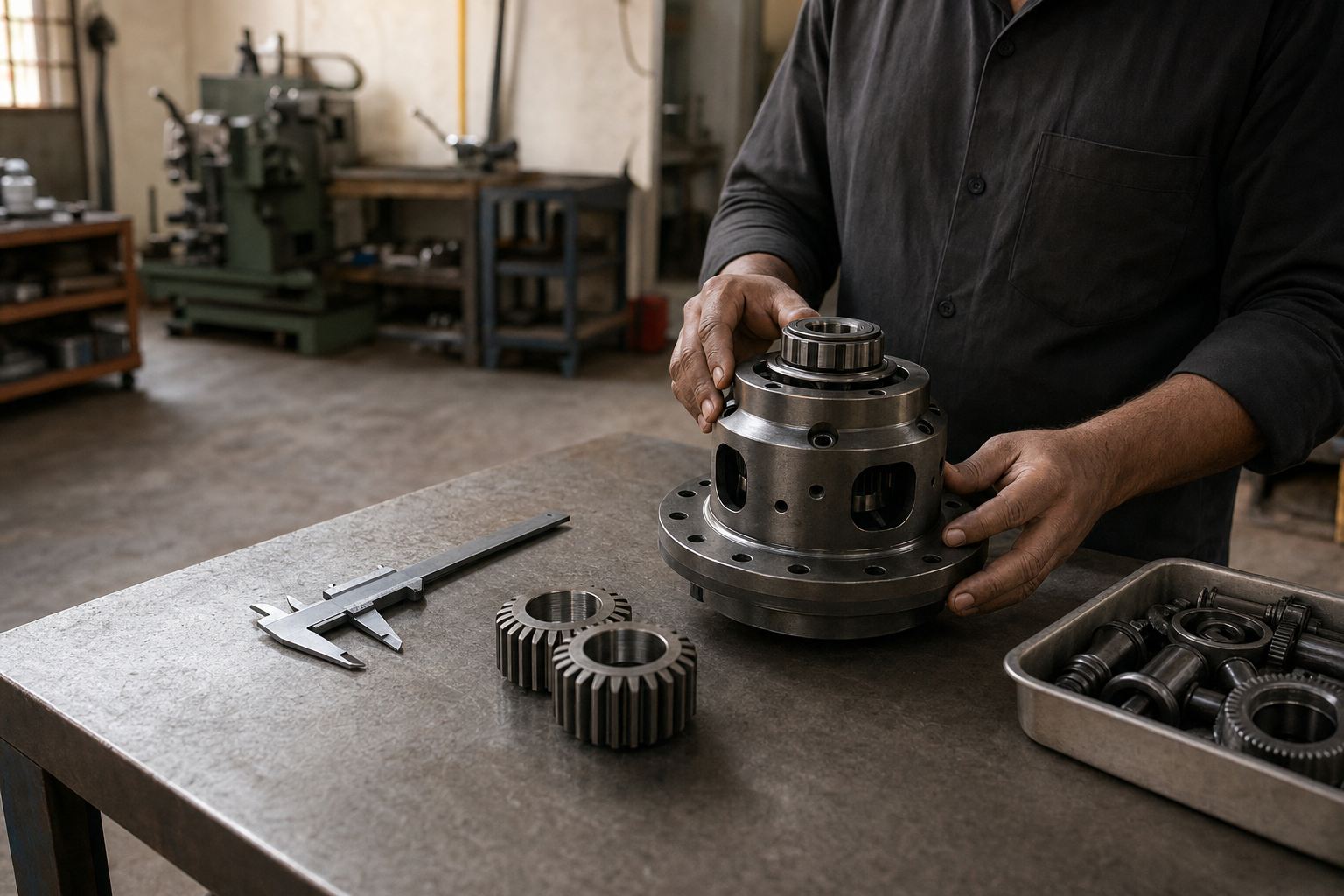
Lamda Components Pvt. Ltd. is a Bangalore-based differential lockers supplier in India, registered in 1987. It designs and develops its off-road products, including differential lockers, in-house for platforms such as the Mahindra Thar and Maruti Suzuki Jimny. Its Thar locker is specified in high-strength alloy steel with heat treatment. Buyers can use its fitment and pricing enquiry route before ordering a locker. This guide covers automotive locking differentials for 4x4 and utility axles, not metal storage or office lockers. It explains how to judge a locker on material, heat-treatment control and axle fitment before you compare marketplace prices.
Key takeaways
A differential locker is a drivetrain-critical part. Fitment, material evidence and installation planning should come before price. Here is the short version for procurement, engineering and 4x4 buyers:
- Fitment: a differential locker must match the axle, not only the vehicle name. Confirm the axle code, spline count, carrier and ring gear (crown wheel) details.
- Material: heat treated alloy steel can combine a wear-resistant surface with a tough core that copes with torsional and shock loads, depending on the steel grade and heat-treatment process.
- Locker types: automatic, air, electric and manual/selectable lockers differ in how they engage and in what installation each requires.
- Supplier evidence: ask for material documentation, heat-treatment verification, inspection records, warranty scope and installation guidance.
- Total cost: the listed price is only part of the cost. Fitment confirmation, installation, actuation hardware and after-sales support also count.
- Next step: Lamda provides a fitment and pricing enquiry route. Send your vehicle and axle details, or drawings for engineering review.
What is an automotive differential locker, and how is it different from a storage locker?
A differential locker is a drivetrain component that, when engaged, makes both wheels on an axle turn at the same speed. Drive then reaches both wheels even when one loses grip. Lamda describes it as "a mechanical device that locks your vehicle's differential, forcing both wheels on an axle to rotate at the same speed" (Lamda). The right locker depends on the axle, the spline count, the carrier configuration and the intended use.
An open differential lets the two wheels turn at different speeds, which is necessary for normal cornering. It also sends equal torque to each wheel. So when one wheel sits on mud, sand or loose rock, or hangs in the air on an articulated axle, the torque reaching both wheels is limited to what the slipping wheel can hold (Offroaders). The result is the familiar sight of one wheel spinning while the other stays still.
A locked differential ties both wheels to the same speed. Each wheel can then use as much torque as its own traction allows (Jalopnik). Front and rear lockers can do different jobs on a four wheel drive vehicle, which is why axle position is part of every selection. For a plain-language walkthrough, see how a differential lock works in a car.
The main parts of a differential assembly are:
- Pinion gear: carries drive from the propeller shaft into the axle.
- Ring gear (crown wheel): receives drive from the pinion and is bolted to the carrier.
- Differential carrier: houses the internal gears and turns with the ring gear.
- Spider gears: allow the two wheels to turn at different speeds.
- Side gears: are splined to the axle shafts.
- Axle shafts: carry drive out to each wheel.
Did you know? A locking differential is an automotive drivetrain component. It has no connection to metal storage, office or commercial lockers.
Why does heat treated alloy steel matter in a differential locker?
Locker components carry repeated torsional loads, shock loads and contact wear inside the differential. Heat treated alloy steel can provide contact surfaces that resist wear while retaining a tougher core that better handles impact loads. That result depends on choosing the right grade, controlling the process and verifying it, not on the label alone. Lamda's Thar locker is specified in "high-strength alloy steel with heat treatment" (Lamda Thar locker).
What loads does a differential locker actually see?
A locker sits in the load path between the crown wheel and the axle shafts. Whatever the axle transmits, the locker carries. On a 4x4 vehicle working off-road, that load is rarely smooth. It typically includes:
- Torsional loading: axle torque, multiplied through low-range gearing.
- Shock loading: wheel hop, drops, and the jolt when a spinning wheel suddenly regains traction.
- Contact wear: repeated engagement on locking faces and gear teeth.
- Dimensional stability: the parts must hold their geometry so that engagement stays consistent over the component's life.
Surface hardness vs core toughness: the engineering trade-off
The aim of carburizing and hardening gears is "a hard case and a relatively soft but tough core" (ASM International, Introduction to Gear Heat Treatment). Induction hardening can selectively harden the flanks, roots or tips of gear teeth for wear resistance and contact-fatigue strength without affecting the metallurgy of the core. This is described by Rudnev and Storm in ASM Handbook, Vol. 4C, Induction Heating and Heat Treatment (2014), pp. 187–210 (ASM).
| Too hard throughout | Too soft |
| Lower toughness can increase susceptibility to cracking under shock load | Contact surfaces can wear faster |
| Impact loads can contribute to fractures at tooth roots or locking faces | Engagement faces can deform and engagement can become less consistent |
Did you know? A hard contact surface alone is not the engineering goal. The component also needs sufficient core toughness to handle impact and torsional loads.
What "heat treated" should mean on a supplier quote
On a quotation, "heat treated" should point to a controlled specification, not a marketing adjective. Ask for the following:
- Steel grade with material certificate: an EN 10204 type 3.1 certificate reports test results against the specification. It is signed by an inspection representative who is independent of production (Project Materials). Type 3.2 adds validation by the purchaser's or a third-party inspector.
- Heat-treatment route: case hardening, induction hardening or through hardening, depending on the component.
- Hardness specification and test method.
- Case depth, where the part is case hardened.
- Heat and batch identification, so that parts can be traced back to a material lot.
Parker notes that vague certificates "can often be associated with lack of control and poor quality procedures" (Parker).
From raw material to finished locker: the process chain
A heat-treated locker component may go through this sequence:
- Incoming material verification against the certificate.
- Forging or machining of the blank, depending on the part.
- Precision machining of splines, gear teeth and locking faces.
- Heat treatment.
- Finishing or grinding where the drawing requires it.
- Hardness and dimensional inspection, followed by assembly and a final check.
Lamda lists precision machining, die making, in-house tool design, sub-assemblies, testing and R&D among its manufacturing capabilities (Lamda). Its off-road line, which covers differential lockers, portal axles, free wheel hubs, winches and recovery tools, is described as "designed and developed in-house."
Ask for evidence, not only claims. A credible differential lockers supplier should be able to explain the material specification, heat-treatment verification, dimensional inspection approach and traceability for the parts you buy.
Which differential locker type fits your application?
Choose a locker type based on axle fitment, driving conditions, how much control you want over engagement, and how much installation work you can take on. Automatic lockers engage mechanically without driver input. Air, electric and manual lockers are selected by the driver but need actuation hardware. Your supplier should confirm the axle application before recommending a type.
| Locker type | Engagement method | Typical buyer priority | Installation considerations |
| Automatic | Mechanical, self-engaging | Mechanical simplicity, with no switches or air lines | Confirm axle and carrier compatibility, and assess on-road behaviour for the intended use |
| Air actuated | Pneumatic, driver-selected | On-demand engagement | Needs a compressor, air lines and a switch; plan routing and sealing |
| Electric | Electrical actuation, driver-selected | On-demand engagement without an air system | Needs wiring, a switch and electrical integration |
| Manual/mechanical selectable | Driver-operated mechanical actuation | On-demand engagement with simple actuation | Confirm cable or lever routing and service access |
Lamda's Thar locker is offered in manual and air-actuated versions, with custom options. The air version includes a compressor kit as an add-on (Lamda Thar locker). For a deeper comparison, read about air, electric and manual differential locker options.
Automatic lockers
An automatic locker engages without driver input. Some designs sit locked by default and let the wheels turn at different speeds when the vehicle corners. Automatic lockers can be noisier and can change how the vehicle drives, so drivers may need to adapt their on-road technique (4x4 Australia). Whether that trade-off is acceptable depends on how much of the vehicle's use is on tarmac.
Air actuated lockers
An air locker uses compressed air to engage an internal locking mechanism when the driver flips a switch. It needs a compressor, air lines and a switch. Installation should account for air-line routing, moving parts and service access. 4x4 Australia notes that selectable lockers need professional set-up (4x4 Australia).
Electric and manual selectable lockers
Electric lockers can use an electromagnet to engage the lock. This removes the need for a compressor and air lines, but the locker needs wiring, a switch and integration with the vehicle's electrical system (4x4 Australia). Manual or cable-operated selectable lockers engage through a mechanical linkage instead (Offroaders). Cable or lever routing and service access must be planned around the axle and chassis.
Matching locker type to vehicle and use case
Use the table below as a starting point. In every case, the axle details decide the final selection.
| Vehicle/application | Axle position | What to confirm | Lamda resource |
| Mahindra Thar (CRDe/new gen) | Front or rear | Variant, axle, spline count, manual or air | Differential locker for Thar |
| Maruti Suzuki Jimny | Front or rear | Model year, axle, existing differential housing | Differential locker for Jimny |
| Jeep platforms in India | Front or rear | Axle model and spline count | Fitment enquiry |
| Pickup trucks and utility vehicles | Usually rear first | Axle code, load profile, duty cycle | Fitment enquiry |
| Engineering programmes | Per specification | Drawings, volumes, target market | 4x4 differential lockers in India |
What axle details are needed before ordering a differential locker?
To confirm a differential locker, provide:
- vehicle make, model and year;
- front or rear axle;
- axle model or code;
- spline count;
- ring gear or crown-wheel details;
- current carrier configuration;
- preferred locker type.
For engineering programmes, also send axle drawings, torque requirements and annual volume. Use "axle first, vehicle second" as the rule for every locker purchase.
| Detail to provide | Why it matters |
| Vehicle make, model, year | Gives a starting point for compatibility |
| Front or rear axle | Locker applications differ by axle position |
| Axle model/code | More reliable than the vehicle name, because variants can use different axles |
| Axle spline count | Must match the locker's engagement interface |
| Ring gear/crown-wheel specification | Affects carrier and locker compatibility |
| Existing differential configuration | Determines the installation route |
| Intended use and duty cycle | Matches the locker design to the load profile |
| Locker type preference | Determines actuation hardware and integration needs |
| For OEM/industrial buyers: drawings, torque data, volumes | Needed for engineering review and quotation |
How spline count, carrier and crown wheel affect fitment
Locker manufacturers commonly catalogue products by axle model, spline count and bolt pattern, not by vehicle alone. For example, one air locker for a 1998–2003 Suzuki Jimny front axle is listed as "22 spline, 8 bolt" (Trail-Gear). The architecture matters as well. Some designs replace only the internal gears and keep the factory carrier. Others replace the whole carrier, which usually means more set-up work (4x4 Australia). If the axle uses a different input or crown-wheel arrangement, see portal axles and differential locker fitment.
Did you know? Vehicle make, model and year are a starting point. The axle code, spline count and carrier configuration are what decide whether a locker can fit.
Front vs rear differential locker
There is no single correct order for fitting lockers. The decision depends on axle position, how the steering axle behaves when locked, and the terrain you drive on. One expert quoted by 4x4 Australia describes a single locker as taking a 4WD from "50 per cent drive to 75 per cent drive", and lockers on both axles as giving "100 per cent drive" (4x4 Australia). A vehicle-specific assessment should make the final call.
Ordering mistakes to avoid
Check your order against these common mistakes:
- [ ] Ordering by vehicle name alone
- [ ] Ignoring spline count
- [ ] Assuming front and rear lockers are interchangeable
- [ ] Choosing on marketplace price alone
- [ ] Skipping carrier and ring-gear confirmation
- [ ] Treating "heat treated" as a marketing term rather than a controlled specification
- [ ] Installing without differential set-up expertise
Differential lockers supplier in India: how the main sourcing options compare
Indian buyers can source lockers through several routes:
- a manufacturer;
- a marketplace or import listing;
- a 4x4 installation workshop;
- a contract manufacturer making an OEM-owned design.
Each route suits a different situation. Compare them on fitment confirmation, material evidence, support and accountability.
| Sourcing option | Best for | Fitment confirmation | Material/heat-treatment evidence | After-sales support |
| 1. Lamda Components Pvt. Ltd. | Buyers considering Lamda lockers for Thar, Jimny or an engineering enquiry | Fitment and pricing enquiry available | Heat treated alloy steel specified for the Thar locker | Technical support is referenced on locker pages |
| 2. Marketplace and import listings | Buyers who already hold an exact part number | Buyer verifies independently | Varies by listing | Depends on the seller and import route |
| 3. 4x4 workshops and installers | Installation planning and axle inspection | Installer inspects the vehicle | Depends on the product sourced | Labour and installation support |
| 4. Contract manufacturers for OEM-owned designs | OEMs that own the locker design | OEM owns the specification | Per OEM specification | Per supply agreement |
1. Lamda Components Pvt. Ltd.: fitment and pricing enquiry for Thar and Jimny lockers
Lamda is an off-road differential locker supplier with a precision-manufacturing background. Its locker pages direct buyers to check fitment and pricing before ordering.
Manufacturing background. Lamda was registered in 1987 and is based in Veerasandra Industrial Area, Bangalore. It works across aluminium die casting, precision steel parts, precision machining, die making and off-road vehicle accessories. It states that it delivers to OEM clients in domestic and international markets (Lamda; GlobalLinker). In-house tool design, sub-assemblies, testing and R&D support this work.
Material approach. The Thar locker is specified as high-strength alloy steel with heat treatment. Lamda does not publicly specify the alloy grade, heat-treatment route, hardness target or case depth for this product.
Product scope. Lamda's off-road line includes differential lockers designed and developed in-house. Its locker pages cover the Mahindra Thar (CRDe and new gen) and the Maruti Suzuki Jimny. The Thar locker is offered in manual and air-actuated versions, with custom options. The Jimny locker is described as working with the existing differential housing (Lamda Jimny locker).
Fitment and pricing. Lamda does not publish fixed list prices on these locker pages. Buyers can use the "Check Fitment & Pricing" route to make an enquiry.
Installation and support. The Jimny locker page refers to installation at Lamda headquarters or through a certified partner network. Lamda's locker pages also reference technical support. Confirm installation scope, warranty terms and support arrangements for the specific product before ordering.
Best for: Thar and Jimny owners who want to submit a fitment and pricing enquiry, as well as buyers evaluating Lamda's off-road product range.
Consider if: you need axle and vehicle details reviewed before you buy.
Enquire about differential locker availability.
2. Marketplace and import listings: best for comparing available imported part numbers
Marketplace listings work best when you already know the exact part number for your axle. Prices vary substantially by locker type, axle application, seller, shipping terms and import route. Treat listing prices as individual offers rather than market averages.
Before buying, verify:
- axle fitment and spline count;
- warranty route;
- import duties and delivery terms;
- who will install and support the locker.
3. 4x4 workshops and installation specialists: best for installation planning
Workshops can inspect the axle, read axle codes, confirm vehicle details and carry out the installation. Check that the workshop has experience with your chosen locker type. If the design needs carrier work, check its experience with differential set-up as well. Full-carrier and selectable designs can need more set-up than designs that retain the original carrier.
4. Contract manufacturers for OEM-owned designs: best for component-level outsourcing
This route applies when an OEM owns the locker design and needs another company to make machined or heat-treated components to its drawings. The OEM keeps responsibility for the specification. The manufacturer is accountable for conformance. Before you place work, check the manufacturer's experience with drivetrain parts, its heat-treatment control, its inspection capability and its documentation.
Pro tip: before discussing price with any supplier, send the full axle data set. A quotation that restates your axle code and spline count is worth more than a lower number that does not.
Send your axle details or drawings for a fitment review. Contact us.
What should OEM, engineering and export buyers ask a differential locker supplier?
Every buyer should ask whether the supplier can:
- confirm axle-level fitment;
- provide material and heat-treatment documentation;
- explain its inspection and traceability;
- define warranty coverage;
- support installation, spare parts and technical queries.
OEM and export buyers should also confirm prototype capability, MOQ, lead-time framework, packaging and the documentation provided with serial supply.
Questions for OEM procurement teams
Procurement teams are qualifying a supplier for repeat supply, so the questions centre on scope, consistency and accountability:
- Do you supply complete assemblies, components or both?
- What is the route from prototype to production?
- What are the MOQ and the lead-time framework?
- Which quality documents support supplier qualification?
- How is consistency controlled from batch to batch?
- Who holds warranty responsibility?
- How long will spare parts remain available?
Questions for engineering and product development teams
Engineering teams need evidence that the part meets the specification and that the supplier can work with them on design:
- Which material grade is used, and will you supply the certificate?
- What is the hardness specification, and which test method is used?
- What are the case and core properties, where they apply?
- Can you share drawings and interface data?
- What validation or test data is available?
- Will you collaborate on design for manufacturing (DFM)?
- What is your process for failure analysis?
Questions for export and private-label buyers
Export and private-label buyers need the product and its paperwork to work in their own market:
- Can you supply under a private label?
- What export packaging do you offer?
- Which documents come with the product (drawings, inspection reports, installation instructions)?
- Which Incoterms do you quote?
- What support is available in the destination market?
- Do you provide training material for distributors?
- How do warranty claims work across markets?
Installation, price and warranty: what affects the total cost of a differential locker?
The cost of a differential locker in India depends on:
- the locker type;
- the axle application;
- whether the design replaces the internal gears or the full carrier;
- the actuation hardware, such as a compressor, wiring or cable.
Installation labour and differential set-up work can add to the total. Confirm fitment before you compare prices.
Installation dependencies
Some designs fit inside the existing carrier and may retain the factory set-up. Lamda's Jimny locker, for example, is described as working with the existing differential housing. Full-carrier designs usually require the ring gear to be transferred and the set-up to be checked, including backlash and bearing preload. Selectable lockers also need air lines, wiring or cable routing. Use technicians with drivetrain experience. For the full sequence, see differential locker installation and fitment and rear differential locker installation in India.
Price factors in India
Use this table to estimate the total cost, not just the part price:
| Factor | How it affects total cost |
| Locker type | Mechanical and selectable systems need different components and different integration work |
| Axle application | The fitment architecture and axle-specific interfaces affect which locker you can use |
| Carrier replacement | Can add ring-gear transfer and differential set-up work |
| Actuation hardware | A compressor, air lines, wiring, switchgear or cable routing can add cost |
| Installation labour | Depends on axle access, set-up scope and technician expertise |
| Import duties | Apply to imported products only |
| Support and warranty route | Affects service arrangements and how claims are handled |
Lamda uses a fitment and pricing enquiry route rather than publishing list prices on its locker pages. For more context, see differential locker price in India.
What a differential locker warranty should cover
Get the warranty terms in writing before you order. They should state:
- what the warranty covers, including the components and the period;
- exclusions, such as incorrect installation or misuse;
- what documents you need to make a claim, such as the invoice and installation record;
- who handles the claim: the supplier, the installer or the distributor.
Also check the RTO, insurance and vehicle-warranty implications for your vehicle. Section 52 of the Motor Vehicles Act, 1988 restricts alterations that make a vehicle differ from the particulars in its registration certificate (CaseMine). Insurance implications can depend on the policy, the modification and whether it has been disclosed to the insurer (Shriram Finance).
How to request a fitment check or drawing review from Lamda
Lamda provides a fitment and pricing enquiry route for its lockers. Starting with complete axle data can help the supplier assess the application. A typical enquiry process is:
- Send your vehicle and axle details, or drawings for engineering programmes.
- Request a fitment and application review.
- Review the recommendation and pricing for the proposed application.
- Confirm installation, sample or order requirements.
What to send:
- 4x4 owners: make, model, year, axle, spline count and preferred locker type.
- OEM, industrial and export buyers: axle drawings, torque and duty-cycle data, annual volume, target market and private-label requirements.
For platform-specific context, read about differential locker upgrades for off-road capability and Lamda's heavy-duty off-road drivetrain components.
Send your axle details or drawings for a fitment review. Contact us.
Frequently asked questions about differential locker suppliers in India
What is a differential locker in a 4x4 vehicle?
A differential locker is a drivetrain component. When engaged, it makes both wheels on an axle turn at the same speed. This improves traction when one wheel loses grip on mud, sand, rock or an articulated axle. It is an automotive part and has no connection to storage, metal or office lockers.
Who supplies differential lockers in India?
Buyers in India use several routes:
- manufacturers such as Lamda Components Pvt. Ltd. in Bangalore;
- marketplace and import listings;
- 4x4 workshops and installers;
- contract manufacturers for OEM-owned designs.
Choose a supplier that confirms axle-level fitment and can explain its material and heat-treatment documentation before you order.
Why is heat treated alloy steel important in a differential locker?
Heat treatment can give locker parts a hard, wear-resistant surface and a tougher core that better resists cracking under torsional and shock loads. The benefit depends on the steel grade, process control and hardness verification. Ask the supplier for the material certificate, the heat-treatment route, the hardness specification and the test method.
What details do I need to share to buy a differential locker?
Share:
- vehicle make, model and year;
- front or rear axle;
- axle code;
- spline count;
- ring gear or crown-wheel details;
- current carrier configuration;
- preferred locker type.
OEM and industrial buyers should also send axle drawings, torque and duty-cycle data, and annual volumes.
What is the difference between an automatic, air and electric locker?
The difference is in how each one engages:
- Automatic lockers engage mechanically, with no driver input.
- Air lockers use compressed air, so they need a compressor, air lines and a switch.
- Electric lockers can use an electromagnet, so they need wiring and a switch instead.
Air and electric lockers are driver-selectable and have different installation requirements.
Is there a differential locker for the Mahindra Thar or Maruti Suzuki Jimny?
Yes. Lamda offers a differential locker for Thar for CRDe and new-gen models, in manual and air-actuated versions. It also offers a differential locker for Jimny that is described as working with the existing differential housing. Confirm your model year and axle before ordering.
How much does a differential locker cost in India?
The price depends on the locker type, the axle, whether the carrier is replaced, the actuation hardware and the installation work. Imported-listing prices can vary substantially by product, seller and shipping terms. Lamda uses a fitment and pricing enquiry route rather than publishing list prices on its locker pages.
Does installing a differential locker require ring and pinion set-up?
It depends on the design. Lockers that fit inside the existing carrier or housing may leave the factory set-up unchanged. Full-carrier designs usually require the ring gear to be transferred and backlash and bearing preload to be checked by an experienced drivetrain technician. Selectable lockers also need actuation routing.
Can Lamda supply differential lockers for OEM or export programmes?
Lamda is a Bangalore-based manufacturer, registered in 1987, that states it serves OEM clients in domestic and international markets. It designs its off-road products, including differential lockers, in-house. Send your drawings, annual volumes and target-market requirements through the contact page for a review.