
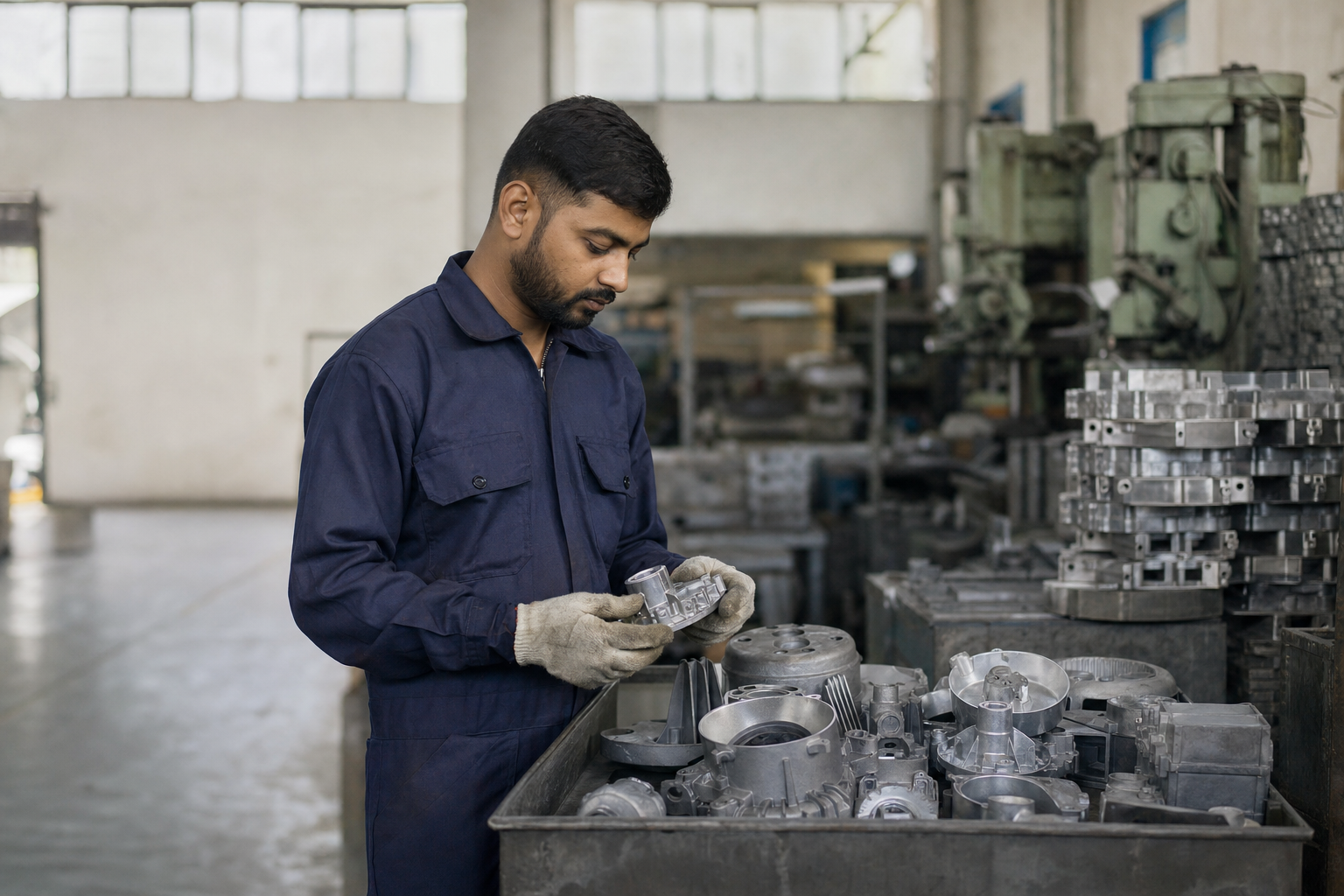
OEMs don't buy casting capacity. They buy motor housings, enclosures and covers that arrive ready to fit into an assembly. Aluminium casting products are components made by filling a mould or die with molten aluminium alloy, such as housings, enclosures, heat sinks, covers, brackets and fluid-handling parts, and the right result depends on matching process, alloy, tooling, machining and finish to the part before the die is released. Lamda Components Pvt. Ltd., an aluminium die casting manufacturer in Bangalore registered in 1987, offers end-to-end die casting solutions including die making, pressure die casting and precision machining for OEMs in domestic and international markets.
Key takeaways
These points summarise how OEM buyers and design engineers should approach aluminium casting products in 2026.
- What they are: Components formed by filling a mould or die with molten aluminium alloy. Common examples are housings, enclosures, heat sinks, covers, brackets, pulleys and pump or compressor parts.
- Process follows the part: High-pressure die casting suits detailed parts made repeatedly. Gravity, sand and investment casting suit other combinations of geometry, size and volume.
- Alloy choice: The alloy depends on the casting process, corrosion exposure, strength, machinability, thermal needs and finish.
- Sector priorities differ:
- Electrical parts need heat dissipation and accurate mounting.
- Medical-equipment housings need cleanable geometry and good surface quality.
- White-goods parts need repeatability.
- Review before tooling: Porosity, distortion and difficult machining are cheapest to address at drawing review, before the die is released.
- Quoting: An accurate quote needs:
- the drawing
- annual quantity
- critical dimensions
- machining scope
- finish
- assembly context
What are aluminium casting products?
Aluminium casting products are parts produced by introducing molten aluminium into a cavity, so the part takes its shape in a single forming stage. Xometry notes that the process uses aluminium's low melting point and low viscosity to make complex, net-shape parts. Typical aluminium casting components include enclosures, motor housings, end covers, heat sinks, brackets, pulleys, and pump or compressor-related parts.
Choosing between a cast part, a fabricated assembly and a fully machined component is a design trade-off:
- Fabrication joins several pieces, which adds joints and handling.
- Machining from solid gives precise geometry but can waste material on complex shapes.
- Casting forms the overall shape at once. Precision machining is then kept for the surfaces that need it.
Cast features such as ribs, bosses and mounting lugs can combine several assembly features into one component. This is subject to a design-for-casting review: ribs are commonly oriented perpendicular to the parting line, and bosses should be filleted into the wall and supported by ribs (Gabrian).
Why OEMs specify cast aluminium instead of other materials
Engineers usually choose cast aluminium for a combination of properties rather than one. Xometry lists a high strength-to-weight ratio, thermal and electrical conductivity, corrosion resistance and the ability to form complex geometries as core benefits. The table below links each property to what it means for the finished part.
| Property | What it means for the finished part |
| Strength-to-weight ratio | Lighter housings and covers that still carry mounting and assembly loads |
| Thermal conductivity | Heat moves out of motors, electronics and drives through the housing or fins |
| Corrosion resistance | Better durability in humid, outdoor or wash-down environments, depending on alloy and finish |
| Machinability | Bores, sealing faces and threads can be machined accurately after casting |
Electrical conductivity can matter for enclosures that need grounding or shielding behaviour. However, the alloy and any coating affect how the finished surface performs.
The aluminium casting products Lamda makes
Lamda describes itself as a manufacturer of aluminium die-cast components and precision steel parts. Its customers are in the automotive, medical, electrical and white-goods sectors. Aluminium parts Lamda names include governor covers, motor housings and rectifier housings. It also lists sub-assemblies such as automated bearing and child parts, stators and alternators.
The table shows aluminium die casting product families OEMs commonly bring for engineering review. It also shows the secondary work each family may need before assembly.
| Product family | Typical examples | Sector relevance | Typical secondary work |
| Enclosures and housings | Electrical enclosures, control housings, rectifier housings, equipment housings | Electrical, medical equipment, white goods | Face and bore machining, tapping, finishing |
| Motor and drive components | Motor housings, end covers, governor covers, gear housings | Electrical, white goods, automotive | Bore, spigot and face machining |
| Heat-management parts | Heat sinks, finned covers | Electrical, electronics | Mounting-face machining |
| Structural and mounting parts | Brackets, frames, mounting plates | Electrical, medical equipment, white goods | Drilling and tapping |
| Rotating and motion parts | Pulleys, hubs | White goods, industrial | Turning |
| Fluid-handling parts | Pump bodies and covers, compressor-related parts | White goods, industrial | Sealing-face machining, leak-integrity checks where specified |
Lamda also makes precision steel parts. Separately, it designs off-road products such as differential lockers, portal axles and free wheel hubs, listed under its off-road accessories. This article covers aluminium casting products only.
Which aluminium casting process fits your product?
The right casting process depends on part geometry, wall sections, production volume and how much secondary work you can accept:
- High-pressure die casting suits detailed, thin-walled parts made repeatedly.
- Gravity or permanent-mould casting suits heavier sections and heat-treatable alloys.
- Sand casting suits larger or lower-volume parts.
- Investment casting suits high-value, intricate forms.
The table compares the four routes.
| Process | Best-fit product profile | Geometry and walls | Tooling | Typical secondary work |
| High-pressure die casting | Detailed parts made repeatedly | Thin walls and intricate features where design permits | Hardened-steel two-part die | Machining, tapping, deburring, finishing |
| Gravity die / permanent mould | Heavier sections, heat-treatment priorities | Thicker, more robust sections | Reusable metal mould, typically hand-poured | Machining, finishing |
| Sand casting | Larger or lower-volume parts, prototypes | Flexible for larger geometries | Pattern with expendable sand mould | Larger machining allowance |
| Investment casting | High-value, intricate parts | Fine detail and complex forms | Sacrificial wax or polymer pattern | Finishing, precision machining |
Lamda's stated casting capability is pressure die casting, supported by die making and precision machining.
Aluminium pressure die casting products: when high-pressure die casting is the right choice
In high-pressure die casting (HPDC), molten aluminium is injected under pressure into a hardened steel die. The metal solidifies and the part is ejected. Xometry notes that these dies suit full automation and long production runs. HPDC is usually the right choice when:
- the part integrates ribs, bosses, fins or mounting lugs
- the part is made repeatedly
- near-net shape reduces machining
- surface finish needs to be consistent from part to part
HPDC also has trade-offs:
- The die is a significant investment.
- Design changes after tooling are expensive.
- Machined or pressure-tight surfaces need early attention to porosity.
NADCA states plainly that "part design is the number one factor affecting the final porosity in a casting".
Aluminium gravity die casting
Gravity die casting pours molten metal into a reusable metal mould without external mechanical force. It suits thicker, more robust sections. Gravity castings can also be T6 heat treated to improve mechanical properties. That route is severely limited for HPDC parts, because trapped gas can cause surface blistering. Gravity casting is worth considering when strength after heat treatment matters more than thin walls and fine detail.
Aluminium sand casting products
Sand casting uses an expendable mould. Xometry identifies it as suited to "lower-volume and/or larger shot-weight castings". Pattern costs are lower than die costs, which makes sand casting practical for prototypes and large parts. The trade-offs are a rougher as-cast surface and a larger machining allowance on functional faces.
Aluminium investment casting
Investment casting forms the mould around a sacrificial wax or polymer pattern. Xometry describes it as reserved for high-value, intricate parts. It produces fine detail and smooth as-cast surfaces. However, the pattern and shell process makes each part more involved than die casting.
How to choose an aluminium casting alloy
Choose an aluminium casting alloy by checking the casting process first. Then consider corrosion exposure, strength, machinability, pressure-tightness and finish:
- LM24 is commonly used for die casting.
- LM6 offers excellent castability for thin walls and good corrosion performance.
- LM25 is selected where heat treatment and higher strength matter.
Alloy grades are defined in BS EN 1706, BS 1490 and JIS H 5302.
| Alloy | Commonly associated process | Typically selected for | Considerations |
| LM24 (BS 1490) / EN AC-46500 | High-pressure die casting | Detailed die-cast parts, machinability | General purpose; assess corrosion exposure and finishing |
| ADC12 (JIS H 5302) | High-pressure die casting | Similar applications to LM24 | Closely related to LM24 but not identical; confirm against the drawing's specified standard |
| LM6 (AlSi12) | Gravity and sand casting | Thin-walled castings, motor housings, meter cases, marine fittings | Machinability considerations |
| LM25 (AlSi7Mg) | Gravity and sand casting | Corrosion resistance combined with higher strength | Properties improve with heat treatment; plan the heat-treatment route |
Total Materia lists LM24 as equivalent to EN AC-46500 (AlSi9Cu3(Fe)(Zn)) and ASTM 380.0. ADC12 is often paired with these grades, but its composition ranges differ.
Avoid a common specification error: don't specify an alloy only because a previous part number used it. Check that the alloy suits the selected casting process and the service environment.
Choose the finish early: high-silicon die-casting alloys can give dull or uneven cosmetic anodising results. Confirm the finish together with the alloy before you specify it.
Electrical aluminium castings: enclosures, motor housings and heat sinks
Electrical aluminium castings are used because one cast part can protect components, conduct heat away from them and provide accurate mounting interfaces. Electrical is one of the sectors Lamda serves, and its named parts include motor housings and rectifier housings. The engineering priorities are heat dissipation, rigidity and accurate machined interfaces.
Aluminium electrical enclosures
An enclosure must stay rigid when fastened down and seal reliably at its joints. Key cast features can include:
- gasket and sealing faces
- cable-entry bosses
- mounting lugs
- ribs that stiffen large panels without adding thick sections
Sealing faces usually need machining. Keep the parting line and ejector marks away from them. For outdoor exposure, choose the alloy and finish together, because corrosion performance depends on both. Define any ingress-protection requirement in the specification so the whole assembly can be validated against it.
Aluminium motor housings and end covers
Motor housings combine features that are cast with features that must be machined:
- Cast: cooling fins, mounting feet and terminal-box bosses can usually be cast.
- Machined: bearing bores, spigots and mating faces generally need machining to achieve concentricity and fit.
The datum strategy matters here. If machining datums are considered during die design, the finished bores relate correctly to the cast features around them. LM6 alloy references list motor housings among typical applications, and HPDC alloys are widely used for detailed housings.
Aluminium heat sinks and heat-dissipation parts
Cast and extruded heat sinks suit different designs:
- Extruded heat sinks suit simple, constant profiles and can offer higher thermal conductivity.
- Die-cast heat sinks can form three-dimensional fin patterns and integrate bosses and mounting features. Their thermal performance depends on the alloy and on porosity.
For cast heat sinks, fins need draft and proportions that the die can fill. The mounting face that contacts the electronics is usually machined to make it flat.
Medical aluminium castings: equipment housings and precision components
Medical equipment may use aluminium casting components such as housings, covers, brackets, mounts and subassembly frames. Medical is among the sectors Lamda lists. The priorities are surface quality, cleanable geometry and repeatable datums. Validation of the device itself sits with the equipment OEM.
Aluminium medical equipment housings and covers
Visible housings need consistent cosmetic surfaces. They also need geometry that is easy to clean: radiused corners, minimal crevices, and fastener and cable interfaces that do not trap residue. Separate cosmetic surfaces from functional ones on the drawing, so that parting lines and ejector marks are placed where they do not matter. The OEM should validate the chosen finish against the cleaning agents and disinfection routine the equipment will face in use.
Precision functional components in medical assemblies
Brackets, mounts and frames inside medical equipment usually locate other modules. That makes repeatable datum features and precision machining more important than appearance. Define critical-to-quality dimensions clearly so that machining and inspection concentrate on them.
What Lamda does and does not claim for medical applications: Lamda lists medical among the sectors it serves and manufactures components to OEM drawings and specifications. The OEM retains responsibility for the medical device, including design validation and compliance.
White goods aluminium castings: appliance components built for repeat production
White goods aluminium castings can include motor covers, pulleys, gear housings, pump and compressor-related parts, and visible appliance parts. Repeatability matters, because appliance lines rely on every batch fitting the same way. White goods is one of Lamda's stated sectors. IMARC Group lists consumer durables among the main application segments of India's aluminium die casting market.
Motor covers, pulleys and gear housings
Rotating and drive parts depend on concentricity between bores, spigots and running surfaces. They also need a dependable assembly fit with bearings and shafts. Pulleys need attention to balance and wear surfaces. Whatever balance requirement applies should be written into the drawing so it can be planned into machining and inspection. Gear housings need bore positions held relative to each other, so they need a clear datum scheme.
Aluminium compressor and pump components
Pump bodies and compressor-related parts must hold pressure without leaking. Achieving this starts with part design and porosity control, and sealing faces need careful machining. Where leak integrity is critical, OEMs can specify vacuum impregnation and leak testing. Impregnation seals interconnecting porosity that breaches the wall. Industry practice is to impregnate after machining, because machining can expose more porosity. Leak requirements are usually set as a leak rate at a specified pressure and duration.
Visible and cosmetic appliance parts
Visible parts need cosmetic surfaces defined on the drawing. This keeps parting lines, gate locations and ejector-pin marks on hidden faces. Powder coating is a common route for appliance parts that need both protection and appearance. Agree the finish and its pretreatment early, alongside the alloy.
From drawing to dispatch: how tooling, casting and precision machining work together
Aluminium die-cast components move through a defined sequence before they are ready for assembly. Keeping die making, casting and machining in one engineering loop reduces handovers between suppliers. It also lets machining datums be planned at die design, and it shortens the correction cycle when samples need adjusting. Lamda describes an in-house tool design and development team and an in-house testing facility for dimension verification.
- Drawing and specification review
- Design-for-casting feedback
- Die design and die making
- Sampling and first-article inspection
- Production casting
- Fettling and deburring
- Precision machining
- Finishing
- Final inspection
- Packing and dispatch
Have a drawing ready? Send it for an engineering review.
Design-for-casting checks before tooling release
Most expensive casting problems start in the drawing, which is why a design-for-die-casting check belongs before die release. Design guidance consistently calls for uniform walls, drafted pull-direction faces, ribs no wider than the wall they support, and machining allowance that covers worst-case draft and tolerances. Confirm the following before you approve the die design:
- Draft on all faces in the pull direction
- Uniform walls and gradual thickness transitions
- Rib and boss proportions, with bosses filleted and supported by ribs
- No isolated heavy sections
- Radiused corners
- Parting line kept away from cosmetic and sealing faces, with a flat parting plane where possible
- Machining allowance on critical surfaces
- A datum strategy for machining
Specify functional surfaces: mark sealing faces, bores, threads and mounting interfaces for machining. Do not expect every as-cast surface to work as a functional surface.
Post-casting machining and finishing: powder coating, anodising and more
Most cast parts need some secondary work before they are ready for assembly. Lamda's stated scope includes precision machining and the sub-assemblies listed above. Its published capability information also includes shot blasting, vibro deburring, resin impregnation, leak testing, anodising, powder coating or painting, and sub-assemblies. Agree the required operation and its acceptance criteria during the RFQ.
| Operation | Purpose | When it is needed |
| CNC machining | Creates critical faces, bores and datums | Where as-cast geometry isn't accurate enough |
| Drilling and tapping | Adds threaded and assembly features | Where threads or holes are required |
| Deburring | Removes sharp edges and residual material | Before handling, finishing or assembly |
| Shot blasting | Prepares or improves the surface condition | When specified as finish preparation |
| Powder coating | Protection and appearance | Where a coated finish is specified |
| Anodising | Surface treatment | Only after an alloy compatibility review |
| Impregnation | Supports leak integrity | Pressure-containing applications |
| Assembly | Delivers a more complete component | Where agreed in the customer specification |
Quality risks in aluminium casting products and how they are controlled
Porosity in aluminium die casting comes from two main sources:
- Gas porosity: turbulent die filling, insufficient venting and high hydrogen content in the melt.
- Shrinkage porosity: inadequate feeding of regions as they solidify.
High-pressure castings can show both types together. NADCA adds that any successful porosity reduction programme "must include porosity prediction and measurement". The AFS likewise treats gas and shrinkage porosity as separate problems with separate controls.
| Defect | Typical cause | Prevention lever |
| Porosity | Trapped air, hydrogen in the melt, inadequate feeding | Part design, gating, venting, melt handling, process settings |
| Shrinkage | Thick or isolated sections | Uniform walls and gradual transitions |
| Cold shuts | Metal fronts meeting too cool to fuse | Die and process design |
| Flash | Die wear or poor parting-line fit | Die maintenance |
| Distortion | Uneven walls or ejection stresses | Design and ejection layout |
| Dimensional drift | Die wear or process variation | Die maintenance and process monitoring |
| Cosmetic defects | Surface flow lines or ejector marks | Die design and finishing approach |
Did you know? Machining can open up porosity hidden below the cast skin. That is why bores and sealing faces on pressure-tight parts need engineering attention before the die is cut.
Lamda verifies critical and complex dimensions in its advanced in-house testing facility.
How to choose an aluminium die casting manufacturer in Bangalore or India
Choosing among aluminium die casting manufacturers in India means looking past casting capacity. Check whether the supplier can deliver a cast, machined, inspected part ready for your assembly. The market is large and growing. IMARC Group values India's aluminium die casting market at USD 2.6 billion in 2025 and projects USD 4.1 billion by 2034, a 4.80% CAGR. That growth gives buyers plenty of choice, so structured evaluation pays off.
What OEM buyers should check before approving a casting supplier
Use these eight checks to compare aluminium die casting companies in Bangalore and across India.
- Process scope and part-size range: Confirm that the supplier's process and machine range suit your geometry.
- In-house tooling and die maintenance: Die design and upkeep drive flash, dimensional drift and correction speed.
- Machining and finishing scope: Know which operations are done in-house and which are subcontracted.
- Quality systems and certifications: Ask for the current certificates your programme requires and check their scope.
- Inspection documentation: Agree first-article and routine inspection reports up front.
- Tooling ownership and drawing-revision control: Confirm who owns the die and how revisions are managed.
- Export packing and documentation: For overseas programmes, confirm packing and shipping paperwork.
- Engineering responsiveness during the RFQ: The quality of design-for-casting feedback is an early indicator of how the supplier will handle problems in production.
Aluminium casting suppliers OEMs commonly evaluate in 2026
Buyers shortlisting an aluminium high pressure die casting manufacturer usually compare an Indian source with international options. The entries below are a starting point for comparison, not a ranking. For a wider Indian view, see our guide to the top aluminium die casting companies in India.
1. Lamda Components Pvt. Ltd. (Bangalore, India)
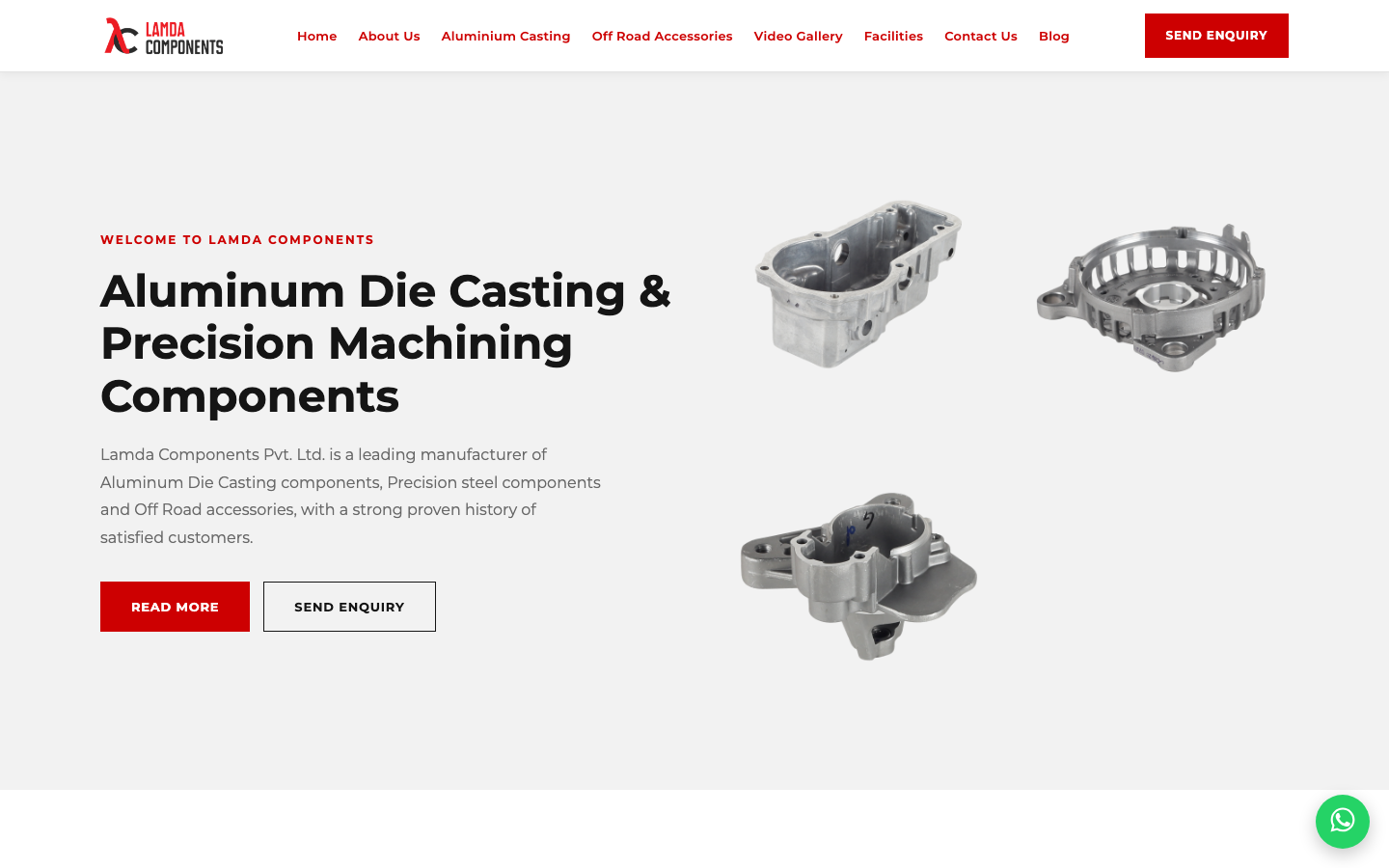
Lamda was registered in 1987 and is based in the Veerasandra Industrial Area, Bangalore. Its end-to-end die casting solutions cover die making, pressure die casting and precision machining. Lamda also produces precision steel parts and sub-assemblies such as stators and alternators. It serves OEM clients in the automotive, medical, electrical and white-goods sectors across domestic and international markets. Its testing facility verifies critical and complex dimensions in-house. Lamda may suit OEMs who want cast-and-machined aluminium parts, ready for assembly, through a single engineering contact from drawing review to dispatch.
2. International alternatives
Buyers may also compare Indian and international die-casting suppliers. Review each company's current processes, locations, machining scope and quality documentation on its own site, using the eight checks above. That way the comparison is like-for-like with your part requirements.
What to send for an aluminium casting quote
To get an accurate aluminium casting quote, send:
- the current drawing revision and a CAD model
- annual and batch quantities
- the alloy or service environment
- critical-to-quality dimensions and machining features
- the finish
- testing requirements
- packaging and destination
- your target timeline
Missing inputs lead to assumptions, and assumptions can change the price later.
| Input | Why it matters |
| Drawing revision and CAD format, such as STEP | Confirms the exact geometry being quoted |
| Annual and batch quantity | Informs process selection and how tooling cost is spread |
| Alloy or service environment | Guides alloy and finish selection |
| Critical-to-quality dimensions | Defines machining and inspection planning |
| Cosmetic versus functional surfaces | Affects parting-line placement and finishing approach |
| Machining features | Sets machining scope and datum strategy |
| Finish | Determines the coating route and alloy compatibility |
| Testing, including leak or pressure requirements | Defines validation requirements |
| Packaging and destination, including Incoterm | Affects packing, documentation and landed-cost planning |
| Target timeline | Sets the tooling and sampling schedule |
Quote the full requirement: a CAD file alone does not define the job. Inspection needs, packaging and destination change the scope as much as the geometry does.
Ready to move from drawing to production? Send your drawing, quantity and finish requirement to Lamda's engineering team for a manufacturability review and quote. Engineers can review the casting route, die design considerations, machining scope and critical dimensions against your assembly needs. Contact us to start the review.
Frequently asked questions about aluminium casting products
What products are made by aluminium die casting?
Aluminium die casting produces enclosures, motor housings, end covers, governor covers, heat sinks, brackets, pulleys, and pump or compressor-related parts. It suits parts made repeatedly with detailed features such as ribs, bosses, fins and mounting lugs. The hardened steel die produces consistent near-net shapes, and precision machining then finishes the critical bores and faces.
What is the difference between aluminium die casting and sand casting?
Die casting injects molten aluminium under pressure into a reusable hardened steel die, which suits detailed parts in repeat production. Sand casting uses an expendable sand mould, which suits larger or lower-volume parts and prototypes. Sand castings generally have rougher as-cast surfaces and need a larger machining allowance on functional faces.
Is LM24 or ADC12 better than LM6 for my part?
Neither is universally better. LM24 and the closely related ADC12 are commonly used for high-pressure die casting of detailed, machinable parts. LM6 (AlSi12) is known for excellent castability in thin sections and is usually associated with gravity or sand casting. Confirm the alloy against your casting process, corrosion exposure, machining needs and the standard named on the drawing.
Can aluminium castings be pressure-tight for pump and compressor parts?
Yes. Pressure-tightness depends on good part design, porosity control during casting and careful machining of sealing faces. Where leak integrity is critical, OEMs can specify vacuum impregnation, which seals interconnecting porosity, and a leak test at a defined pressure and duration. Write these requirements into the drawing so they are planned from the start.
Can a die-cast part be anodised?
It depends on the alloy. High-silicon die-casting alloys can give dull, grey or uneven cosmetic results when anodised. If appearance matters, review alloy and finish together before tooling, or consider an alternative such as powder coating where it meets the requirement.
How much machining should I design into a cast part?
Cast everything the process can form reliably. Then machine only the interfaces that need precision, such as bearing bores, sealing faces, threads and datum surfaces. Leave machining allowance on those surfaces to cover draft and casting tolerances. Confirm the final allowance and datum strategy during drawing review, before the die is designed.
Does Lamda make aluminium castings for medical equipment?
Medical is among the sectors Lamda serves. Lamda manufactures components to OEM drawings and specifications. The equipment OEM keeps regulatory responsibility for the medical device, including validating finishes against cleaning agents and approving the final design.
Does Lamda export aluminium casting products?
Lamda serves OEM clients in both domestic and international markets from its Bangalore facility. International buyers should include the destination, the Incoterm and any packaging requirements in the RFQ. That way packing, documentation and landed-cost planning are agreed as part of the quote.
Are there aluminium die casting manufacturers in Bangalore that also do precision machining?
Yes. Lamda Components, registered in Bangalore in 1987, lists die making, pressure die casting and precision machining among its end-to-end die casting solutions. This lets OEMs source cast-and-machined aluminium parts through one engineering contact. Learn more on the Lamda homepage.
What information do I need to request an aluminium casting quote?
Send:
- the drawing revision and CAD file, ideally STEP
- annual and batch quantity
- the alloy or service environment
- critical-to-quality dimensions
- machining features
- finish
- testing requirements
- packaging and destination
- your target timeline
Complete inputs give you a more accurate quote and better design-for-casting feedback. Share them through Lamda's contact page.