

Aluminium die casting parts are not finished when they leave the steel die. Depending on what the part has to do, they may need trimming, shot blasting, deburring, CNC machining, resin impregnation, leak testing, coating and protective packing before they are ready for assembly. A fresh casting can still carry gates, runners, flash and parting-line material, and its bores, threads and sealing faces may not yet meet the drawing. It can also contain sub-surface porosity that only shows up under pressure. This guide from Lamda Components Pvt. Ltd., a Bangalore-based manufacturer serving domestic and export customers, covers each post-casting step, what it solves, what it does not solve, and what to put in your RFQ. If you already have a drawing, talk to Lamda's engineering team.
Key takeaways
These points summarise how a casting becomes a component that is ready for assembly.
- After ejection, a part may go through trimming, shot blasting, deburring, machining, sealing, testing, coating and packing. Not every part needs every step.
- Each step does a different job:
- Trimming removes excess metal.
- Deburring improves the condition of edges.
- Machining creates the functional interfaces.
- Resin impregnation can seal micro-porosity where the drawing permits it.
- The right route depends on what the part does: sealing, mounting, appearance, corrosion exposure, thermal contact or assembly fit.
- A casting that looks clean can still fail a leak test or a dimensional check. Inspection should follow the critical-to-quality features you agree with the supplier.
- Quotations can only be compared when each one states the supply condition and the secondary operations it includes.
- Lamda’s complete die-casting solution includes finishing operations selected around the drawing and application requirements.
What happens to aluminium die casting parts after they leave the die?
Once a casting is ejected, it is separated from its gates and runners, then trimmed and cleaned. Depending on its function, it may then be shot blasted, deburred, machined, impregnated, leak tested, inspected for dimensions, coated and sub-assembled before protective packing.
The sequence below is typical. The actual route for each part is set during drawing review. For the upstream stages, see Lamda's guide to the aluminium die casting process.
- Ejection
- Trimming and de-gating
- Shot blasting
- Vibro deburring
- CNC machining
- Resin impregnation, where required
- Leak testing and dimensional inspection
- Painting or powder coating, where specified
- Sub-assembly
- Protected packing
The order of the later steps matters. Machining can expose porosity that was enclosed beneath the casting skin, so sealing and leak verification are commonly considered after machining where leak-tightness matters. Coating is generally applied after machining, with masking wherever bare interfaces are required.
Lamda's post-casting finishing route, step by step
Each step below exists for a specific reason. Lamda’s listed die-casting facilities support shot blasting, vibro deburring, resin impregnation, precision machining, leak testing, powder coating or painting, and sub-assembly delivery.
Step 1. Trimming, de-gating and flash removal
Trimming removes the gates, runners, overflows, vents and parting-line flash. Even after trimming, two marks may remain:
- Gate vestige: the mark left where the gate was removed.
- Parting-line witness: the line where the die halves met.
On faces the customer will see, both marks need acceptance criteria agreed in advance. A parting line that sits in a single plane can make complete flash removal more reliable.
Specify: Mark the cosmetic faces where trim marks must be blended.
Step 2. Shot blasting
Shot blasting can clean the surface and give the casting a more even appearance. It may also remove minor residual material and prepare a casting surface for a specified paint or powder-coating system.
What shot blasting does not solve: dimensional problems, internal porosity, or corrosion protection on its own. Blasting is surface preparation, not a protection system.
Specify: State the surface appearance you need. Also list the faces that must be protected during blasting, such as pre-machined or sealing faces.
Step 3. Vibro deburring
Vibro deburring can remove burrs and sharp edges from batches of parts. This can make parts safer to handle, support assembly fit and help achieve a consistent edge condition.
"Deburr all edges" is not a measurable requirement unless the drawing defines the edge condition. ISO 13715 is the international standard for indicating and dimensioning edges of undefined shape on technical drawings, including burr-free edges and limited burrs.
Specify: Define:
- the edge-break requirement
- burr-free zones
- bores, threads and O-ring grooves
- surfaces that must be shielded from deburring media
Step 4. Precision CNC machining
Die casting produces a near-net shape, but some functional features may still need machining. Typical examples are:
- bearing bores
- threaded holes
- mounting faces
- sealing faces
- datum surfaces
There is a trade-off. Machining only the required features can keep secondary-processing cost under control, but every cut can expose sub-surface porosity. More detail is in Lamda's guide to precision machining for die cast parts.
Specify: GD&T, the datum scheme, thread standard, gauge method, flatness and surface roughness.
Step 5. Resin impregnation where leak-tightness matters
Resin impregnation can seal micro-porosity in housings and covers that must hold fluid or pressure. A leak path forms through interconnected pores. Practitioner guidance from Godfrey & Wing recommends impregnating after final machining, so that leak paths opened by machining can be sealed.
Impregnation is not a cure for every casting issue. Confirm the acceptance criteria, and confirm on the drawing that impregnation is permitted. See leak-tight aluminium castings for more.
Specify: The leak requirement, test medium and pressure, and whether impregnation is allowed.
Step 6. Leak testing and dimensional inspection
A visual check cannot prove that a part holds pressure or that its critical features are in the right place. Agree the critical-to-quality features before tooling and process planning. Visual inspection should then be done against the cosmetic zones you have agreed.
- Leak verification: Agree the method, medium and pressure, and whether parts are sampled or tested at 100%.
- Dimensional verification: Make sure the inspection method and reporting cover the critical bores, datums, threads and sealing faces.
Step 7. Painting or powder coating where specified
A coating can provide an environmental barrier, improve appearance, and support wear resistance in some applications. Surface preparation affects coating adhesion.
Porosity can also cause problems during curing. Products Finishing notes that air or gas trapped in porous castings can expand as the coating cures, which can cause blisters or craters.
Some areas may need masking, such as machined interfaces, threads and earthing points.
Specify:
- coating type
- colour reference
- thickness range
- masking zones
- operating environment
- the acceptance test you will use
Name the test itself rather than simply writing "corrosion resistant". ASTM B117 salt spray, for example, has seldom been shown to predict performance in natural environments when used on its own (Element).
Step 8. Sub-assembly, packing and dispatch
Sub-assembly can reduce the number of vendors a buyer needs to coordinate when approved requirements define the inserts, bushes, seals or fasteners to be fitted.
Packing should protect machined and coated surfaces, especially for export shipments.
Specify: Packaging, labelling, lot identification and destination requirements.
How alloy and casting process shape the finishing route
The alloy and casting process can affect machinability, blasted-surface appearance, coating behaviour and corrosion performance. HPDC parts can contain gas porosity, which is relevant when deciding machining depth and whether impregnation may be needed.
Alloy choice belongs in an early conversation. See die casting alloy selection and Lamda's aluminium die casting facility.
| Alloy | Discussion point | Finishing consideration to discuss |
| ADC12 | Commonly used aluminium die-casting alloy designation | Machinability, and sensitivity to porosity where deep machining is needed |
| LM2 | Aluminium casting alloy designation | How much machining is needed, and the coating requirements for the application |
| LM4 | Aluminium casting alloy designation | Casting-route suitability, wall section and machining depth |
| LM6 | Aluminium casting alloy designation | Coating and exposure requirements, considered alongside the alloy choice |
Matching the finish to the part's function
Start with what the part has to do, not with a generic list of finishes. A sealing face, a customer-visible cover and a heat-sink contact surface can each need different treatment on the same housing.
| Part requirement / example | Likely post-casting focus | Questions to settle before quoting |
| Fluid or pressure containment: pump housings, gear housings | Machined bores and faces, impregnation where permitted, leak testing | Test medium and pressure, bore tolerances, alignment, whether impregnation is permitted |
| Automotive housings and covers: alternator covers, starter-motor housings | Trimming, deburring, machined interfaces, dimensional checks, coating where specified | Critical features, thread gauging, cosmetic zones, whether a leak test is needed |
| Motor covers and industrial enclosures | Gate removal, blasting, consistent coating | Visible faces, colour and finish standard, masking of earthing points |
| Switchgear boxes and outdoor enclosures | Surface preparation and a specified protection system | Exposure environment, coating type, acceptance test |
| Heat sinks and thermal-contact parts | Flatness of contact faces, restrictions on coating | Thermal interface requirement, flatness, whether contact faces may be coated |
| Threaded assembly points | Drilling, tapping and burr control | Thread standard, depth, gauge method, expected torque |
For application detail, see:
- aluminium die cast housings
- aluminium die cast pump housings and valve components
- aluminium die casting automotive parts
- automotive aluminium die casting parts
Design-for-finish note: Label each surface on the drawing as cosmetic, functional, machined, coated or as-cast. A single general surface-finish note is rarely enough for a complex housing.
As-cast, machined, sealed or coated: which supply condition are you quoting?
Two quotations for the same drawing may not be comparable. One might cover a trimmed casting, while another includes machining, testing, coating or assembly.
The main factors that drive cost are:
- geometry
- alloy
- tooling
- volume
- amount of machining
- sealing and testing
- coating
- inspection documentation
- packing
| Supply condition | What the buyer receives | What remains for the buyer |
| As-cast / trimmed | The shape, with gates removed | Machining, sealing, testing and coating |
| Trimmed and blasted / deburred | A clean casting that is safe to handle | Functional machining and testing |
| Machined | Functional interfaces machined to the drawing | Sealing, testing or coating where required |
| Machined, sealed and leak-tested | A component verified against the agreed leak requirement | Coating or assembly where required |
| Finished and sub-assembled | A component prepared for the defined assembly route | Final assembly only |
Finish-related issues to agree before production approval
Agree these points before production starts. That way, everyone accepts parts against the same criteria. Lamda's HPDC part design guidelines cover the design side.
- Gate vestige and parting-line witness: where these marks may sit, and how visible they may be.
- Flash and burrs in functional zones: where zero tolerance applies.
- Porosity exposed by machining: the acceptance criteria and the sealing route.
- Coating coverage and masking: which zones must stay bare.
- Cosmetic class by face: which surfaces the customer will see.
- Edge-break definition: measurable values, not "deburr all edges".
- Transit damage to finished surfaces: how parts are separated and protected in packing.
Why one accountable route matters for OEM and export buyers
Splitting casting, machining, sealing, coating and inspection across several vendors adds hand-offs. It can also make ownership unclear. If a machined housing leaks, the cause could be the casting, the machining or the sealing step, and the buyer is left coordinating between vendors to find out.
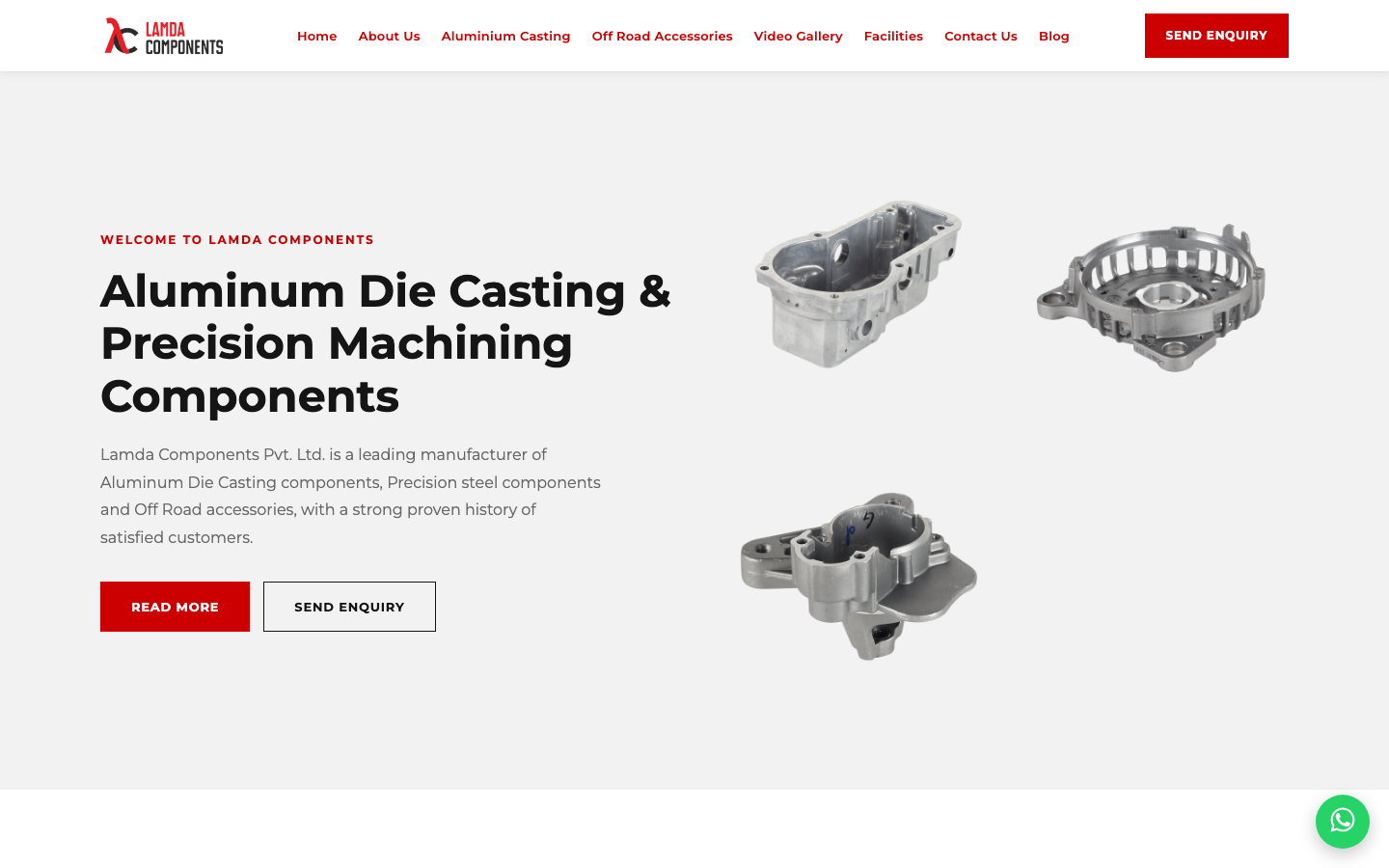
Lamda Components Pvt. Ltd. is an aluminium die casting parts manufacturer based in Bangalore, serving domestic and export customers. Its complete die-casting solution lists these operations:
- tool design and development
- aluminium die casting
- shot blasting
- vibro deburring
- resin impregnation
- precision machining
- leak testing
- powder coating and painting
- sub-assembly
For buyers sourcing aluminium pressure die casting parts or die casting aluminium parts for automotive and industrial programmes, coordinating these steps around the drawing can reduce the number of hand-offs between casting and a component prepared for assembly.
What to include in an RFQ for finished aluminium die casting parts
For an accurate quotation, provide drawings, annual quantity, MOQ and the full quality requirements. The more completely you define the finishing route at the start, the more accurate and comparable the quotation will be. Use this checklist when comparing any aluminium die casting parts supplier.
- [ ] 2D drawing with revision level, plus 3D model
- [ ] Alloy requirement or application context
- [ ] Annual volume, batch size and MOQ
- [ ] Required supply condition
- [ ] Critical-to-quality dimensions and datums
- [ ] Machining features, threads and GD&T
- [ ] Leak requirement, and whether impregnation is permitted
- [ ] Cosmetic classification by face
- [ ] Coating system, colour and masking zones
- [ ] Operating environment
- [ ] Inspection documentation required
- [ ] Packaging, labelling and destination country
Share your drawings, volumes, quality requirements and the finishing operations you need, and Lamda will review the route against your drawing. Contact us or request an aluminium die casting quotation.
FAQs about finishing aluminium die casting parts
The common processes are trimming, shot blasting, vibro deburring, CNC machining, resin impregnation, leak testing, dimensional inspection, painting or powder coating, and sub-assembly. The right combination depends on the part's function: sealing, mounting, appearance, corrosion exposure, thermal contact or assembly fit. Most parts need only some of these steps.
No. Machining is used only where the as-cast condition cannot meet the drawing requirements for bores, threads, sealing faces, mounting faces or datums. Machining only the features that need it can control secondary-processing cost. It also limits how much sub-surface porosity may be exposed on parts that must stay leak-tight.
Housings can leak through interconnected micro-porosity, which machining may expose. Prevention starts with casting design and process control. Resin impregnation can then seal leak paths where the drawing permits it, typically after machining. Leak testing before dispatch verifies performance against the agreed test requirement.
No. Shot blasting cleans the casting surface, evens out its appearance and can prepare it for coating. It does not provide corrosion protection by itself. Where protection is needed, it comes from a specified coating system, such as paint or powder coating, with a defined acceptance test.
Where the drawing and quality plan define the requirements, castings can be machined, sealed, tested, coated and sub-assembled before dispatch. Lamda lists these operations as part of its complete die-casting solution. The supply condition and acceptance criteria should be agreed during drawing review.
The main factors are:
- geometry and alloy
- tooling and production volume
- how much machining is needed
- sealing and leak testing
- coating
- inspection documentation
- packing
Every quotation should state the supply condition it covers. That is the practical way to compare suppliers against the same drawing.
Lamda Components Pvt. Ltd. is a Bangalore-based manufacturer serving domestic and export customers. Share your drawing, volumes, quality requirements, packing needs and destination country through the contact page, and Lamda can review the requirements for quotation.