

In automotive aluminium high-pressure die casting, the expensive problems seldom begin on the casting machine. The right aluminium HPDC supplier for automotive work controls the whole process around a part. That process covers design review, die design, repeatable casting, machining, inspection, traceability and change management, so that critical features hold through serial production and not only on the first sample. This guide sets out considerations for evaluating automotive HPDC suppliers, including Lamda Components Pvt. Ltd., a Bangalore-based manufacturer and exporter established in 1987.
Lamda works as an aluminium HPDC manufacturer across pressure die casting, die making, precision machining, precision steel parts and sub-assemblies for OEM and industrial customers in domestic and international markets. The sections below cover production considerations, a supplier evaluation checklist and an RFQ readiness list. You can use them to assess any automotive HPDC supplier, Lamda included.
Key takeaways
The points below summarise what buyers should test before nominating an aluminium die casting supplier for an automotive programme.
- A first sample that meets the drawing does not prove a stable serial-production process. Repeatability is the real qualification test.
- Most automotive HPDC risk is fixed before tool release. It comes from the critical-to-quality (CTQ) features, datums, machining stock, draft, wall transitions and parting line.
- Tooling is a long-term production-control asset. Die design, maintenance and revision control directly affect dimensional consistency.
- Porosity and pressure-tightness requirements must be designed into the part and the process. They cannot be inspected in afterwards.
- Casting, machining and inspection work best under one accountable process chain that protects critical features.
- Buyers should weigh traceability, change control and documentation readiness alongside piece price and capacity.
What makes an aluminium HPDC supplier ready for automotive work?
An automotive-ready aluminium HPDC supplier controls the full process around a part, not just the casting. That process includes manufacturability review, die design, consistent casting, machining, inspection, validation, traceability and change management. The supplier should be able to explain how it will protect your critical dimensions, integrity requirements, volumes and approval documentation.
High-pressure die casting injects molten aluminium alloy into a steel die under high pressure. It can suit repeatable, thin-walled components at higher volumes, but suitability always depends on the part's geometry, alloy and integrity needs. In practice, automotive readiness shows up in five areas:
- Engineering review before tooling is committed
- In-house or tightly controlled tooling and dies
- A defined approach to quality planning and process validation
- Ownership that runs from casting through machining
- Traceability and engineering-change discipline
For a broader view of component types, see our guide for buyers choosing an aluminium pressure die casting supplier.
Lesson 1: A successful first sample is not a stable production process
Automotive buyers are qualifying a process, not a single part. A first-off casting shows that the tool can fill and that the part can meet the drawing once. Serial production then adds variables that a sample run cannot reveal. These include die temperature stability across a shift, gradual die wear, alloy and melt condition, consistency of trimming, wear on machining fixtures and the condition of gauges.
Each of these can drift slowly. A part that measured correctly at sampling can then move out of tolerance weeks into production. The supplier's job is to define how each variable is monitored and controlled before volumes ramp up.
Automotive HPDC lesson: A conforming first sample shows the part can be made. A stable process shows it can be made the same way on every shift, across the life of the tool and through engineering changes.
| What a first sample shows | What serial readiness requires |
| The part can conform to the drawing | Conformance holds across batches and shifts |
| The tool fills the cavity | Die maintenance intervals and revision control are defined |
| Features measure correctly once | A measurement plan and gauge method are agreed |
| Machining is achievable | Fixtures and datums are repeatable at volume |
Lesson 2: The drawing is only the beginning
A drawing defines what the part must be. It does not define how the part will be gated, vented, ejected, machined or measured. The buyer and the supplier make those decisions together, and they need to make them before steel is cut.
Identify critical-to-quality features early
CTQ features are the characteristics that decide whether the finished part works in its assembly. In automotive HPDC components, they typically include:
- Sealing faces
- Bearing bores
- Mating and mounting faces
- Threaded ports
- Cosmetic surfaces
The supplier needs to know these features before die layout begins. They affect where gates, overflows and ejector pins can be placed without compromising a functional surface.
Agree the datum strategy and machining stock before die design
Casting datums, machining fixtures and inspection references must line up. When they do not, tolerance errors stack up on exactly the features that matter most.
Machining allowance is a trade-off. Too little stock and the surface may not clean up. Too much and the cutter can reach subsurface zones where porosity is more likely. Agree the allowance and the functional zones early, so that the die design, the fixtures and the measurement plan all work from the same references.
Did you know? A casting can conform to an as-cast drawing and still create risk after machining if the casting datums, fixture references and inspection datums are not aligned.
Design for castability: draft, wall transitions and parting line
The main castability trade-offs to settle early are:
- Draft: enough draft angle for clean ejection without distorting functional faces.
- Wall thickness: wall thickness kept as consistent as the function allows.
- Section changes: gradual transitions instead of abrupt changes, which can reduce hot spots.
- Ribs and bosses: ribs and bosses proportioned to support filling and solidification.
- Parting line: placed so that it stays clear of CTQ features and sealing faces.
For detailed guidance, see our article on high pressure aluminium die casting DFM capability.
Pro tip: Ask the supplier to mark CTQ features, casting datums, machining datums and inspection references on the model before die design is finalised.
Lesson 3: Tooling control is production control
Die design governs how aluminium fills, cools, solidifies and releases from the tool. As a result, it affects dimensional stability, surface finish, porosity risk, cycle consistency and tool maintenance. For automotive parts, die decisions should be aligned with the critical features, the machining plan and inspection access before the tooling is finalised.
At a conceptual level, gating controls how metal enters the cavity, venting and overflows give trapped air and cold metal somewhere to go, and thermal balance helps keep the die at a stable working temperature. When any of these is wrong, the result can look acceptable at sampling and then drift in production.
Tooling also has a life. Dies wear, need maintenance and are revised when the part changes. When die making and casting are managed within the same organisation, observations from production can feed back to tool corrections more directly. Lamda lists die making alongside pressure die casting and machining, supporting a connected capability set.
Buyers should ask:
- Who designs the die, and who makes it?
- How are die maintenance and refurbishment scheduled and recorded?
- How are tool revisions controlled after a part is approved?
- Who owns the tool, and what documentation comes with it?
Machine selection matters as well. Our guide to high pressure die casting supplier machine capability explains how tonnage and platen size relate to the part.
Pro tip: Define tool ownership, maintenance responsibility, revision control and documentation in the quotation, not after approval.
Lesson 4: Porosity and pressure-tightness must be planned, not inspected in
Porosity in aluminium HPDC can open up during machining, create leak paths in sealed housings, spoil surface finish and weaken load-bearing sections. Its impact depends on where it sits relative to functional features. Control starts with part and die design, continues through controlled casting conditions and is confirmed by an inspection method suited to the part's function.
Die casting technical literature describes gas porosity as the biggest single problem in die casting. Shrink porosity forms because the metal contracts by roughly 4–6% by volume as it solidifies (Hill and Griffith). Fully enclosed porosity may become visible when machining removes material, which is why machining stock and functional zones need to be agreed early.
| Part function | Porosity risk | What buyer and supplier should agree |
| Sealed or pressure-tight housing | Leak paths through machined faces | Leak-test criteria, test pressure and method |
| Machined bores and threads | Voids exposed after cutting | Machining stock and porosity acceptance zones |
| Cosmetic or coated surfaces | Surface defects after finishing | Cosmetic grade and finishing route |
Lamda's facilities list leak testing and resin impregnation, both relevant to parts that must hold pressure. For a deeper treatment, read our article on automotive HPDC quality control and porosity prevention.
Lesson 5: Casting, machining and inspection need one accountable process chain
A casting-only supplier delivers raw castings and passes machining to another party. An end-to-end HPDC supplier manages casting, machining and inspection as one process, so datum references, machining stock and measurement methods stay aligned. This can reduce the risk that a casting conforms on its own while the finished part fails at a critical feature.
Lamda lists the following connected capabilities:
Die making → Aluminium pressure die casting → Shot blasting and vibro deburring → Precision machining → Inspection and leak testing → Sub-assembly (where required)
Each handoff between separate suppliers adds risk:
- Datum mismatch: casting references and machining fixtures may not match.
- Unclear porosity responsibility: it can be hard to agree who is responsible when porosity appears after machining.
- Duplicated inspection: inspection may be repeated or may conflict between suppliers.
- Slower root cause: root-cause analysis takes longer when no single party sees the whole process.
Lamda's facilities list CNC turning, VMC, HMC and VTL machining, along with CMM inspection, a vision measuring system, a spectrometer for alloy checks and a universal testing machine. Its sub-assembly capability includes automated bearing and child-part assembly for stators and alternators. Read more about moving from casting to finished HPDC parts manufacturer capability, or see examples of HPDC automotive components.
Lesson 6: Documentation, traceability and change control build buyer confidence
Automotive programmes run on evidence. Buyers need to see how requirements were agreed, how the process is controlled and what happens when something changes.
PPAP, APQP and IATF 16949 in practical terms
These terms are often used loosely. In supplier evaluation, it helps to separate what each one means and when it actually applies. PPAP is a production-part approval framework associated with the Automotive Industry Action Group (AIAG). It is commonly used within APQP planning, while IATF 16949 requirements and customer-specific requirements vary by programme. In practice, each OEM's own requirements shape what is checked.
| Term | What it means for the buyer | When it applies |
| APQP | Structured planning from requirements through to launch | Where a programme requires APQP-aligned planning |
| PPAP | Production-part evidence that the process meets requirements | Where the customer requires PPAP or equivalent approval evidence |
| IATF 16949 | The automotive quality management system standard | Where OEM or Tier requirements specify it |
Did you know? PPAP and APQP are programme requirements, not universal claims. Confirm the documentation scope your specific programme requires before you compare quotations.
Traceability and engineering change management
Traceability links a finished part back to how it was made. For automotive HPDC, the useful records can include:
- Alloy lot and material verification
- Casting batch
- Tool revision
- Machining batch
- Inspection and test records
When a problem appears, these records influence how narrowly the supplier can contain affected parts and how quickly it can investigate the cause. Changes made after tool approval should follow a controlled path: change request, impact review, tool revision, re-validation and updated documentation.
Comparing aluminium HPDC supplier options for automotive programmes
Different supplier models suit different programmes. The comparison below uses neutral criteria. Lamda appears first because this is Lamda's page and it is the capability model being described.
1. Lamda Components Pvt. Ltd.: aluminium HPDC, die making and precision machining
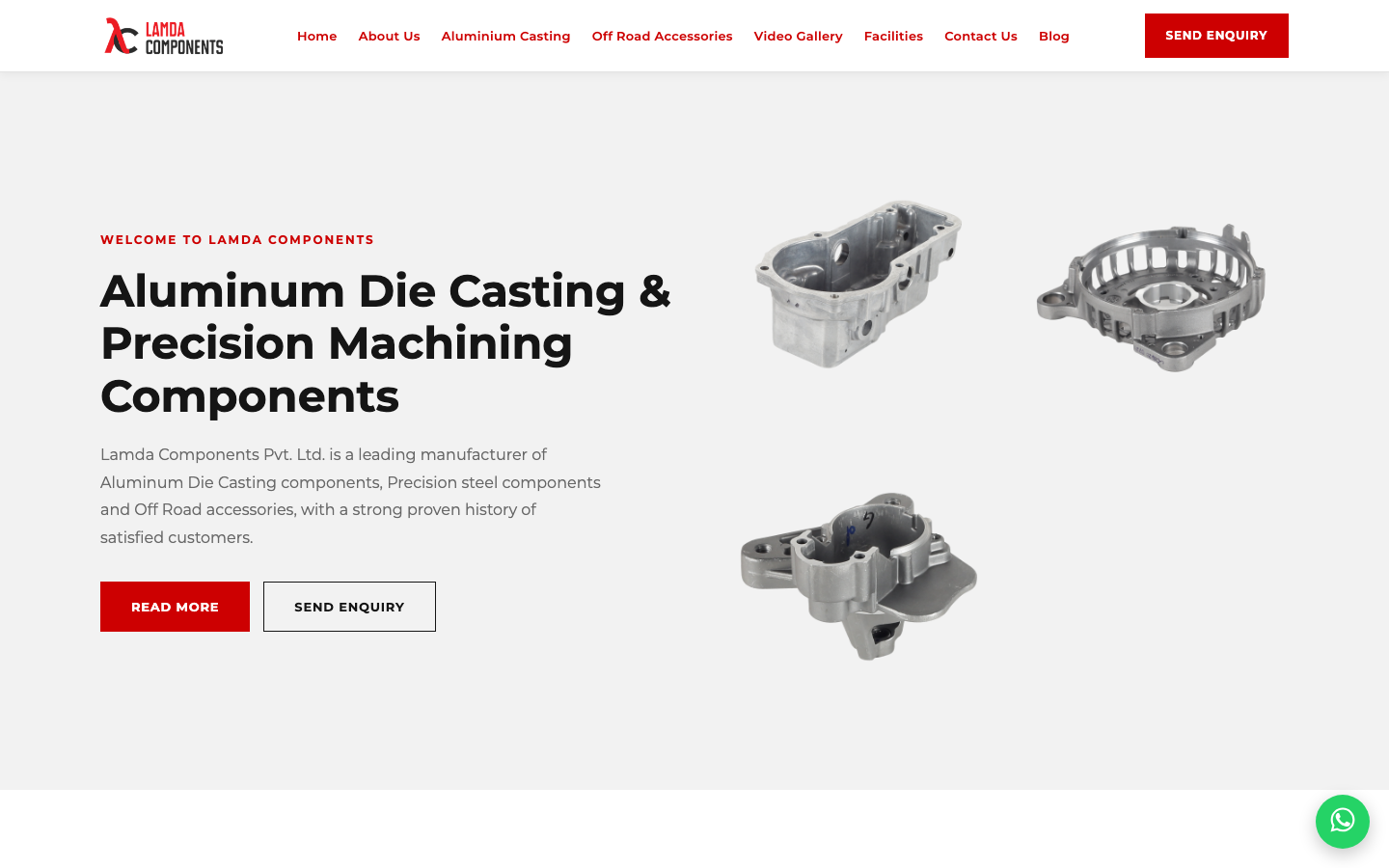
Lamda offers die making, pressure die casting and precision machining within one company. This can suit buyers looking to discuss tooling, casting and machining requirements with one supplier.
- Established in 1987 and based in Veerasandra Industrial Area, Bangalore
- Manufacturer and exporter of aluminium die casting products and precision steel parts
- Die making, aluminium pressure die casting, precision machining and sub-assemblies
- Advanced testing facility listing leak testing, CMM inspection and spectrometer alloy analysis
- Facilities page lists shot blasting, vibro deburring and resin impregnation
- Industries served: automotive, medical, electrical and white goods
- Manufactures off-road accessories such as differential lockers, portal axles, free wheel hubs and hydraulic winches
- Serves OEM and industrial customers in domestic and international markets
Best fit: OEM and Tier buyers evaluating suppliers with die making, casting and machining capabilities, particularly for parts with machined CTQ features. Learn more about Lamda as an automotive casting supplier in India and its custom aluminium die casting housings.
2. Casting-only die casting foundries
These foundries supply as-cast parts. They suit buyers who already have their own machining capacity. The trade-off is that the buyer takes responsibility for the interface between casting and machining, including datum alignment and disputes over porosity found after cutting.
3. Large multinational die casting groups
These groups can suit very high-volume or large structural programmes. For mid-volume parts, buyers should weigh minimum volume thresholds, scheduling flexibility and how much direct access they will have to engineers.
4. Digital manufacturing platforms and sourcing networks
These platforms can be useful for quick quoting and prototype sourcing. For serial production, buyers should check who owns the tooling, who controls the process and how continuity is managed if a network partner changes.
| Supplier model | Tooling control | Casting-to-machining accountability | Best fit |
| Integrated (Lamda) | Die making capability within the same company | One supplier for listed capabilities | Automotive and industrial parts with machined CTQ features |
| Casting-only foundry | Varies | Split between suppliers | Buyers with in-house machining |
| Large multinational group | Usually in-house | Usually integrated | Very high-volume programmes |
| Digital platform | Often through network partners | Varies by partner | Prototypes and early sourcing |
Automotive HPDC supplier evaluation checklist: questions to ask before nomination
Use these questions with any die casting supplier for the automotive industry before nomination.
| Evaluation area | What to ask | Why it affects automotive outcomes |
| Part review | Will you review castability, CTQs and the machining plan before tooling release? | Finds risk before it is built into steel |
| Tooling and dies | Who designs, makes, maintains and revises the die? | Tool condition drives long-term consistency |
| Machine suitability | Which press range suits this part's size and shot weight? | A mismatch affects fill quality and stability |
| Porosity and integrity | Which integrity risks apply to this part's function, and how will they be verified? | Aligns process controls with the application |
| Machining | Do casting and machining share one datum scheme and one owner? | Protects precision features |
| Inspection | What measurement plan, gauges and CMM methods will be used? | Confirms that dimensional accuracy is measurable |
| Validation | What sample, approval and PPAP-aligned evidence can you provide? | Supports customer approval and start of production |
| Traceability | Which lot, material, tool-revision and inspection data is traceable? | Enables containment and root-cause work |
| Change control | How are engineering changes reviewed and re-validated? | Prevents uncontrolled drift after approval |
| Communication | Who is the single technical and commercial contact? | Speeds up issue resolution, especially for export |
For more background, see how to choose an aluminium die casting manufacturer in India and Lamda's automotive die casting production capacity.
What to include in an automotive aluminium HPDC RFQ
An aluminium HPDC RFQ should include:
- A 2D drawing and a 3D model
- The alloy requirement
- Annual and lifetime volumes
- Critical dimensions and datums
- Machining and assembly needs
- Leak or pressure requirements
- Surface-finish expectations
- Required documentation
- Packaging and delivery destination
Complete inputs let the supplier assess tooling, process risk and quotation assumptions accurately. Use this as your RFQ checklist:
- 2D drawing with revision level
- Native or neutral 3D CAD (STEP)
- Alloy specification
- Annual volume, batch size and lifetime volume
- Target start-of-production timing
- CTQ characteristics and datum references
- Machining, threading, insert or assembly requirements
- Leak, pressure, cosmetic or surface-finish requirements
- Required inspection reports and approval documents (PPAP level, if applicable)
- Tool ownership expectations
- Packaging, labelling and delivery destination (domestic or export)
Pro tip: For sealed, machined or cosmetic parts, agree the relevant integrity risks and acceptance criteria before the tooling is released.
Ready to send a package? Request a quote from an aluminium HPDC supplier.
Evaluating an aluminium die casting supplier in India for domestic and export programmes
When you evaluate an aluminium die casting manufacturer in India, look for the substance behind each capability claim. Ask to see:
- The documented quality system
- How the engineering review is carried out
- The format of inspection reports
- Who owns the response when a problem is raised
Equipment lists are a starting point. The way the supplier uses that equipment to control your part is what matters.
Export buyers should also check:
- How communication works across time zones
- How engineering changes are communicated and confirmed
- What inspection evidence ships with the parts
- Export packaging and labelling
- Documentation for customs and receiving inspection
Lamda's Bangalore base is located in an established Indian manufacturing area. See Lamda's range for global buyers as an aluminium die casting supplier for global OEMs.
2026 buyer considerations: resilience and traceability
Three considerations are relevant to supplier evaluation this year:
- Part-specific integrity requirements: Sealed housings, machined interfaces and other functional requirements should be assessed part by part.
- Resilience and dual sourcing: Buyers may weigh tooling control and documentation alongside piece price when planning second sources.
- Traceability: Industry commentary in 2026 emphasises sub-tier visibility and documentation. Traceable records support containment work.
How Lamda assesses an automotive HPDC requirement
For an automotive HPDC RFQ, buyers should expect the supplier to assess more than the drawing. The review should cover:
- Castability and HPDC suitability, including whether another process may suit the part better. Lamda's facilities also list gravity die casting.
- CTQ features, datums and the machining plan
- The tooling approach and die-design considerations
- Inspection, validation and documentation needs
Examples of past work are available in our article on the aluminium die casting parts supplier role across pumps, valves and housings.
Share your drawing, 3D model, annual volume, alloy and critical requirements when discussing an automotive or industrial programme.
Frequently asked questions about aluminium HPDC suppliers
What is an aluminium HPDC supplier?
An aluminium HPDC supplier is a manufacturer that injects molten aluminium alloy into a steel die under high pressure to produce near-net-shape parts. For automotive work, the role can extend to design-for-manufacture review, die making, machining, leak testing, inspection and the approval documentation that the programme requires.
How do I choose an automotive HPDC supplier?
Assess the process control around your part, not just the quoted piece price. Review the supplier's approach to design review, die design, casting consistency, machining, inspection, validation, traceability and engineering change management. The evaluation checklist in this article gives specific questions you can put to each supplier before nomination.
Can aluminium HPDC parts be machined after casting?
Yes. Machining is common for tight tolerances, threads, sealing faces and bores on automotive aluminium die casting parts. For reliable results, the casting, fixturing, machining stock and inspection must share common datums. Machining allowance should also be agreed early so that cutting does not expose subsurface porosity in functional zones.
What causes porosity in aluminium die castings, and can it be prevented?
Porosity mainly comes from gas trapped during filling and from shrinkage as the metal solidifies. It can be reduced through part and die design, venting and controlled casting conditions. It is then managed by keeping it away from functional features. Pressure-tight parts may also need leak testing or resin impregnation.
Is IATF 16949 certification required for an automotive die casting supplier?
It depends on the OEM or Tier requirement and the classification of the part. Many automotive programmes require IATF 16949 or expect equivalent quality-system evidence, along with customer-specific requirements. Buyers should verify the certificate's scope, issuing body and validity dates directly with any supplier they are considering.
What is the difference between HPDC and gravity die casting?
HPDC injects metal at high pressure and can suit thin walls, fine detail and higher volumes. Gravity die casting fills the die under gravity and may suit thicker sections or different integrity needs. The right choice depends on the part's geometry, volume, alloy and functional requirements, so it should be assessed case by case.
What information do I need to get an accurate HPDC quote?
Provide a controlled 2D drawing, 3D CAD, the alloy specification, annual and lifetime volumes, CTQs and datums, machining needs, and any leak or finish requirements. Include the documentation level, tool ownership expectations, packaging and delivery destination. Complete inputs let the supplier quote tooling and process risk accurately.
Who owns the die in an aluminium HPDC programme?
Tool ownership is normally defined in the commercial agreement between buyer and supplier. The quotation should state who owns the die and who is responsible for maintenance, refurbishment and revision control. It should also state what documentation accompanies the tool, so that there is no ambiguity later in the programme.
Does Lamda Components supply export customers?
Yes. Lamda Components Pvt. Ltd. is a Bangalore-based manufacturer and exporter. It serves OEM and industrial customers in domestic and international markets with aluminium die casting products, precision machined parts, precision steel parts and off-road accessories. Export buyers can contact us to discuss their programme requirements.