
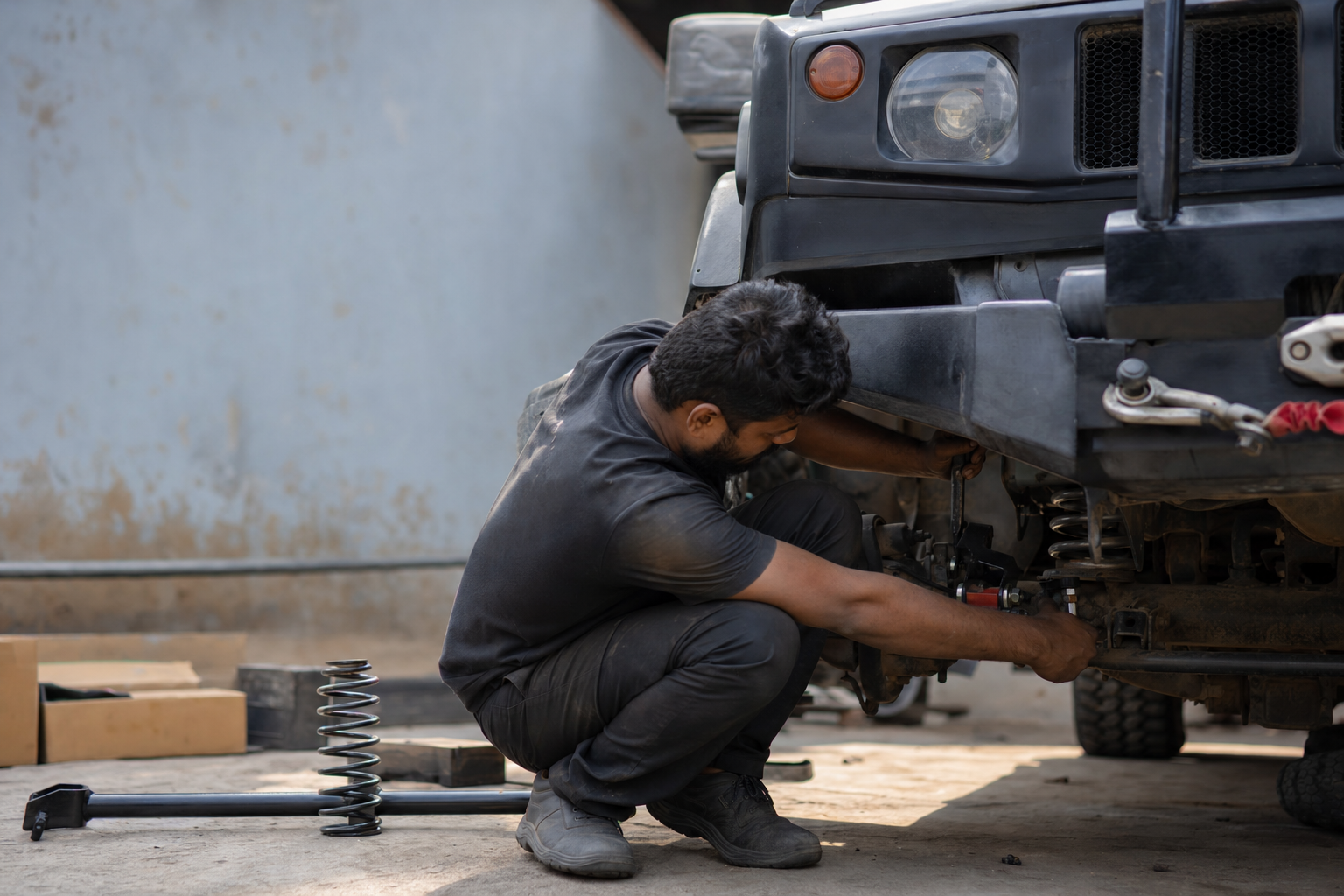
When a Bolero or Scorpio gets stuck, the cause is often a shortage of traction, clearance or recovery readiness, so the most useful off road car accessories are the ones that address those three limits. The best off road car accessories for a Bolero or Scorpio address traction, clearance and recovery first: a suitable differential locker or freewheel hubs where the drivetrain supports them, terrain-matched tyres with an inflator, underbody protection and rated recovery gear, followed by lighting, roof storage and styling. This roundup ranks each upgrade by its functional impact, gives separate Bolero and Scorpio selection paths, and explains what to verify before you order.
Key takeaways
- Real off-road capability starts at the axle and tyres. Body kits and lights come after traction, clearance, protection and recovery planning.
- Buy in this order: drivetrain upgrades where suitable, terrain-appropriate tyres and air-management tools, underbody protection, rated recovery gear, then lighting, cargo systems and styling.
- A bumper guard or decorative tow hook is not a recovery point unless it is rated and mounted for recovery loads.
- Bolero builds generally prioritise utility and durability. Scorpio builds often prioritise touring, protection and visibility. Exact fitment depends on generation, variant and drivetrain.
- Electrical, recovery, suspension and axle upgrades need professional installation and a review against warranty, insurance and road-use requirements.
- Lamda Components can discuss vehicle requirements and off-road accessory enquiries. Contact us.
What should off road car accessories actually solve on a Bolero or Scorpio?
Every accessory on a Bolero or Scorpio should earn its place by solving a specific problem on the terrain you drive.
Off road car accessories should improve traction, ground clearance, underbody protection, recovery readiness, visibility or cargo utility. Anything that does none of these is a styling item. Styling can be worthwhile, but buy it after the functional upgrades, because it will not get a stuck vehicle moving.
Each of the six capabilities does a different job:
- Traction: Helps deliver drive to the wheel with grip, using lockers, suitable hubs and the right tyres.
- Clearance: Keeps the axles, differentials and sills above obstacles.
- Protection: Helps shield vulnerable underbody areas and sills from rocks and ruts.
- Recovery: Gives you rated points and equipment to extract the vehicle safely.
- Visibility: Adds lighting for night driving on unlit rural roads and trails.
- Cargo utility: Carries gear without overloading the roof or cabin.
Most Bolero and Scorpio owners drive mixed routes. A typical week can include highway runs, a city commute, farm or site roads and the occasional weekend trail. Good 4x4 accessories improve the off-road side of that mix without unnecessarily compromising on-road behaviour. That is why vehicle compatibility matters more than catalogue appeal when you choose off-road accessories for a car you also use every day.
The axle-first upgrade framework: how to prioritise your build
An axle-first build spends money where the vehicle meets the ground before it spends money on how the vehicle looks. Follow this order:
- Axle and traction control: lockers, freewheel hubs, and portal axles where justified.
- Tyres, with wheel and clearance checks.
- Underbody protection.
- Recovery readiness.
- Suspension and control, only where required.
- Lighting and cargo utility.
- Cosmetic finishing.
Use the table below to group purchases by priority.
Fitment check: Before ordering, confirm the model generation, trim, 2WD or 4WD configuration, axle specification, bumper arrangement and current tyre size.
14 off road car accessories for the Bolero and Scorpio, ranked by capability
This list is ordered by functional impact, not by price or visual appeal. Items 1 to 4 are Lamda axle and recovery categories. Bolero and Scorpio suitability for these items depends on the vehicle's drivetrain, axle and mounting configuration.
Lamda Components Pvt. Ltd. was founded in 1987 and manufactures from the Veerasandra Industrial Area in Bangalore. Its core capabilities include aluminium pressure die casting, die making and tool design, precision machining, sub-assembly and in-house testing, and it supplies OEMs in domestic and international markets (Lamda Components). Lamda designs and manufactures its range of car off-road accessories in-house, including differential lockers, portal axles, freewheel hubs, winches and recovery tools.
1. Differential locker (Lamda Components): controlled traction where it counts
What it solves: An open differential can send drive to the wheel with the least grip. When one wheel lifts or sits on mud, that wheel can spin while the vehicle loses forward progress. A locker couples both wheels on an axle so torque can reach the wheel that has traction. For a fuller explanation, read how a differential lock works in a car.
Who needs it: Drivers who regularly face cross-axle trails, deep ruts, loose soil and slippery inclines. Fleet and worksite users may also consider one where terrain regularly causes loss of traction. A locker is not essential if you only drive on poor roads.
Compatibility checks: Verify the axle model, spline count, ring gear specification, front or rear location and factory differential type. This matters on the Scorpio-N. Its 2026 diesel 4WD "4Xplor" configuration is reported with low-range gearing, brake-locking and mechanical locking differentials (CarDekho). Any aftermarket locker conversation should therefore start from the actual axle specification, not an assumption. Lamda's published locker applications are the Mahindra Thar differential locker and the Suzuki Jimny (Jimny off-road upgrades). Both show platform-specific engineering experience. Bolero and Scorpio locker compatibility should be confirmed before purchase.
Installation and safety: A locker needs professional installation, correct setup and a correct engagement procedure. Locked-differential operation changes steering behaviour, so disengage it on high-grip surfaces. The differential locker installation and fitment guide covers sequence and common mistakes.
Lamda angle: Lamda's differential locker for off-road driving is designed and manufactured in-house. The company says it has tested the locker on Ladakh passes, in the Western Ghats and on Rajasthan dunes. Browse the full range of off-road car accessories in India.
What to avoid: Leaving the locker engaged on tarmac or through tight, high-grip turns.
Safety check: A locked differential changes steering behaviour. Engage it only when traction demands it.
2. Portal axles (Lamda Components): clearance gained at the axle
What it solves: A portal axle offsets the axle tube above the wheel centre and uses a gear reduction at each hub. This raises clearance beneath the differential housing without a suspension lift or larger tyres (Suncruiser Media).
Who needs it: Serious trail, expedition and specialty-vehicle builds. For many weekend users it is over-specified.
Compatibility checks: Review gear-reduction effects, brake and wheel-end interfaces, steering geometry, track width and road-legality requirements. Lamda's confirmed application is the Jimny portal axles kit. It uses heat-treated high-grade steel alloy, is CNC-machined, bolts on, and offers ratios of 1:1.22, 1:1.33 and 1:1.44. Bolero and Scorpio are not listed as off-the-shelf portal-axle applications.
Trade-offs: Portal axles add unsprung weight and more complex hub assemblies. Hubs can run hot at sustained high speed, and the setup needs robust axle-control components. Read more on portal axles for greater ground clearance.
See portal axles vs lift kits and larger tyres for the full comparison.
Did you know? A suspension or body lift raises the chassis but leaves the differential housing at the same height above the axle line. Portal systems address clearance at the axle itself, subject to engineering and legality review.
3. Freewheel hubs (Lamda Components): choose when the front axle turns
What it solves: On suitable part-time 4WD systems, freewheel hubs disconnect the front wheels from the front driveline in 2WD. They are intended to reduce front-driveline drag when 4WD is not engaged.
Who needs it: Owners of part-time 4WD variants with compatible front hubs. Hubs are not relevant to standard rear-wheel-drive Bolero variants or to 2WD Scorpio variants. The current Bolero is rear-wheel drive (Autocar India), and the Scorpio Classic is reported as rear-wheel drive as standard.
Compatibility checks: Lamda's 4x4 freewheel hubs are manually operated. The application list includes the Mahindra Bolero and Mahindra Scorpio alongside the Thar, Mahindra Jeep, MM540 and MM550, Isuzu D-Max, Tata Xenon and Maruti Gypsy. For Bolero and Scorpio, confirm the exact 4WD or legacy application, drivetrain type, hub and spline specification and factory hub arrangement before ordering.
Manual vs automatic: Manual hubs give deliberate engagement and a simple mechanism, but the driver has to leave the vehicle to lock them. Automatic hubs prioritise convenience and engage differently. Compare both in manual vs automatic freewheel hubs.
Did you know? Standard Bolero variants are reported as rear-wheel drive. Front freewheel hubs and front-axle upgrades apply only after the exact legacy or specialist 4WD configuration is confirmed.
4. Hydraulic winch and rated recovery points (Lamda Components)
What it solves: A winch provides self-recovery when no second vehicle is available, and controlled extraction from mud or inclines.
Who needs it: Solo travellers, remote-route users, and fleet and utility operators. Groups on lighter trails may be better served by a rated kinetic-recovery setup before they buy a winch.
Hydraulic vs electric: A hydraulic winch runs from a hydraulic power source. An electric winch draws on the vehicle's electrical system. The right choice depends on duty cycle, available power and installation complexity, as the hydraulic vs electric winch guide explains. Lamda's hydraulic winch for off-road recovery range covers recovery, off-road vehicle and industrial applications.
Compatibility checks: Confirm a winch-rated mounting plate or bumper, the chassis attachment, added front-end weight, airbag and sensor considerations, and electrical or hydraulic integration. Bolero and Scorpio mounting and rating requirements should be confirmed before installation.
What to avoid: Never anchor to a decorative tow hook or a non-rated bumper guard. A winch is only as strong as its mount and anchor.
5. All terrain vs mud terrain tyres
AT tyres are generally used for mixed road and trail driving. MT tyres are intended for mud and loose terrain, but can involve trade-offs in road comfort, noise and wet-road behaviour.
Check any new size for wheel-arch clearance at full steering lock and full suspension compression. Also check spare-wheel compatibility, speedometer implications and road legality.
Tyre check: Match the spare tyre to the running tyres where your setup requires it.
6. Tyre inflator and deflator
Lowering tyre pressure lets the tyre flex and spread, which enlarges the footprint and improves grip on loose ground. On sand it can help the vehicle float (BFGoodrich). Over-deflation raises the risk of sidewall damage or a tyre unseating from the rim. Reinflate before driving at speed on paved roads, because a soft tyre builds heat quickly on hard surfaces (Driven Car Guide). The correct pressure depends on the vehicle, tyre, load and terrain, so there is no universal number.
When choosing an inflator and deflator, look at gauge readability, duty cycle, hose reach, power connection and storage.
7. Underbody protection and skid plates
Skid plates can help protect vulnerable underbody zones from rocks, ruts, debris and uneven terrain. The right system depends on the variant, drivetrain layout, terrain and available mounting provisions. It must be secured properly while still allowing drainage, inspection and service access.
Engineering checks should cover material suitability, mounting design, fastener access, repeatable fitment, corrosion resistance and serviceability. A plate that traps mud or blocks drain points can cause more trouble than it prevents.
8. Front bumper guard and rear bumper guard
Bumper hardware falls into three groups. Cosmetic guards are mostly for looks. Protective bumpers are intended to shield the vehicle. Winch- or recovery-rated bumpers are designed to carry recovery loads. Any of them can change approach and departure angles and can interfere with parking sensors and airbag deployment. A guard is not automatically a recovery point.
The legal position needs care. MoRTH has asked state transport departments to act against unauthorised crash guards and bull bars, citing Section 52 and the penalty provisions of the Motor Vehicles Act, 1988 (Factly). In September 2021, the Madras High Court upheld the Centre's December 2017 notification directing states to prohibit them (LiveLaw). Enforcement varies by state, so confirm the position with your RTO.
9. Rock sliders vs side steps
Rock sliders and side steps look similar but do different jobs.
Verify how a product mounts before you rely on any protection claim.
10. Suspension lift kit and shock absorbers
A suspension upgrade may make sense when you add weight from a bumper, winch or roof load, or when you drive rough roads often. After any lift, check steering geometry, alignment, driveshaft angles, brake-line length, ride quality and the effect on centre of gravity.
Treat wheel spacers with caution. Confirm their engineering suitability, fastener engagement and road-use requirements before fitting them.
11. LED auxiliary lights, LED light bar and fog lamps
Auxiliary lighting must comply with CMVR and AIS lighting requirements. Unauthorised or glare-causing lights can attract enforcement, so check with your RTO before fitting. AIS-010 covers the installation of lighting devices (ARAI AIS-010).
Before you fit any lights, confirm:
- Correct beam pattern and glare control.
- Rigid, vibration-resistant mounting.
- Fused and relayed wiring.
- Weather-sealed connectors.
- Professional installation.
12. Roof rack and roof carrier
A loaded roof behaves differently at rest than on a moving, articulating vehicle. Check the manufacturer's roof-load guidance for your generation, the mounting method, the added vehicle height for parking structures, and wind noise. A high load can also change handling in corners and crosswinds, which matters on a tall body like the Bolero or Scorpio.
13. Snorkel
A snorkel raises the air-intake point and can help in dusty conditions. It does not make a vehicle waterproof. Rated wading capability also depends on electrical components, breathers, cabin seals and other systems, and low-mounted ECUs and fuse boxes can be damaged if flooded (Top Gear Philippines).
14. Basic recovery kit, cabin protection and styling-led extras
Recovery kit: Carry a recovery strap or kinetic rope, load-rated bow shackles marked with their WLL or SWL (4x4 Australia), traction boards, a shovel, gloves and a damper. Every item must suit the vehicle's rated recovery points.
Cabin and daily use: Washable floor mats with retaining clips, seat covers, a boot liner, a correctly wired dash camera, a first-aid kit and an emergency kit.
Styling-led extras: Fender flares and wheel-arch cladding may be required to cover wider tyres where permitted. A bonnet scoop, headlight grille or off road body kit should come last. Explore Lamda's off-road accessories for car applications.
Recovery check: Inspect the whole recovery system, not only the strap or rope. The mount, shackle, anchor and load direction must all be appropriate.
Off road accessory priority matrix for Bolero and Scorpio
The matrix below summarises all 14 categories with qualitative ratings. Bolero relevance reflects utility and rough-road use. Scorpio relevance reflects touring and mixed trail use.
Relevance depends on generation, variant and intended use. Confirm before ordering.
Bolero vs Scorpio: two different off-road ownership paths
The two vehicles share a badge but usually serve different owners, so the build sequence should differ too.
Bolero off road accessories: the utility and durability path
The Bolero is commonly used on rural routes, in farm and site duty, on rough roads and occasionally on trails. The current model is rear-wheel drive, with a 1,493 cc diesel making 76 hp (Autocar India). Prioritise terrain-suitable tyres, protection for vulnerable underbody areas, a rated recovery kit and cabin protection. Traction upgrades such as front hubs or lockers apply only where the drivetrain and axle configuration supports them. A Bolero roof rack, Bolero side steps and Bolero LED lights follow on utility needs. Treat any Bolero bumper guard decision through the legal lens above.
Mahindra Scorpio off road accessories: the touring and protection path
The Scorpio typically covers highway touring, family travel and weekend exploration. Its generations differ substantially. The Scorpio Classic uses a 2.2-litre mHawk diesel with 132 PS and is reported as rear-wheel drive as standard. The 2026 Scorpio-N offers a rear-wheel-drive-only petrol and a diesel in rear-wheel and four-wheel drive (CarDekho). Prioritise AT tyres, underbody protection, a recovery kit, an assessment of whether the front end can take a winch, Scorpio LED lights and Scorpio roof rack planning. Scorpio side steps and Scorpio bumper guard choices come later.
Functional protection vs appearance-only accessories
To tell function from appearance, ask four questions of any accessory. Is it structurally mounted or attached to plastic? Is it rated? Does it protect a specific component? Does it reduce clearance? If the answers are "plastic", "no", "no" and "yes", you are buying styling.
From Lamda's manufacturing perspective, an engineered component only works when the material, fitment, mounting and application are all correct. The same logic applies to every protection or recovery part you bolt to a Bolero or Scorpio.
Vehicle compatibility checklist before you order
Most fitment problems come from incomplete vehicle information. Gather these details before you buy any 4x4 accessories:
- Exact model name and generation.
- Model year and variant or trim.
- 2WD or 4WD, and whether the system is part-time or another type.
- Axle and wheel-end configuration.
- Bumper or body configuration and factory mounting points.
- Current tyre size and any suspension changes.
- Intended terrain, payload and duty cycle.
- Warranty, insurance and road-legality review.
Insurers treat replacing OEM parts with aftermarket parts as a modification. If the change affects cost, safety or risk, a claim may be reduced or rejected, and early disclosure helps avoid disputes (Outlook Money). Confirm warranty implications with your Mahindra dealer before fitting.
Send your vehicle details and requirements to Lamda: Contact us.
Installation, recovery and post-trail safety checklist
Correct installation and disciplined recovery protect both the vehicle and the people around it.
Which accessories need professional installation?
Differential lockers, portal axles, freewheel hubs, winches, suspension, recovery bumpers and auxiliary electrical systems should all be fitted by a qualified installer. Each one can affect driveline, steering, braking, structural or electrical behaviour. A setup error can create a safety problem that only appears under load or on the trail.
Electrical integration: lights, compressors, winches and dash cameras
Every added circuit needs:
- Correct fusing and relays.
- Wire gauge sized for the product's load.
- Routing away from heat and moving parts.
- Sealed connectors.
- A review of battery capacity.
Aftermarket wiring faults can fall outside vehicle warranty cover, which is another reason to use professional installation.
Recovery safety basics
- Use rated points only.
- Inspect equipment before use.
- Set the correct load direction.
- Use a damper where appropriate, as it restricts whipping if a strap or cable fails (ARB).
- Keep bystanders well clear, with only the drivers in the vehicles.
- Use clear communication throughout the recovery.
- Escalate to assisted recovery when needed.
What to inspect after mud, water or rocky trails
Post-trail check: After every trail, check:
- Mounting-hardware security.
- Skid-plate damage and drainage.
- Hub engagement and locker operation.
- Wiring and connectors.
- Corrosion on fasteners.
- Tyre sidewalls for cuts.
For OEMs, dealers and export buyers: evaluating an off-road accessory manufacturer
OEM procurement, dealer-accessory teams, industrial and fleet vehicle makers, export distributors and private-label buyers need more than a product page. They need evidence that a supplier can design, make, test and repeat a component at volume. Lamda has manufactured precision components since 1987, supplies OEMs in domestic and international markets, and develops its off-road range in-house.
Buying off road car accessories in India in 2026
Where you buy affects how confident you can be in the fitment. Each route has a different profile:
- Marketplace listings: Wide choice, but fitment confidence and documentation vary and after-sales support may be limited.
- Manufacturer-direct: Access to product and specification information before purchase.
- Dealer fitment: Local installation and a single point of contact, subject to what the dealer stocks.
Off road car accessories India buyers should flag tyre-size changes, lifts, bull bars and auxiliary lighting for legal, insurer and manufacturer review. Section 52 of the Motor Vehicles Act governs alterations that deviate from the registration certificate. Bull bars and crash guards have been the subject of MoRTH directions and court rulings, and enforcement varies by state.
Off-road responsibly. Obtain route permissions, avoid damaging habitats and carry your waste out.
Get in touch with Lamda about Bolero or Scorpio accessories
Tell us your vehicle generation, variant, axle configuration and intended terrain. For OEM or export programmes, also share your requirements. Lamda can discuss suitable off-road accessory categories and OEM sourcing requirements. You can reach the team at sales@lamdacomponents.com or +91 81237 38855.
Frequently asked questions about off road car accessories
What are the first off-road accessories to buy for a Bolero or Scorpio?
Start with terrain-suited tyres, underbody protection, rated recovery gear and a tyre inflator/deflator. Add drivetrain traction upgrades such as a locker or freewheel hubs only where the exact drivetrain supports them. Leave lighting, roof storage and styling for later.
Do I need a differential locker for light off-roading?
Not always. A locker matters most on cross-axle terrain, deep ruts and slippery climbs. If you mainly drive poor roads, tyres and underbody protection are usually the better first purchases.
Do I need skid plates for a Bolero or Scorpio?
Skid plates can be worthwhile if you drive rocky or rutted terrain, because they help protect vulnerable underbody zones. Choose a variant-compatible design that mounts securely and still allows drainage and service access.
Is a bumper guard the same as a recovery point?
No. A bumper guard is not a recovery point unless it is rated and mounted for recovery loads. Use only the vehicle's approved or rated recovery provisions for snatch or winch recovery.
What is the difference between all-terrain and mud-terrain tyres?
AT tyres suit mixed road and trail use. MT tyres prioritise grip in mud and loose surfaces, but they are often noisier, less comfortable and less composed on wet tarmac.
Hydraulic or electric winch: which suits Indian trails?
The choice depends on duty cycle, available power source, installation complexity and operating conditions. A hydraulic winch runs from a hydraulic power source, while an electric winch draws on the vehicle's electrical system. The hydraulic vs electric winch guide covers the trade-offs.
Are LED auxiliary lights legal for road use in India?
Auxiliary lights must comply with CMVR and AIS lighting requirements, and lights that cause glare can attract enforcement. Use a compliant beam pattern, control glare, wire through fuses and relays, and check with your RTO before road use.
Will off-road accessories affect my warranty or insurance?
They can, depending on the part, the installation, the dealer and the insurer. Insurers treat aftermarket parts as modifications and may reduce or reject claims if a change affects risk. Disclose modifications and confirm the impact before fitting.
Can Lamda supply off-road components for OEM or export programmes?
Lamda supplies OEMs in domestic and international markets and designs its off-road components in-house. Share your requirements through Lamda's contact page to start a programme discussion.