
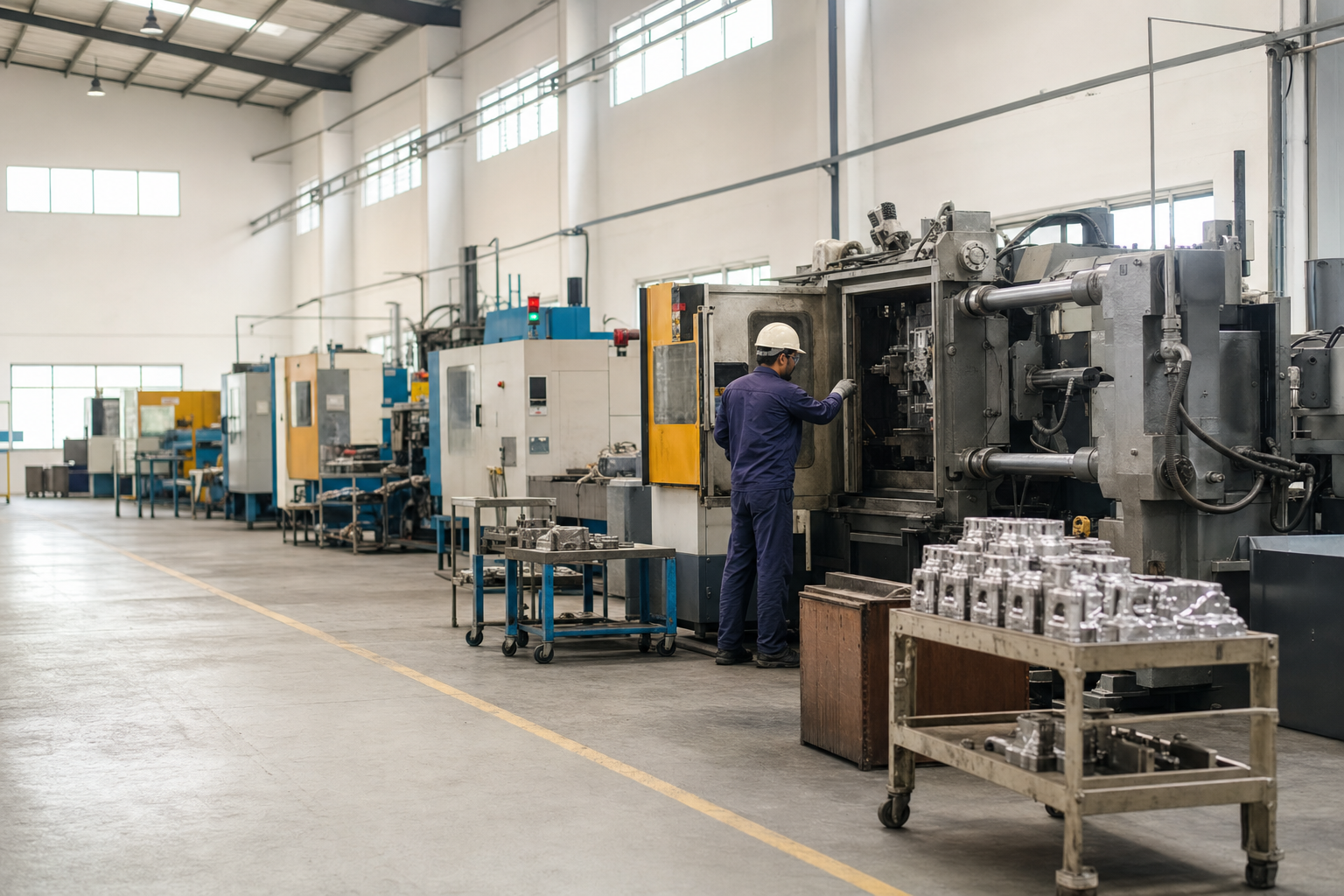
A pressure die casting facility is a manufacturing site where molten non-ferrous metal is injected into reusable steel dies under high pressure to produce repeatable components. A complete facility combines casting machines with tooling support, trimming, machining and inspection. Lamda Components Pvt. Ltd. was registered in 1987 in Bangalore. It manufactures and exports for OEM customers in domestic and international markets, and its facilities page lists 11 pressure die casting machines from 250T to 800T (Lamda Components – Facilities).
This article explains what that machine range means in engineering terms and how a casting moves through the plant. It also covers what to check before you issue an RFQ. If you already have a part in mind, you can share your drawing for a feasibility review.
Key takeaways
Buyers and engineers assessing a 250T to 800T facility should treat it as a manufacturing route, not a list of machines. These points summarise the article.
- A pressure die casting facility is a production system in which machines, dies, trimming, machining and inspection work together.
- Lamda's facilities page lists 11 pressure die casting machines: three at 250T, three at 400T, four at 420T and one at 800T.
- Machine tonnage is clamping force, not a part-size label. Projected area, cavity layout, alloy and gating all influence which machine a die runs on.
- Part quality is shaped before the first shot through the design of the parting line, gates, overflows and vents. Ongoing die care helps sustain repeatability.
- Many castings need trimming, deburring and CNC machining before assembly, so plan those operations together with the casting route.
- A first drawing review should cover geometry, alloy, annual volume, critical dimensions, machined features and sealing requirements.
What does a pressure die casting facility do?
High pressure die casting (HPDC) forces molten aluminium, zinc or magnesium alloy into a hardened steel die at high speed and pressure. The process produces near-net-shape parts that can be repeated across long production runs. An HPDC manufacturing facility brings together the equipment and people needed to turn alloy into finished, inspected components.
The core die casting facility equipment covers five functions:
- Melting and holding: turning alloy ingot into molten metal and keeping it at a stable temperature near the machine.
- Die casting machines: clamping the die and injecting the metal.
- Tooling support and die care: designing, producing and maintaining the dies needed for production.
- Trimming and degating: removing gates, runners, overflows and flash.
- CNC machining, inspection and finishing: adding functional features and confirming the part conforms.
Lamda describes its offer as end-to-end die casting, including die making, pressure die casting and precision machining. Its listed equipment and process capabilities are available on its pressure die casting facility capabilities page.
Facility insight: A die casting facility is not just a row of casting machines. Its output depends on how tooling, metal handling, trimming, machining and inspection are coordinated.
Inside Lamda's 250T to 800T die casting machine range
Lamda's pressure die casting machines are spread across four tonnage classes. That spread matters more to buyers than the size of the largest machine.
| Tonnage class | Number of machines listed |
| 250T | 3 |
| 400T | 3 |
| 420T | 4 |
| 800T | 1 |
| Total | 11 |
Lamda also lists a tilting gravity die casting machine as a separate process route.
Why a spread of machine sizes matters to buyers
A range of machine sizes lets each die run on a machine matched to its engineering requirements, instead of defaulting to the largest press available. This matters for three reasons:
- Machine fit: a 250 ton die casting machine and an 800 ton die casting machine are suited to different die sizes and clamping requirements. Running a small die on an oversized machine is not automatically better.
- Multiple machines per class: the 250T, 400T and 420T classes each have more than one listed machine. The 800T class has a single machine, so confirm planning for that class during the RFQ discussion.
- Component families: procurement teams sourcing related brackets, covers and housings can discuss the whole family against one facility's die casting plant capabilities.
Where the cold-chamber configuration fits
Die casting machines are generally built in two configurations. The distinction matters mainly because of alloy compatibility.
| Factor | Cold chamber | Hot chamber |
| Where metal is held | Separate furnace; metal is ladled into a shot sleeve | Melt pot built into the machine, with the injector submerged |
| Typical alloy context | Aluminium and other higher-melting alloys | Zinc and other lower-melting alloys |
| Why it matters | Metal transfer, die design and the shot system all shape the casting route | Different machine and alloy compatibility |
Aluminium melts at a higher temperature than zinc. Keeping the injection components out of molten aluminium avoids the immersion corrosion associated with a submerged system. This is why cold-chamber die casting is commonly used for aluminium.
Why does machine tonnage matter in die casting?
Die casting machine tonnage describes the force that keeps the die shut, not the size of the part. Research on HPDC machines describes locking force as the parameter that determines machine size, and notes that the die must stay fully locked for safe operation (MM Science Journal, 2025). For a deeper explanation, see our guide to die casting machine tonnage selection.
Clamping force, projected area and machine selection
Tonnage is the clamping force that holds the die halves closed during injection. If clamping is insufficient, injection pressure can force the halves slightly apart, and metal escapes as flash at the parting line.
The separating force depends on injection pressure acting across the projected area of everything in the shot. That includes every cavity, the runners and the overflows. Machine selection also considers cavity count, die dimensions and the requirements of the shot system.
Alignment matters too. The same 2025 study notes that when the centre of the cavity insert and the centre of the gating system are not aligned, the forces produce a twisting effect on the die.
Engineering note: Machine tonnage is not a part-size label. It is one of several checks made against the die design.
Why two similar-size parts can need different machines
Two castings of similar weight can need very different machines:
- Projected area versus depth: a flat casting with a large projected area may need more clamping force than a deeper, more compact part.
- Cavity layout: a multi-cavity die adds projected area and die footprint compared with a single-cavity die.
- Gating and overflows: runners and overflows add to the area that injection pressure acts on.
The final machine allocation is confirmed during drawing review, once the die layout is known.
What happens before the casting machine starts?
Part quality is largely decided in die design, before the first shot. Lamda states that it has an in-house team for tool design and development, and it lists die making within its end-to-end offer. This is where die casting tooling and trimming are planned together.
Die design: parting line, gates, overflows and vents
Each feature of the die affects the finished part in a specific way.
| Feature | What it does | Why it affects the finished part |
| Parting line | Marks where the die halves meet | Influences flash location and trimming |
| Gates | Let metal enter the cavity | Influence the fill pattern and porosity-sensitive areas |
| Overflows | Collect the leading metal | Help direct colder or oxide-laden metal away from the part |
| Vents | Let cavity air escape | Reduce the risk of trapped gas |
Vents can fail when their channels are too small or blocked by deposits (Ampco Metal Academy).
Design checkpoint: Lock down the parting line, draft and machining datums before the die design is finalised.
Why tool-room support and die maintenance matter
Dies go through repeated heating and cooling with every shot, and their condition changes over time. Surface problems can indicate that local thermal conditions and the interaction between metal and tool are drifting. Soldering, caused by local overheating or lubrication failure, narrows the process window (Ampco Metal Academy).
Wear at parting lines can contribute to flash, while damaged ejector pins or cores can affect dimensions and ejection. Planned die care helps maintain repeatability and reduce unplanned stoppages.
Tooling commercial terms matter as much as the engineering. For more on this, see die casting tooling ownership and amortisation.
How does an aluminium casting move through the facility?
The high pressure die casting process runs as a sequence of handoffs, with each stage preparing the part for the next. For a full process explanation, see our guide to the high-pressure die casting process.
| Facility stage | Primary purpose | Typical equipment or activity | Key engineering or quality consideration | Output to next stage |
| Alloy receipt | Confirm the correct alloy enters production | Ingot storage and spectrometer check of chemical composition | Alloy verification | Approved alloy |
| Melting and holding | Bring metal to casting temperature and keep it stable | Melting and holding equipment | Temperature stability and metal cleanliness | Molten metal at a controlled temperature |
| Die preparation | Prepare the die for repeatable shots | Die heating and die spray or lubricant | Die temperature control and part release | Die at operating condition |
| Injection and solidification | Fill the cavity and form the component | Shot sleeve, plunger and clamping unit | Fill pattern, pressure and venting | Solidified casting |
| Ejection and trimming | Release the part and remove excess metal | Ejector pins, trimming and degating | Distortion control and a clean trim line | Trimmed casting |
| Machining and finishing | Add functional features | CNC machining, deburring and finishing | Datums and porosity-sensitive faces | Finished component |
| Inspection and dispatch | Release conforming parts | Dimensional inspection, visual checks and specified testing | Acceptance criteria | Dispatch-ready part |
From alloy preparation to molten metal handling
Lamda's facilities page lists a spectrometer used to check the chemical composition of aluminium ingots before they enter production.
The melting stage turns ingot into liquid metal. Holding equipment keeps that metal at a stable temperature close to the machine. Stability matters because temperature drift changes how freely the metal flows and how it shrinks as it solidifies.
Cold-chamber injection: shot sleeve, plunger and die cavity
In a cold-chamber machine, injection typically follows four steps:
- Molten metal is ladled into the shot sleeve.
- The plunger advances through an initial phase, then accelerates to fill the cavity.
- Pressure is applied as the metal solidifies.
- The die stays clamped until the casting is solid enough to eject.
Plunger speed matters. An incorrectly selected speed in the first phase is one cause of air entrapment (Ampco Metal Academy).
Solidification, die opening and ejection
Wall thickness and die temperature both influence how long the casting takes to solidify. Once the die opens, ejector pins push the part out. Draft on the walls lets the part release cleanly, without drag marks. Die spray is then typically applied before the next shot.
For the alloy-specific detail behind each step, see our aluminium die casting process guide.
What happens after the part leaves the die?
A casting leaving the die is rarely ready for assembly. Gates, runners, overflows and flash are normally removed after ejection, and many parts then need machining before final inspection.
Trimming, degating and deburring
A trim press with a dedicated trim die can remove runners, gates, overflows and flash in a single stroke. Some geometries still need manual degating.
A clean trim line depends on the parting line, so a worn die can make trimming harder and leave more burr. Lamda lists shot blasting and vibro deburring among its finishing operations. Vibro deburring smooths edges and removes burrs after machining.
When CNC machining is added after casting
A casting can be near-net-shape and still need machining for functional bores, threads, sealing faces or assembly datums. Plan machining allowances and datums alongside the die design. That way, machined faces avoid porosity-sensitive regions instead of cutting into them.
Lamda's facilities page lists 30 CNC turning machines, 21 vertical machining centres, 2 horizontal machining centres and 1 vertical turret lathe. These listed resources support machining requirements alongside the die casting route. Read more in die casting CNC machining and finishing.
| Feature requirement | Possible as-cast approach | When machining may be considered | Design or quality note |
| General external profile | Cast to shape | Rarely | Allow draft |
| Mounting holes | Cored holes | Tight position or fit requirement | Cored pilot holes can reduce machining |
| Threads | Generally not cast | Almost always machined or tapped | Check for porosity at thread depth |
| Sealing or gasket faces | Cast face | Flatness or surface-finish requirement | Porosity-sensitive; review early |
| Bearing or precision bores | Cored to near size | Tight diameter or position requirement | Plan machining allowance with the die design |
| Cosmetic surfaces | As-cast finish | Rarely | Gate and ejector locations matter; finishing may follow |
How are die cast components checked for quality?
Quality in die casting is controlled from die design through to final release, not only at final inspection. Many of the decisions that affect porosity risk and dimensional stability are made before production starts.
Porosity: where it comes from and where it matters
Porosity is a defect that needs to be managed in machined and pressure-tight parts. It takes two main forms:
- Gas porosity: trapped air and lubricant vapour can create voids. Lubricant on the dies or plunger releases gas when molten metal heats it, and plunger lubricant is often the largest source (Hill and Griffith).
- Shrinkage porosity: die casting alloys lose about 4% to 6% of their volume as they turn from liquid to solid. The resulting voids concentrate at the last point to solidify and can occur in heavier sections.
Porosity becomes a problem when machining opens it up or when it creates a leak path through a pressure-tight wall. Design, gating, venting and process control all influence the risk.
Lamda's facilities page also lists resin impregnation for sealing micro-pores. Learn more about preventing porosity in automotive HPDC castings.
Quality checkpoint: Review pressure-tight or heavily machined regions for porosity sensitivity before tooling release.
Dimensional inspection and requirement-specific testing
Lamda's facilities page lists the following inspection and testing equipment:
- 2 coordinate measuring machines for dimensional inspection.
- A vision measuring system.
- A spectrometer for alloy composition.
- A universal testing machine for raw-material specimens.
- 14 leak-testing machines for parts with sealing requirements.
The inspection and testing scope for each part should be agreed during drawing review. For sealing applications, see leak-tight aluminium casting testing.
What should engineers consider when designing a die cast part?
Design choices made early influence whether the die runs cleanly or needs rework. Use this checklist before you release a drawing:
- Uniform wall thickness: NADCA guidance calls for uniform wall sections as far as possible. This helps limit shrinkage porosity and distortion.
- Draft on walls normal to the parting line: draft supports clean ejection. Fillets projected normal to the parting line need draft as well.
- Generous fillets and radii: these can improve metal flow and reduce stress concentration.
- Ribs instead of thick sections: ribs can add stiffness without adding heavy walls.
- Parting-line location: place it where flash is acceptable and trimming is practical.
- Gate and ejector-pin locations: keep them away from cosmetic and sealing surfaces where possible.
- Machining allowance and datums: define them for every machined feature.
- Undercuts: flag any feature that needs slides, because slides add tooling complexity and cost.
Involving the supplier early can help identify die-related changes before tool release. For deeper guidance, see die casting wall thickness, draft and fillets and die casting tooling cost and per-part economics.
HPDC vs LPDC and gravity casting: where pressure die casting fits
HPDC, LPDC and gravity die casting differ mainly in how metal enters the die. That difference shapes the wall sections and part properties each process suits (Kurtz Ersa).
The main advantages of pressure die casting are thin walls, near-net shape and repeatability. Its trade-off can be lower strength values than slower-filling processes. For a fuller comparison, see cold-chamber aluminium die casting.
| Factor | HPDC | LPDC | Gravity die casting |
| How metal fills the die | A piston drives metal from a shot chamber into the die at high speed and pressure | Low pressure pushes metal upward from a furnace below the die | Metal is poured into the die under gravity |
| Typical wall sections | Suited to thin-walled components | Thicker minimum walls | Moderate to thicker walls |
| Lamda equipment listed | 11 machines, 250T to 800T | Not listed | Tilting gravity die casting machine |
Which components suit a 250T to 800T pressure die casting facility?
A 250T to 800T range can be suitable for a broad set of non-ferrous components. Common examples include automotive die casting components such as housings, covers and brackets, along with motor and pump parts and industrial machinery housings.
Lamda lists the following sectors where its castings are used:
- Fuel injection pumps, alternators and starter motors.
- Electric vehicle motors.
- Textile machinery, hydraulic equipment and pneumatic products.
- Off-road products and the wider automotive sector.
- LED lights and door closures.
- Electrical and household appliances.
- Medical equipment.
Lamda also lists automated bearing and child-part sub-assembly for stator and alternator castings.
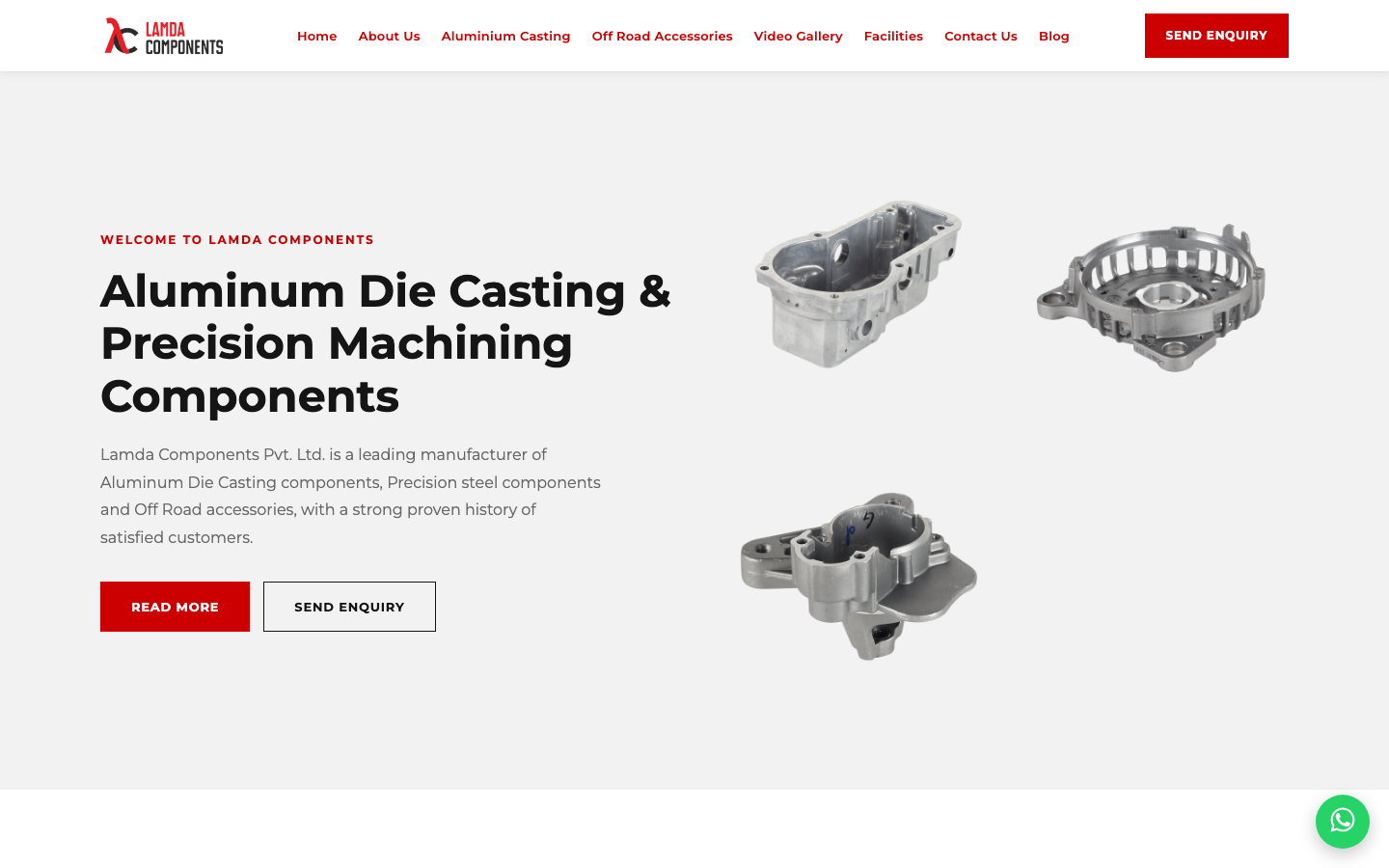
Weight, packaging and drivetrain requirements can make aluminium die casting relevant to a component programme. Whether a specific part fits is still decided by its drawing. Browse automotive aluminium die casting parts and Lamda's aluminium pressure die casting components.
How to evaluate a pressure die casting facility before you send an RFQ
A facility visit or a call should tell you how your part will move through the plant, not just which machines are on the floor. Use these two lists to structure the conversation.
Questions to ask a facility
- Which machine class would my die run on, and how many machines are in that class?
- Is die design, manufacture and maintenance handled in-house or through a partner?
- Are trimming, machining and inspection coordinated through one documented process plan?
- What inspection and testing records can be supplied for my part?
- How will tooling status, samples and order progress be communicated?
What to include in your RFQ
- 2D drawings and 3D models.
- Alloy specification.
- Annual and batch volumes.
- Critical dimensions and machined features.
- Cosmetic, sealing or leak-tightness requirements.
- Packaging and delivery expectations, including the export destination where relevant.
Send a drawing for a feasibility review. Lamda's engineering team can review your geometry against the 250T to 800T machine range, the tooling approach and the machining route, then share manufacturability feedback. Contact us
Pressure die casting facility FAQs
High pressure die casting injects molten non-ferrous metal, most commonly aluminium, into a hardened steel die at high speed and pressure. It produces near-net-shape parts with thin walls and good repeatability. Because the die is expensive to build but reusable, HPDC suits recurring production, where the tooling cost is spread across volume.
HPDC drives metal into the die at high speed using a piston. LPDC pushes metal up gently from a furnace below the die and holds pressure while the part cools. HPDC suits thinner walls, while LPDC generally suits thicker sections. The comparison table above sets out the main differences.
Aluminium melts at a higher temperature than zinc. Keeping injection components submerged in molten aluminium would expose them to corrosion. In a cold-chamber machine, metal is held in a separate furnace, ladled into a shot sleeve, and then injected into the die by a plunger.
An 800T machine applies higher clamping force. It can therefore keep dies with larger projected areas, more cavities or larger footprints closed during injection. Tonnage is not a part-size label, though. Final machine selection depends on the die design, the gating layout and the shot requirements.
There is no single universal list of casting types. Common processes include sand casting, investment casting, gravity permanent-mould die casting and pressure die casting. Other processes include centrifugal casting and low-pressure die casting. Pressure die casting is generally chosen for repeat production of complex, thin-walled non-ferrous parts.
Lead time is quoted per project. It depends on die complexity, the number of design revisions, sampling and approval cycles, and any machining or finishing requirements. Sharing complete drawings, volumes and critical features at the start shortens the review and helps produce a realistic schedule.
Yes. Lamda offers end-to-end die casting covering die making, pressure die casting and precision machining, with in-house dimensional inspection and leak-testing equipment. The exact route for your part, including testing, finishing, packing and inspection scope, can be agreed during drawing review.