
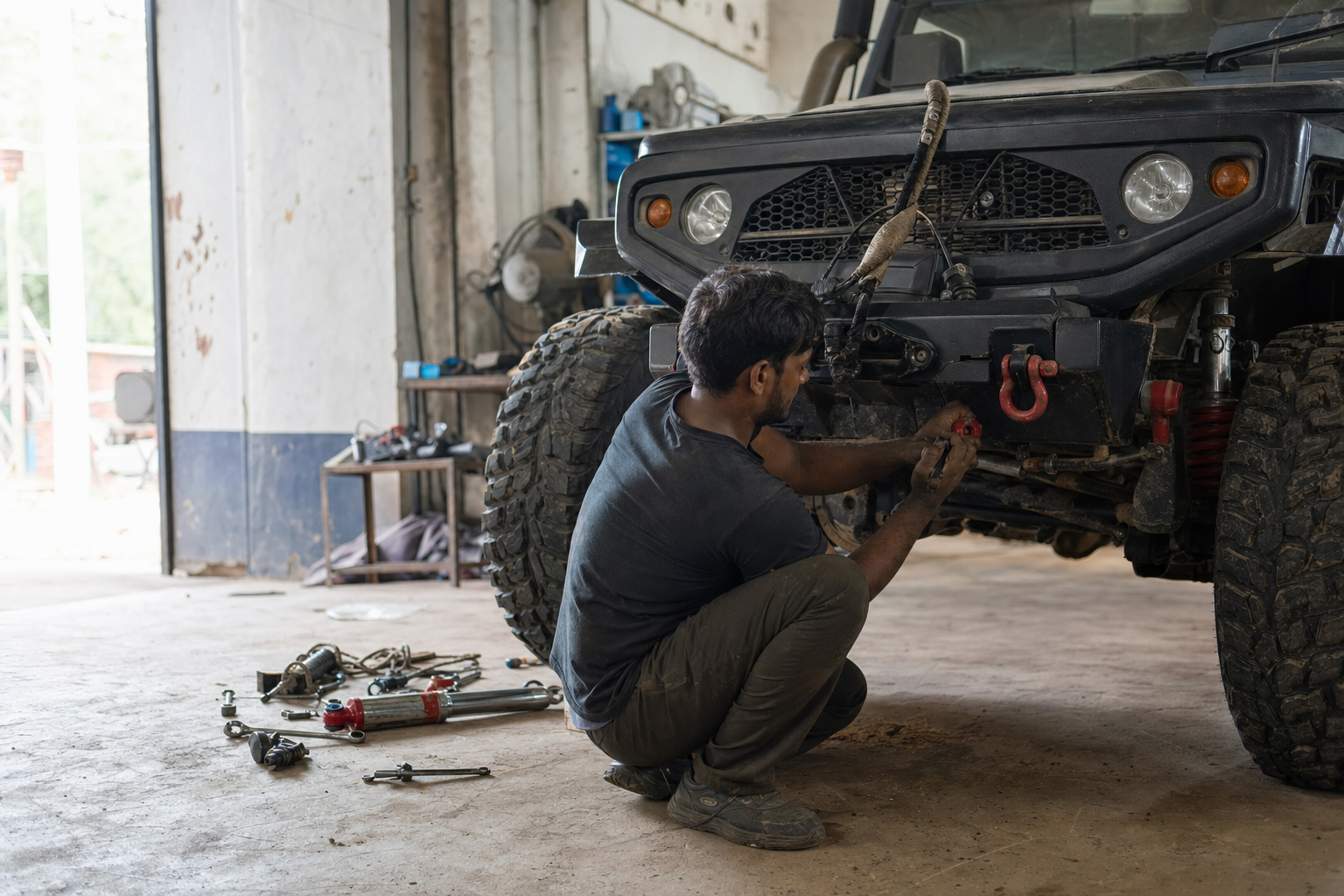
Search for off road accessories in India and the results mix light bars, roof carriers, styling bumpers and universal-fit parts with drivetrain hardware. A buyer has no easy way to tell which parts change what the vehicle can do. This guide separates the components that help a 4x4 climb from the ones that change how it looks, and shows how to check fitment before ordering.
Our focus is the hardware that changes the outcome of a climb: wheelspin, the differential striking terrain, and the need for a controlled recovery. If you drive a Mahindra utility platform, we have also covered off-road car accessories for the Bolero and Scorpio separately.
We write this as a manufacturer. Lamda Components has designed and built components in Bangalore since 1987, with in-house aluminium pressure die casting, precision machining and die making (Lamda). Each section below covers what a component does, what makes it functional, what to check for fitment and what goes wrong with a poor match. For the full product range, see Off-Road Accessories in India.
Key takeaways
The off-road accessories that help a 4x4 climb change its traction, clearance, drivetrain control or recovery capability: differential lockers, portal axles, winches, freewheel hubs and rated recovery gear. Bumpers, sliders and lights only add capability when their mounting and load path suit the exact vehicle and variant.
- Most off road accessories in India change how a 4x4 looks. A smaller group changes what it can climb.
- Lamda develops differential lockers, Jimny portal axles, hydraulic winches, manual freewheel hubs and other recovery tools in-house.
- A bumper, slider or light bar only works if its mounting, clearance and load path suit the exact vehicle, variant and existing modifications.
- "Fits Thar" or "fits Jimny" is not enough. Confirm the model year, variant, axle, wheel and tyre size, offset and brake/ABS setup before ordering.
- Choose upgrades by the obstacle that stops your vehicle, not by the part that looks most capable.
- OEM, industrial and export buyers should send vehicle data, drawings and the intended duty cycle with any enquiry.
What makes an off-road accessory functional rather than cosmetic?
A functional off-road accessory changes the vehicle's traction, clearance, drivetrain behaviour, protection or recovery capability. It is also mounted so that trail loads pass safely into the vehicle structure. A cosmetic accessory changes appearance. Many parts can fall into either group, depending on how they are designed, how they are mounted and whether they suit the exact vehicle.
| Component | What it should do on a trail | What separates functional from cosmetic | Fitment question to ask |
| Differential locker | Makes both wheels on an axle turn at the same speed when one loses grip | Engagement type, axle compatibility, material and heat treatment | Which vehicle, axle and model year? |
| Portal axle | Raises the axle and differential housing above the ground | Gear reduction, housing design, brake integration | Which variant, wheel offset and brake setup? |
| Hydraulic winch | Controlled self-recovery or recovery of other vehicles | Mounting structure, hydraulic supply, free-spool function | Where is the mount, and what is the hydraulic source? |
| Freewheel hub | Disconnects the front wheels from the front driveline in 2WD | Engagement reliability and sealing | Which hub type and axle spline? |
| Front or winch bumper | Approach clearance, protection and, where engineered, winch integration | Chassis-mounted structure versus a body-mounted shell | Is it compatible with sensors, airbags and the winch? |
| Rock slider | Takes side contact on rocks | Structural mounting versus a decorative side step | What is the ground clearance, and is door access clear? |
| Skid or bash plate | Shields the sump, transfer case and other exposed parts | Coverage, mounting points, service access | Can you still reach the drain plug and filter? |
| LED light bar | Trail visibility where its use is permitted | Rigid mounting and a fused wiring harness | Is it legal for road use, and will it cause glare? |
Climbing, not show: If an accessory changes clearance, carries load, supports a winch or may touch terrain, its mounting design matters as much as its finish.
Why 4x4s stop on a climb: The four capability problems
Start with the obstacle, not the catalogue. Each way a 4x4 stops on a climb has a mechanical cause, and each cause points to a different component.
| What happens on the trail | Mechanical cause | Component that addresses it | Lamda product |
| One wheel spins and the vehicle stops | An open differential sends drive along the easiest path, which is the wheel with the least grip | Differential locker | Yes |
| The axle or differential housing hits rocks or ruts | Height at the axle centre limits usable clearance | Portal axle | Yes, for the Suzuki Jimny |
| The vehicle is stuck and momentum will not help | Lost traction, or an obstacle beyond the vehicle's approach angle, departure angle or ground clearance | Winch and recovery gear | Yes: hydraulic winch and other recovery tools |
| The front driveline keeps turning during 2WD road use | The front wheels back-drive the front axle components | Freewheel hub | Yes |
Bumpers, sliders and skid plates limit the damage when the vehicle makes contact with terrain. Traction, clearance and recovery components decide whether it reaches the top. You need both groups, but in the right order.
7 off-road accessories that actually help you climb in India
Lamda designs and manufactures the first four items. The last three complete the system, and they depend just as much on correct fitment.
1. Lamda differential lockers: Traction when one wheel lifts
A differential locker restricts both wheels on an axle to the same rotational speed, regardless of how much traction each one has (Lamda). On a cross-axle climb or a loose surface, drive reaches the wheel that still has grip. Without a locker, that drive is lost to the wheel spinning in air or mud.
What it helps with: Cross-axle articulation, steep loose climbs, deep ruts and slow technical driving where speed and momentum are not options.
What makes it functional: Lamda's Thar locker uses high-strength alloy steel with heat treatment and a corrosion-resistant coating. Manual and air-actuated versions are available as custom options, and an optional compressor kit is offered for the air-actuated version (Lamda).
What to check for fitment: Lamda lists model-specific lockers for the Suzuki Jimny and Mahindra Thar. Custom lockers for other 4WD vehicles are available on request. Before ordering, confirm: - the vehicle and model year - the axle - whether the locker is for the front or rear axle - any existing modifications - who will install it.
What goes wrong with a poor match: A locker that does not match the axle will not fit correctly. A locked axle also resists differences in wheel speed, so steering may feel heavier and turning can become harder on high-grip surfaces. Lamda states that its lockers are intended for off-road use only.
For applications and options, see 4x4 Differential Lockers.
Not sure which locker suits your 4x4? Share your vehicle, model year and axle details with Lamda for a fitment discussion.
2. Lamda portal axles: Clearance at the axle, not just the body
Portal axles use a gear-reduction hub that places the wheel centre below the axle centre. This raises the axle and differential housing relative to the ground. On Lamda's Jimny portal axles, the axle centreline moves higher, which increases ground clearance without lifting the vehicle (Lamda).
What it helps with: Clearance under the differential on rutted tracks and in rock gardens. The reduction gearing also changes effective gearing for crawling.
What makes it functional: Lamda's portal axles are built specifically for the Suzuki Jimny as a bolt-on assembly. Gear ratios of 1:1.22, 1:1.33 and 1:1.44 are available.
What to check for fitment: Check the following before ordering: - variant and model year - wheel offset - change in track width - brake and ABS configuration - tyre size - speedometer calibration.
Lamda notes that late-model 4x4s with camera- and radar-based driver assistance may need ADAS, ESC or alignment checks after large changes to ride height or track width (Lamda).
What goes wrong with a poor match: Problems can arise when portal axles, a large lift and oversized tyres are combined without reviewing centre of gravity, steering and braking. They can also arise when wheel-offset or ABS questions are left until after installation.
Did you know? A suspension lift raises the body, frame and suspension mounting points relative to the axle, but it does not raise the differential housing itself. Bigger tyres raise the differential by only half of the increase in tyre diameter (Lamda).
To compare options, read Jimny Portal Axles for More Ground Clearance and Portal Axles vs Lift Kits and Bigger Tyres.
3. Lamda hydraulic winches: Recovery that does not depend on battery reserve
A hydraulic winch draws power from the vehicle's hydraulic system rather than the battery. This can make it suitable for applications involving sustained hydraulic operation. It still needs a mount designed for the specific vehicle, the correct cable, a fairlead and sound recovery practice.
What it helps with: Self-recovery, recovery of other vehicles, remote fleet and rescue work, and applications involving repeated pulls. Electric winches remain common for lighter recreational use.
What makes it functional: Lamda's hydraulic winch range has these published specifications (Lamda):
| Specification | Value |
| Line pull | 4,500 to 9,000 kg |
| Hydraulic supply | Gear-type pump, 32 lpm at 160 bar |
| Hydraulic motor | 163 to 315 cc |
| Cable | 10 mm × 60 ft |
| Brake | Valve-type |
| Gearbox | 4:1 single-stage planetary |
| Line speed | 25 ft/min |
| Spooling | Free-spool clutch |
Listed applications go beyond off-road vehicles to industrial and specialist vehicle use.
What to check for fitment: Confirm: - the winch mounting plate or engineered bumper - the load path into the chassis rails - the hydraulic source and hose routing - the fairlead position - clearance around sensors and airbags.
What goes wrong with a poor match: Common failures include a bumper with a winch-shaped opening but no engineered mount, improvised recovery points, and a winch fixed to structure that cannot take the load.
Do not treat these as interchangeable: A winch-ready bumper is not the same as a bumper with a winch opening. A rated recovery point is not the same as a convenient metal tab.
For more detail, see Hydraulic Winches for 4x4 Recovery and Hydraulic vs Electric Winch for Off-Road Recovery.
4. Lamda manual freewheel hubs: Selectable front drive for road and trail
Manual freewheel hubs let the driver disconnect the front wheels from the front axle shafts in 2WD. This can reduce unnecessary rotation of the front driveline on the road. Lamda's hubs are mechanically activated and operated at the axle end, so the driver steps out to lock them before engaging 4WD (Lamda).
What it helps with: Disconnecting the front wheels can reduce drag. Lamda also cites better fuel efficiency, smoother steering in 2WD, less wear and quieter running. When the driver chooses 4WD, engagement is mechanical.
What makes it functional: Reliable engagement, sealing against water and dust, and accurately machined splines.
What to check for fitment: Check the axle and spline type, the hub model, any existing auto-hub setup, and how the driver uses 4WD. Lamda lists applications for: - Mahindra Thar, Mahindra Jeep, Bolero, Scorpio and MM540/MM550 - Isuzu D-Max - Tata Xenon - Maruti Gypsy.
What goes wrong with a poor match: The driver forgets to lock the hubs before a climb, or the seals allow water in after a crossing.
To compare hub types, see Manual Freewheel Hubs for 4x4 Vehicles and Freewheel Hubs: Manual vs Automatic.
5. Recovery interfaces and recovery gear
Recovery gear is only as safe as the point it attaches to. A basic kit may include: - rated recovery points - recovery straps - D-shackles or soft shackles - a snatch block - traction boards - a line dampener - gloves - a tyre deflator.
Lamda develops winches and other recovery tools in-house.
Static versus kinetic: Static straps are for slow, steady tension and towing. Kinetic or snatch recovery stores energy in the strap or rope, which makes rated attachment points essential. Experienced recovery practice also builds the kit so the strap, not the shackle or the recovery point, is the weakest link (4x4 Australia).
Safety boundary: ARB's Steve Sampson notes that tie-down points generally carry no rating for the extra load of a snatch recovery (4x4 Australia). Never attach to tie-down points, suspension parts, bumper tabs or other locations that are not rated for recovery. Get recovery training and follow the equipment maker's instructions.
6. Underbody and side protection: Skid plates, bash plates, rock sliders and bumpers
"Skid plate" and "bash plate" usually mean the same thing. Rock sliders, however, are not side steps, and a steel off-road bumper is not a styling bumper.
What it helps with: Shielding the sump, transfer case and fuel tank, taking side contact on rock, and potentially improving the approach angle.
What makes it functional: Structural mounting suited to the vehicle, full coverage of exposed components, drainage, and an angle that lets the panel slide over rock.
What to check for fitment: Access to drain plugs and filters, door clearance, sensor positions and departure angle.
What goes wrong with a poor match: A decorative side step can fold onto the sill, or a plate can trap mud and obstruct servicing.
7. Tyres and air management
All-terrain tyres are commonly chosen for mixed highway and trail use. Mud-terrain tyres use a more aggressive tread pattern that may suit loose mud and some off-road surfaces, with trade-offs in road noise and wear.
What to check for fitment: Tyre size affects: - axle and locker loads - fender clearance - the need for fender flares - effective gearing.
Air management: A portable compressor or tyre inflator lets you air down for sand and rock. Reinflate to road pressure before driving back on tarmac.
Clearance trade-off: For clearance at the differential specifically, portal axles can be an alternative to relying only on oversized tyres.
Accessories that support the build but do not make it climb
These accessories make a build more usable or comfortable. None of them adds traction or clearance on its own.
- Auxiliary lights, LED light bars, spot lights and fog lamps. Use rigid mounts, sealed connectors, a fused wiring harness and a relay. Check road-use rules before fitting.
- Roof racks, roof carriers, rooftop tents and portable fridges. Weight on the roof raises the centre of gravity. Check the load limits in the owner's manual and the rack maker's rating.
- Wheel spacers and off-road wheels. They can change bearing loads and steering geometry. Get advice for your specific vehicle.
- Snorkels. Their value depends on the terrain you drive. They are not a universal upgrade.
- Lift kits and suspension upgrades. A lift changes driveshaft angles, bumper and slider geometry and how loads reach the axle. It does not raise the differential.
Useful as these parts are, none of them moves the vehicle when a wheel is in the air.
How off-road components work together on a climb
Adding one component changes the load on others. Plan each upgrade together with the parts it depends on:
| Component | What it depends on |
| Differential locker | Axle strength, tyre size, driver technique |
| Portal axle | Wheel offset, brakes and ABS, steering, speedometer, ADAS and alignment checks |
| Hydraulic winch | Mounting plate, bumper or bracket, chassis rails, hydraulic supply, recovery plan |
| Freewheel hubs | Routine for engaging 4WD, sealing |
| Rock sliders | Structural mounting, ground clearance, whether they are used as a step |
| Roof rack | Cargo weight, centre of gravity, suspension |
The interfaces carry the load: splines, mounting faces and bracket geometry. When these are machined accurately, the component sits in the same position every time and transfers load as designed. Lamda's in-house precision machining, die making and die casting support manufacturing requirements from tooling through to finished sub-assemblies.
Vehicle-specific fitment: What "for your Thar" should actually mean
Did you know? A vehicle name is not a complete fitment specification. Fitment depends on the platform, model year and variant, and on what has already been changed. Two vehicles with the same badge can need different parts.
Ask before you buy: - Make, model, model year and variant - Drivetrain layout and axle model - Current wheel and tyre size and offset - Suspension changes and lift height - Brake and ABS configuration - Sensors, cameras and driver-assistance systems on newer variants - The terrain you drive and how hard you use the vehicle - Where your installer is based and what work they can do
Mahindra Thar accessories for climbing
Lamda offers a model-specific locker for the Mahindra Thar CRDe and new-generation Thar, in manual or air-actuated form. The locker is intended for off-road use, so plan how and where you will use it. Freewheel hubs are listed for the Thar as well. See Differential Lockers for Mahindra Thar and the Mahindra Thar Off-Road Locker Guide.
Maruti Suzuki Jimny accessories for climbing
The Jimny's compact size can make traction and clearance upgrades worth considering before very large tyre changes. Lamda supplies a Jimny-specific locker and bolt-on Jimny portal axles with a choice of three gear ratios. Confirm your model year, then review wheel offset and brake setup before ordering portal axles. See the Suzuki Jimny Differential Locker and Suzuki Jimny Off-Road Upgrades.
Toyota Hilux and Fortuner accessories
Both vehicles require vehicle-specific review before changes to bumpers, ride height or track width. For custom-development enquiries, start with your vehicle data and current setup.
Gypsy, Tata Xenon, MM-series and utility platforms
Lamda's manual freewheel hubs list applications for the Maruti Gypsy, Tata Xenon, MM540/MM550, Mahindra Jeep and Isuzu D-Max. For custom lockers on these platforms, send your axle details for review.
Get a fitment review: Send Lamda your vehicle details and current setup through the contact page.
What to upgrade first: Choose by terrain and use case
Upgrade according to where you drive and what stops you there.
| Use case | First priority | Add after checking | Main risk to manage |
| Rocky climbs and cross-axle terrain | Differential locker, underbody protection, suitable tyres | Portal axles, rock sliders | Wheel lift and differential strikes |
| Monsoon mud and ruts | Locker, recovery gear, mud-terrain tyres | Hydraulic winch | Getting stuck with no recovery plan |
| Sand | Air management, traction boards | Locker | Overheating and reinflation |
| Farm, estate or remote site | Locker, freewheel hubs, hydraulic winch | Portal axles | Duty cycle and uptime |
| Overlanding | Recovery kit, roof or cargo system | Lighting, fridge, tent | Weight and centre of gravity |
| Night trail travel | Auxiliary lighting with a proper harness | Bumper or rack mounts | Glare, wiring failure and legality |
Fix the obstacle that actually stops the vehicle first. In most builds, traction comes before armour bought for its looks, and recovery gear comes before lighting. For upgrade paths, see Differential Lockers and 4x4 Upgrades.
Buying off-road accessories online in India vs from a manufacturer or 4x4 garage
India's automotive aftermarket accessories market was valued at USD 15.8 billion in 2025 (IMARC). Most of that catalogue is lifestyle product. Where you buy should depend on what the part has to do.
| Source | Suited to | What to verify | Installation |
| Lamda Components, manufacturer, Bangalore | Traction, clearance, recovery and drivetrain components; fitment discussion; OEM, industrial and export supply | Fitment for your exact variant and the documentation supplied | Confirm installation arrangements with Lamda; Swastik Fabs is listed as a Bangalore dealer |
| Online accessory retailers | Wide catalogues of lights, racks and armour | Whether vehicle-specific fitment and mounting design are stated | Usually arranged by the buyer |
| Specialist 4x4 garages | Installation, custom fabrication and complete builds | Fabrication drawings, weld quality and inspection | In-house |
| Imported-brand distributors | Products from global brands | Fitment for Indian variants and availability of spares | Varies |
Buy engineered drivetrain components where your axle, ratio and setup can be reviewed before shipping. Lights and roof gear are easier to buy off the shelf. Lockers, portal axles and winches should be installed by a competent technician either way. You can browse the range at Shop Off-Road Accessories Online in India.
Installation, inspection and safe recovery
A correct part can still fail if it is installed or maintained badly.
Who should install drivetrain and recovery components
Lockers, portal axles and winches change how load passes through the axle and chassis. They need a technician with the right tooling and experience with your platform. Hydraulic winches also need correct hose routing away from heat and moving parts. Treat installation as part of the purchase, not an afterthought.
Post-installation and post-trail inspection checklist
- Re-check fasteners after the first drive and after hard trail use.
- Check clearance at full steering lock and full suspension travel.
- Inspect hub and axle seals after water crossings.
- Check the condition of the differential oil.
- Inspect the winch cable, hydraulic lines and fittings.
- Check that wiring is protected and secured.
- Confirm drain plugs and filters can still be reached.
- Look for corrosion after monsoon or coastal use.
Safe recovery boundaries
This article is not a recovery procedure. Use rated recovery points only, and never improvise attachment locations. Keep bystanders well clear of the line and use a line dampener. Inspect gear before every use, and get hands-on training before attempting kinetic or winch recoveries.
Legal compliance and road use for modified 4x4s in India
Rules for modified vehicles in India vary by accessory, and enforcement varies by state. Section 52 of the Motor Vehicles Act, 1988 restricts alterations that move a registered vehicle away from its manufacturer specifications. Judicial interpretation has tightened that position (Casemine).
A December 2017 government notification described bull-bar fitment as a contravention of Section 52, citing interference with sensors and airbags and the risk to pedestrians (Autocar India). Lighting is governed by the Motor Vehicles Act, the Central Motor Vehicles Rules, 1989 and Automotive Industry Standards. States such as Kerala have also taken active enforcement action against modified vehicles (Onmanorama).
Check before purchase: - Whether your registration documents are affected - Your insurer's disclosure requirements, since undeclared modifications can affect a claim (ICICI Lombard) - The rules on auxiliary lighting - The rules on bumpers and protrusions - Changes to vehicle dimensions from portal axles and tyres - Local RTO guidance in your state
For OEM, industrial and export buyers: What to include in an enquiry
Lamda supplies OEM clients in domestic and international markets. It handles design, tooling and production in-house. A complete enquiry shortens the review.
RFQ checklist: - Application and vehicle or equipment platform - Drawings or samples - Volumes for prototype, pilot and serial production - Duty cycle and terrain - Validation and test requirements - Quality documentation and traceability needs - Packaging and export destination - Spares and warranty expectations - Private-label or distributor model
Lamda's manufacturing base: - Established in 1987 in the Veerasandra Industrial Area, Bangalore - In-house design and development of off-road products - Aluminium pressure die casting, precision steel parts and precision machining - In-house die making, covering tool design and development - Sub-assembly and testing facilities
Talk to Lamda about your climb
Choose components for traction, clearance and recovery, not accessories for show. Send Lamda the following: - vehicle and model year - axle - wheel and tyre setup - existing modifications - the terrain you drive - your location.
Contact Lamda with your vehicle details before you commit. OEM and industrial buyers can send drawings for a technical review.
Contact Lamda for 4x4 Off-Road Accessories
Frequently asked questions about off road accessories in India
What are the most useful off-road accessories for climbing in India?
Start with traction, clearance and recovery. That means a differential locker, underbody protection, suitable tyres and rated recovery gear. Add portal axles or a winch depending on your terrain. The right combination depends on your vehicle, your existing modifications and the obstacles you actually drive.
Do I need a differential locker or a lift kit first?
It depends on what stops you. If a wheel spins and the vehicle stops, a locker addresses the cause. If the differential or underbody strikes terrain, you need clearance. A suspension lift raises the body but not the differential housing. Portal axles raise the axle itself.
What is the difference between rock sliders and side steps?
Rock sliders are designed and mounted to take side contact with rocks. Side steps mainly help people get into the cabin and can bend under impact. Judge a slider by its mounting design and intended load, not its appearance.
Are skid plates and bash plates the same thing?
Usually, yes. Both terms describe protective panels under the vehicle. The label matters less than what the plate covers (sump, transfer case, fuel tank), how strong its mounting points are, and whether drain plugs and filters can still be reached for servicing.
Do I need a winch bumper to install a winch?
You need a mount designed for your vehicle and winch. That can be a winch mounting plate or a bumper with an engineered mount. A bumper with a winch-shaped opening may not qualify. Check the load path into the chassis, the fairlead position and the routing of power or hydraulic lines.
Can I buy off-road accessories online in India and install them myself?
Many owners can fit lights and handle recovery gear themselves. Lockers, portal axles and hydraulic winches need a competent technician, correct tooling and appropriate installation procedures. Whatever you buy online, confirm it fits your exact variant before ordering, and plan installation as part of the purchase.
Are ARB and other imported off-road brands better than Indian-made accessories?
Where a part is made matters less than how well it suits your vehicle. Compare fitment for your Indian variant, documented design, quality systems, spares availability, installation support and suitability for your duty cycle. A well-matched part from any source is preferable to a poorly matched one.
Are modified off-road accessories legal on Indian roads?
There is no single answer. Rules differ by accessory, and enforcement varies by state. Section 52 of the Motor Vehicles Act restricts alterations to registered vehicles, and bull bars and lighting face specific scrutiny. Check your vehicle documents, insurer requirements and local RTO guidance before modifying a road-going vehicle.
Does Lamda make off-road bike accessories?
Lamda's published off-road range focuses on four-wheel 4x4 components, including differential lockers, portal axles, hydraulic winches, manual freewheel hubs and other recovery tools. Lamda also offers die casting and precision machining for OEM programmes. Send any custom manufacturing enquiry through the contact page.